How to Identify New Geographic Markets for Your Products (2026) | GTsetu
Home ›
Blog ›
How to Identify New Geographic Markets for Your Products
🌍 Global Trade & Compliance
How to Identify New Geographic Markets for Your Products
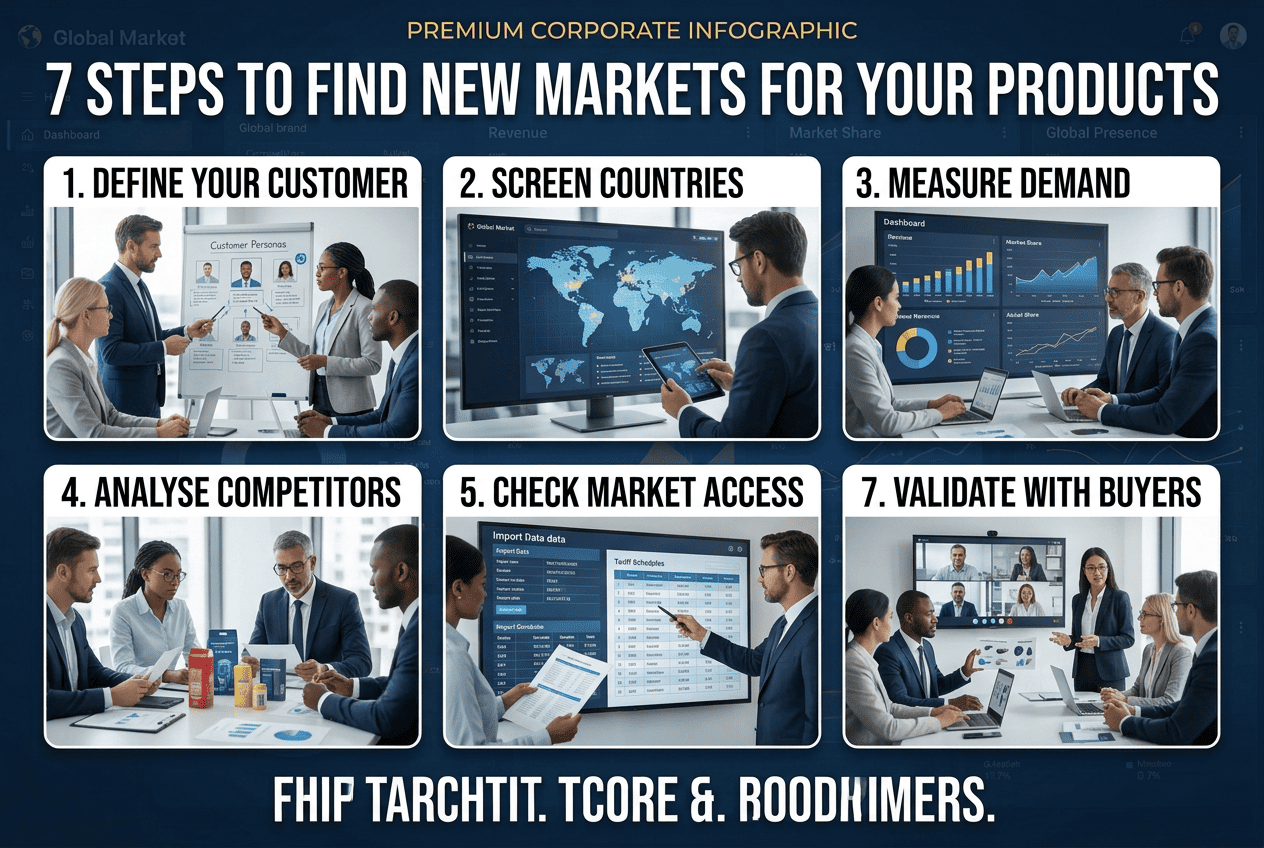
Direct Answer: To identify new geographic markets for your products, follow seven steps. First, define your ideal customer and what makes your product win. Second, screen countries using market size, growth, income and trade data. Third, read demand signals such as import volumes, search interest and buyer inquiries. Fourth, assess competition and local substitutes. Fifth, check market access: tariffs, standards, certifications and logistics. Sixth, score and rank the shortlist with a weighted scorecard. Seventh, validate the top one to three markets through buyer conversations, partner checks and a pilot. GTsetu helps by connecting you with government‑tie‑up verified importers, distributors and partners across 100+ countries, with built-in NDA workflows and zero broker commission.
📅 Published October 20, 2026🔄 Updated October 20, 2026⏱ 14 min read✍️ GTsetu Editorial Team
7
Steps in the Framework
1–3
Markets to Pilot First
100+
Countries on GTsetu
0%
Broker Commission
Most companies do not fail abroad because their product is weak. They fail because they picked the wrong market, or picked a market for the wrong reason: a trade-fair lead, a friendly distributor, or a hunch. A disciplined approach to identifying new geographic markets replaces guesswork with evidence and helps you commit resources where returns are most likely.
Manufacturers, exporters, brand owners, product and strategy teams, and business development leaders who want to decide where to sell next, before spending on partners, certification, logistics or marketing.
⚖️ Legal & Compliance Disclaimer
This guide provides general commercial education. It does not constitute legal, tax, investment or regulatory advice. Market data and trade rules change frequently. Always confirm current requirements with official sources and qualified local advisers before committing capital.
SECTION 1
1 Why Geographic Market Selection Matters
🎯 Definition
New geographic market identification is the process of finding and ranking countries or regions where your product can win, based on customer demand, competitive position, market access and your ability to serve. It combines desk research (data and reports), field validation (buyer and partner conversations) and a structured scoring approach to compare options fairly.
What Good Market Selection Gives You
🎯
Focus
Concentrate limited sales, compliance and partner resources on the markets most likely to pay back.
⏱️
Faster Entry
Knowing requirements and buyers up front shortens the path from first inquiry to first order.
💰
Better Margins
Understanding duties, logistics and local pricing avoids entering markets where the economics do not work.
Clear market criteria help you select partners who fit your goals, not just whoever contacts you first.
📈
Scalable Playbook
A repeatable framework lets you evaluate every future market the same way.
SECTION 2
2 The 7-Step Framework at a Glance
Move from broad, low-cost screening to narrow, higher-cost validation. Each step removes weaker options so you invest deeply only in the best ones.
1
Define
Clarify your ideal customer, use case and winning advantages.
🎯 Fit
2
Screen
Filter countries by size, growth, income and trade data.
📊 Top-Down
3
Demand
Look for import volumes, search interest and buyer inquiries.
📡 Signals
4
Compete
Map local and foreign rivals, pricing and substitutes.
⚔️ Landscape
5
Access
Check tariffs, standards, certifications and logistics.
🛃 Feasibility
6–7
Score & Validate
Rank with a weighted scorecard, then test the top markets.
✅ Decision
✨ GTsetu Insight
Desk research tells you where demand should exist. Conversations with verified buyers and distributors tell you whether it actually does. GTsetu shortens that second step by putting you in touch with government-verified companies, then you can assess them using our partnership evaluation criteria.
SECTION 3
3 Step 1: Define Your Ideal Customer & Product Fit
You cannot choose where to sell until you know who you sell to and why they choose you. Start from your best existing customers and work outward.
1
Profile Your Best Customers
Identify the industries, company sizes, applications and buying behaviours of customers who buy repeatedly and pay on time.
2
Name Your Winning Advantages
Be specific: price, quality, lead time, customisation, service or technology. Advantages must matter to buyers abroad, not just at home.
3
Set Your Constraints
Capacity, working capital, certifications you hold, languages and time zones you can support, and the entry models you can afford.
4
Write Your Market Criteria
Convert the above into a short list of must-haves and nice-to-haves, such as minimum market size, maximum tariff or required certifications. These become your scorecard later.
SECTION 4
4 Step 2: Screen Countries With Data
Begin top-down. Use public data to remove countries that clearly do not fit, leaving a manageable long list of roughly ten to fifteen.
Screening Indicator
What It Tells You
Typical Sources
Market Size & Growth
Whether the category is large and expanding
Industry reports, national statistics, trade bodies
Import Volumes
How much of your product category the country already buys abroad
International trade databases, customs data
Economic Indicators
Purchasing power, industrial output and investment trends
Multilateral institutions, central banks
Ease of Doing Business
Regulatory burden, contract enforcement and stability
Government agencies, advisory firms
Trade Agreements
Preferential tariffs or access between your country and the target
Statistics show potential. Demand signals show intent. Combine both to separate countries that look good on paper from those where buyers are actively looking.
📦
Import & Customs Data
Rising imports of your product category, and which countries currently supply them, reveal an active buyer base.
🔎
Search & Marketplace Interest
Keyword trends and listings on trade and e-commerce platforms indicate how many buyers are looking and what they ask for.
📬
Inbound Inquiries
Review where your existing website, trade-fair and platform inquiries come from. Unsolicited demand often points to promising countries.
🏗️
Industry Expansion
New plants, infrastructure projects and investment announcements create demand for equipment, materials and components.
🎪
Trade Fairs & Associations
Exhibitor lists, visitor profiles and association directories show who is active and growing in each region.
🗣️
Customer & Partner Feedback
Ask existing customers, suppliers and distributors where they see unmet demand.
SECTION 6
6 Step 4: Assess Competition
A large market is not attractive if it is saturated by entrenched local players, or if buyers have cheaper, good-enough substitutes.
✅ Favourable Competitive Signs
✅ Local supply is limited or lower in quality for your segment.
✅ Buyers already import from abroad and are open to new suppliers.
✅ Your pricing is competitive after duties and logistics.
✅ Distribution channels are fragmented and reachable.
⚠️ Challenging Competitive Signs
⚠️ A few dominant players control key channels.
⚠️ Local producers are protected by tariffs or preferences.
⚠️ Price competition is extreme and margins are thin.
⚠️ Buyers are locked into long-term supplier relationships.
✨ GTsetu Insight
Where channels are fragmented, distributors often decide who wins. Learn how to evaluate them in our guide to international wholesale distributors.
SECTION 7
7 Step 5: Check Market Access & Compliance
A market is only attractive if you can legally and profitably deliver to it. Check access before you fall in love with a forecast.
💶
Tariffs & Landed Cost
Duties, taxes and freight determine your real price to the buyer. Define who bears what with Incoterms 2020 and FCA (Free Carrier).
Ports, customs speed and inland transport affect cost, reliability and the buyer’s inventory needs.
💱
Payment & Currency
Check currency stability, payment norms and the availability of secure instruments such as letters of credit.
⚖️
Legal Framework
Contract enforcement, IP protection and dispute resolution affect how safely you can sell. See breach of contract.
SECTION 8
8 Step 6: Score & Rank Your Shortlist
A weighted scorecard forces trade-offs into the open and makes your decision defensible. Score each shortlisted country from 1 to 5 on every factor, multiply by its weight, and compare totals.
Factor
Example Weight
What a High Score Means
Market Size & Growth
20%
Large and expanding demand for your category
Customer Fit
20%
Buyers match your ideal customer profile
Competitive Position
15%
You can win on price, quality or service
Market Access
15%
Manageable tariffs, standards and logistics
Payment & Legal Risk
15%
Predictable payments and enforceable contracts
Partner Availability
15%
Credible, verifiable local partners are reachable
📌 Adjust Weights to Your Business
The weights above are examples only. A capital-equipment seller may weight service capability and payment security more heavily, while a commodity exporter may prioritise landed cost. Decide your weights before scoring so they do not drift to justify a favourite.
SECTION 9
9 Step 7: Validate Before You Commit
Take the top one to three markets and test the assumptions behind your scores. Validation is cheaper than a failed launch.
1
Talk to Buyers and Distributors
Ask about needs, current suppliers, pricing and decision criteria. Verify any counterparty first, and see how to approach commercial due diligence.
2
Protect Information Before Sharing
Sign a mutual NDA before sharing drawings, pricing or roadmaps. GTsetu’s NDA workflow provides a digital audit trail.
3
Run a Pilot
Start with a limited order, territory or product line. Define the support you will provide, including a clear warranty clause.
11 How GTsetu Helps You Find and Validate New Markets
🌐 Platform Spotlight, GTsetu
Turn Market Research Into Verified Conversations
Once your scorecard points to promising countries, you need credible people to talk to. GTsetu connects manufacturers, exporters, importers and distributors across 100+ countries, and every company is verified using direct government tie‑ups across six essential credentials: legal name, registered address, registration number, company status, company type, and date of certificate of incorporation. GTsetu does not verify industry certifications, product quality, or financial standing; those must be exchanged and validated directly between partners.
✅
Government Tie‑Up Verification6‑point verification: legal name, registered address, registration number, company status, company type, incorporation date.
📜
Certifications & QualityNot verified by GTsetu. Validate directly with partners during due diligence.
🕵️
Anonymous DiscoveryExplore verified profiles in a target country without revealing your identity until mutual interest is confirmed.
📄
Built-In NDA WorkflowFormalise confidentiality before sharing pricing, designs or plans, with a full digital audit trail.
🚫
Zero CommissionNo broker fees on any distribution, supply or partnership deal.
🔐
Encrypted CollaborationDocuments and messages encrypted in transit and at rest from first contact.
🌍
100+ CountriesA growing verified network for testing demand across regions.
QHow do I identify new geographic markets for my products?
Define your ideal customer and product fit, screen countries using macro and trade data, look for demand signals such as import volumes and search interest, assess competition and market access (tariffs, standards, certifications), score the shortlist with a weighted scorecard, and validate the top markets with primary research or a pilot before committing.
QWhat data sources help identify new export markets?
Useful sources include national and international trade statistics, customs and import data, government export-promotion agencies, industry associations, market research reports, search and e-commerce demand data, trade fairs, and conversations with distributors, buyers and your existing customers.
QHow many markets should I target at once?
Most companies do better by focusing on one to three markets at a time. This keeps research, compliance and partner management manageable and allows you to learn from a pilot before expanding further.
QWhat factors should a market scorecard include?
Typical factors are market size and growth, customer fit, competitive intensity, regulatory and certification requirements, tariffs and landed cost, payment and currency risk, logistics, and availability of trustworthy local partners. Weight each factor by what matters most to your business.
QHow do I validate a market before committing?
Talk directly to potential buyers and distributors, request quotes and feedback, test demand with a small shipment or pilot, and check regulatory requirements with local advisers. Verify any counterparty before sharing pricing or technical data.
QHow does GTsetu help with new market identification?
GTsetu connects manufacturers, exporters, importers and distributors across 100+ countries. Companies are verified through government tie-ups on six credentials (legal name, registered address, registration number, company status, company type, incorporation date), with anonymous discovery, built-in NDA workflows, encrypted collaboration and zero broker commission. GTsetu does not verify certifications, product quality or financial standing; those are validated directly between partners.
Ready to Test New Markets With Verified Partners?
Join 500+ verified manufacturers, exporters, and importers already building cross-border partnerships on GTsetu, with government‑tie‑up verification of six core credentials, built-in NDA workflows, and zero broker fees across 100+ countries.
They represents the product, and research team behind GTsetu, a global B2B collaboration platform built to help companies explore cross-border partnerships with clarity and trust. The team focuses on simplifying early-stage international business discovery by combining structured company profiles, verification-led access, and controlled collaboration workflows.
With a strong emphasis on trust, and disciplined engagement, Team GTsetu shares insights on global trade, partnerships, and cross-border collaboration, helping businesses make informed decisions before entering deeper commercial discussions.