How to Verify a Chinese Manufacturer Before Doing Business (2026) | GTsetu
Home ›
Blog ›
How to Verify a Chinese Manufacturer Before Doing Business
🌍 Global Trade & Compliance
How to Verify a Chinese Manufacturer Before Doing Business
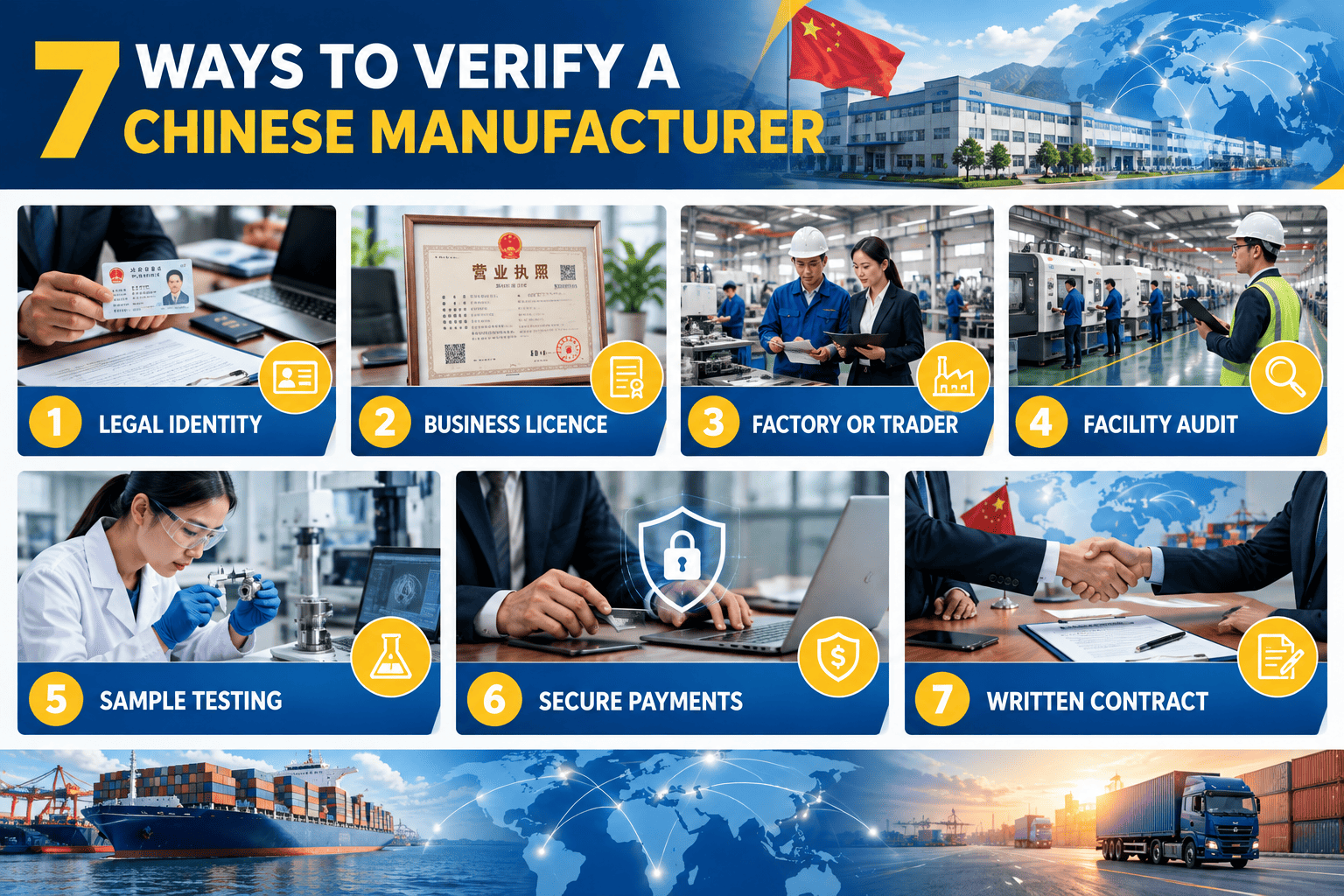
Direct Answer: To verify a Chinese manufacturer, work through seven checks before you pay a deposit or share designs. First, confirm the legal identity (company name, registered address and 18-character Unified Social Credit Code) against official registry records. Second, read the business licence and confirm its scope covers your product. Third, establish whether you are dealing with a factory or a trading company. Fourth, audit the facility by live video or a third-party inspector. Fifth, test samples and check certifications with the issuing body. Sixth, protect payments by paying only to a corporate account in the verified company’s name, in stages. Seventh, lock everything into a clear contract with defined quality, delivery and dispute terms. GTsetu helps you start from a stronger position by connecting you with government‑tie‑up verified companies across 100+ countries, with built-in NDA workflows and zero broker commission.
📅 Published October 12, 2026🔄 Updated October 12, 2026⏱ 14 min read✍️ GTsetu Editorial Team
7
Verification Steps
18
Characters in a USCC
100+
Countries on GTsetu
0%
Broker Commission
China remains one of the world’s largest manufacturing bases, and also one of the places where buyers most often lose deposits to fake factories, reseller middlemen, and counterfeit paperwork. The good news: most supplier fraud is detectable with a disciplined checklist, applied before money or intellectual property changes hands.
Importers, brand owners, procurement teams, e-commerce and dropshipping sellers, and startups sourcing finished goods, components, or raw materials from China, and anyone evaluating a Chinese supplier before a first order.
⚖️ Legal & Compliance Disclaimer
This guide provides general commercial education on supplier due diligence. It does not constitute legal, financial, or regulatory advice. Registry names, access methods and rules change; always confirm current procedures with official Chinese government sources and consult qualified legal counsel or a licensed due diligence provider for high-value deals.
SECTION 1
1 Why Verifying a Chinese Manufacturer Matters
🎯 Definition
Supplier verification is the process of independently confirming that a manufacturer is a legally registered entity, actually capable of producing your product to specification, and safe to pay. It combines document checks (registry and licence data), physical checks (audits and samples), and transaction safeguards (payment terms and contracts). It is distinct from trusting a marketplace badge or a polished website.
A supplier that looks perfect online may be a one-person trading shop using borrowed factory photos, a company that has been dissolved, or a legitimate firm whose name was copied by a scammer. Verification turns “seems credible” into evidence. For broader strategy, see our guide on cross-border business partnerships.
What Goes Wrong When You Skip Verification
💸
Lost Deposits
Fake or impersonated suppliers collect an upfront payment and disappear. Wire transfers are rarely recoverable.
📉
Quality Failures
An unqualified workshop or a reseller outsourcing blindly can ship goods that miss specifications, tolerances, or safety standards.
🔓
IP Leakage
Sharing drawings or formulas without an NDA and a verified counterparty invites copying and rival production.
If the contracting entity is wrong or unregistered, enforcing a breach of contract claim becomes far harder.
🛃
Compliance Exposure
Missing certifications can block customs clearance or retail listing in your destination market.
SECTION 2
2 The 7-Step Verification Process at a Glance
Each step filters out a different kind of risk. Do them in order: cheap desk checks first, expensive physical checks only for suppliers who pass.
1
Identity
Match company name, address and USCC to official registry records.
🪪 Desk Check
2
Licence
Read the business licence: status, scope, registered capital, legal representative.
📜 Documents
3
Factory
Establish whether the supplier manufactures or resells.
🏭 Capability
4
Audit
Verify the facility by live video or independent on-site inspection.
🔍 Physical
5
Samples
Test product quality and confirm certifications with issuers.
🧪 Quality
6
Payment
Pay only to a verified corporate account, in staged milestones.
💶 Safeguard
✨ GTsetu Insight
Steps 1–2 are where most buyers start from zero, hunting through registries in an unfamiliar language. On GTsetu, every company is already checked against government sources on six credentials, so you begin with a verified identity and spend your effort on the checks only you can do. See our partnership evaluation criteria.
SECTION 3
3 Step 1: Confirm Legal Identity & USCC
Every legally registered Chinese company carries an 18-character Unified Social Credit Code (USCC) printed on its business licence. It is the single most useful identifier for cross-checking a supplier, because it is unique to the legal entity and searchable in official registry records.
1
Request the Business Licence
Ask for a clear, current copy of the business licence and the full legal name in Chinese characters. Suppliers who hesitate to share it are signalling a problem.
2
Look Up the USCC in Official Records
Search the USCC and Chinese company name in the National Enterprise Credit Information Publicity System or a reputable verification provider that draws on registry data.
3
Match Every Field
Company name, registered address, legal representative, registered capital and incorporation date should match the licence and what the supplier told you. Mismatches are the first red flag.
4
Check Status & Records
Confirm the company is active, not revoked, dissolved, or flagged for abnormal operations, and look for court or administrative penalty records where accessible.
📌 Name Match ≠ Same Company
Scammers often copy a real company’s name or licence image. Always confirm that the entity you will contract and pay is the entity in the registry, with the same name and USCC on your contract and bank details. This is the core of commercial due diligence.
SECTION 4
4 Step 2: Read the Business Licence & Scope
The licence is more than proof of existence. Each field tells you something about whether this company can credibly supply what you need.
Licence Field
What to Check
Warning Sign
Company Name & USCC
Matches registry, contract and bank account holder
Name differs from the one quoted or invoiced
Business Scope
Includes manufacturing or processing of your product category
Only “trading”, “import/export” or unrelated products
Registered Capital
Plausible for the claimed scale of operations
Very small capital but claims of large factories
Incorporation Date
Consistent with the claimed years of experience
Registered months ago, but “20 years in business”
Legal Representative
Named person is reachable and consistent across documents
Changing names or an unwillingness to confirm
Registered Address
Matches the factory or office you were shown
Residential unit, virtual office, or a different city
SECTION 5
5 Step 3: Factory or Trading Company?
Many suppliers presenting themselves as “factories” are trading companies or sourcing agents. That is not automatically bad, since good traders add consolidation and quality control, but you need to know who actually makes your product, and price your risk accordingly.
🏭 Signs of a Real Factory
✅Manufacturing scope on the licence and a production address in an industrial zone.
✅Machinery and process detail: can explain tooling, lead times, and tolerances without hesitation.
✅Live, unscripted video of production lines, with your product or similar ones in progress.
✅Welcomes audits and third-party inspections.
🕵️ Signs of a Trader or Fake
⚠️Huge, unrelated catalogue spanning dozens of product categories.
⚠️Stock photos or factory images that reverse-image-search to other companies.
⚠️Evasive about location or refuses a live video walkthrough.
⚠️Prices far below market with pressure to pay quickly.
✨ GTsetu Insight
If you are sourcing at scale, compare direct manufacturers with distributors and wholesalers. See our guide on international wholesale distributors for when an intermediary makes sense.
SECTION 6
6 Step 4: Audit the Facility
Documents prove a company exists. An audit proves it can make your product. Match the depth of audit to the order value and risk.
Audit Method
Best For
What It Confirms
Live video walkthrough
Low-value or first-contact checks
Facility exists, equipment is running, staff are present
Third-party factory audit
Mid to high-value or recurring orders
Capacity, quality systems, working conditions, ownership
Pre-shipment inspection
Every significant order
Quantity, workmanship and specification match before the balance is paid
Your own site visit
Strategic, long-term partners
Direct relationship, culture and process confidence
SECTION 7
7 Step 5: Test Samples & Check Certifications
Order samples made on the actual production line, not showroom pieces, and test them against your specification. Then verify any certificate the supplier claims directly with the issuing body, because certificate images are easy to fake. See our overview of manufacturing certifications for international trade.
🧪
Production Samples
Specify materials, dimensions, finish and packaging in writing. Compare the sample to the spec, then keep it as the reference for bulk orders.
🏅
Certificate Verification
Ask for certificate numbers and confirm them with the certification body. Learn what is involved in standards such as ISO 22301 or NSF sanitation certification.
📋
Warranty Terms
Get defect liability in writing. See how a warranty clause should be framed.
🤝
Trade References
Ask for past overseas customers you can contact, and actually contact them. Check consistency between their account and the supplier’s claims.
SECTION 8
8 Step 6: Protect Payments & Shipping Terms
Payment is where verification pays off, or fails. A verified identity only helps if your money goes to that identity.
🎯 Payment Safety Rules
• Pay only to a corporate bank account in the exact registered company name, never a personal account.
• Treat last-minute bank detail changes as fraud until confirmed through a known contact.
• Use staged payments tied to milestones, with the balance paid after pre-shipment inspection.
• Avoid 100% upfront payment to any unverified supplier.
• Fix delivery responsibilities with clear terms. Read our explainers on Incoterms 2020 and FCA (Free Carrier).
SECTION 9
9 Step 7: Lock It Into a Contract
A signed agreement converts verification findings into enforceable commitments. Define specs, tolerances, inspection rights, delivery dates, IP ownership and dispute resolution before production begins. For a full walkthrough, read our guide on international business development consulting for support options.
1
Sign an NDA First
Before sharing drawings, formulas or pricing, execute a mutual NDA with the verified legal entity. GTsetu’s built-in NDA workflow creates a digital audit trail.
2
Define Quality & Remedies
Set acceptance criteria and remedies for defects. Understand what counts as a material breach and how consequential damages are handled or excluded.
3
Plan the Exit
Agree how either party can end the relationship. Review termination for convenience before committing to long supply terms.
Verification takes time, and the earliest steps are the most tedious. GTsetu connects manufacturers, exporters, importers and distributors across 100+ countries, and every company is verified using direct government tie‑ups across six essential credentials: legal name, registered address, registration number, company status, company type, and date of certificate of incorporation. GTsetu does not verify industry certifications, product quality, factory capability, or financial standing; those must be exchanged and validated directly between partners using the steps in this guide.
✅
Government Tie‑Up Verification6‑point verification: legal name, registered address, registration number, company status, company type, incorporation date.
📜
Certifications & QualityNot verified by GTsetu. Validate directly with partners during due diligence.
🕵️
Anonymous DiscoveryBrowse verified profiles without revealing your identity until mutual interest is confirmed.
📄
Built-In NDA WorkflowFormalise confidentiality before sharing designs or pricing, with a full digital audit trail.
🚫
Zero CommissionNo broker fees on any supply, distribution or technology deal.
🔐
Encrypted CollaborationDocuments and messages encrypted in transit and at rest from first contact.
🌍
100+ CountriesA growing verified network for sourcing and partnerships.
Confirm the company’s legal identity (name, registered address, 18-character Unified Social Credit Code) against official Chinese registry records, check that its business scope covers your product, verify it owns or operates a real factory through a video audit or third-party inspection, test samples, and pay only to a corporate bank account in the registered company name.
QWhat is a USCC and why does it matter?
The Unified Social Credit Code (USCC) is the 18-character identifier on a Chinese company’s business licence. It uniquely identifies the legal entity, so you can look it up in official registries and confirm the name, address, status and legal representative match what the supplier told you.
QHow can I tell a factory from a trading company?
Check the business scope on the licence (manufacturing vs. trading or import/export), ask for production line footage and equipment details, and request an on-site or third-party audit. Trading companies are not necessarily bad, but you should know who actually makes your product.
QIs a platform badge like “Gold Supplier” enough to trust a supplier?
No. Marketplace badges are a starting signal, not proof. You still need to verify legal registration, factory capability, certifications and references independently.
QWhat payment terms reduce risk with a new Chinese supplier?
Pay only to a corporate account in the verified company’s registered name, never a personal account. Use staged payments tied to milestones, a pre-shipment inspection before the balance, and clear Incoterms. Avoid paying 100% upfront to an unverified supplier.
QHow does GTsetu help verify manufacturers?
GTsetu verifies companies through government tie-ups on six credentials (legal name, registered address, registration number, company status, company type, incorporation date), and offers anonymous discovery, built-in NDA workflows, encrypted collaboration and zero broker commission across 100+ countries. GTsetu does not verify industry certifications, product quality or financial standing; those are validated directly between partners.
Ready to Source From Verified Manufacturers?
Join 500+ verified manufacturers, exporters, and importers already building cross-border partnerships on GTsetu, with government‑tie‑up verification of six core credentials, built-in NDA workflows, and zero broker fees across 100+ countries.
They represents the product, and research team behind GTsetu, a global B2B collaboration platform built to help companies explore cross-border partnerships with clarity and trust. The team focuses on simplifying early-stage international business discovery by combining structured company profiles, verification-led access, and controlled collaboration workflows.
With a strong emphasis on trust, and disciplined engagement, Team GTsetu shares insights on global trade, partnerships, and cross-border collaboration, helping businesses make informed decisions before entering deeper commercial discussions.