Why the Harmonized System Matters for Global Trade
The HS is the universal economic language and code for goods. It is an indispensable tool for international trade, contributing to the harmonization of customs and trade procedures and reducing the costs associated with cross-border transactions. For businesses, understanding and correctly applying HS codes is not just a regulatory requirement—it is a strategic necessity that impacts duties, compliance, and market access. Whether you are a manufacturer exploring cross-border manufacturing partnerships or a distributor working with international wholesale distributors, accurate HS classification is fundamental.
📊 Key Statistic
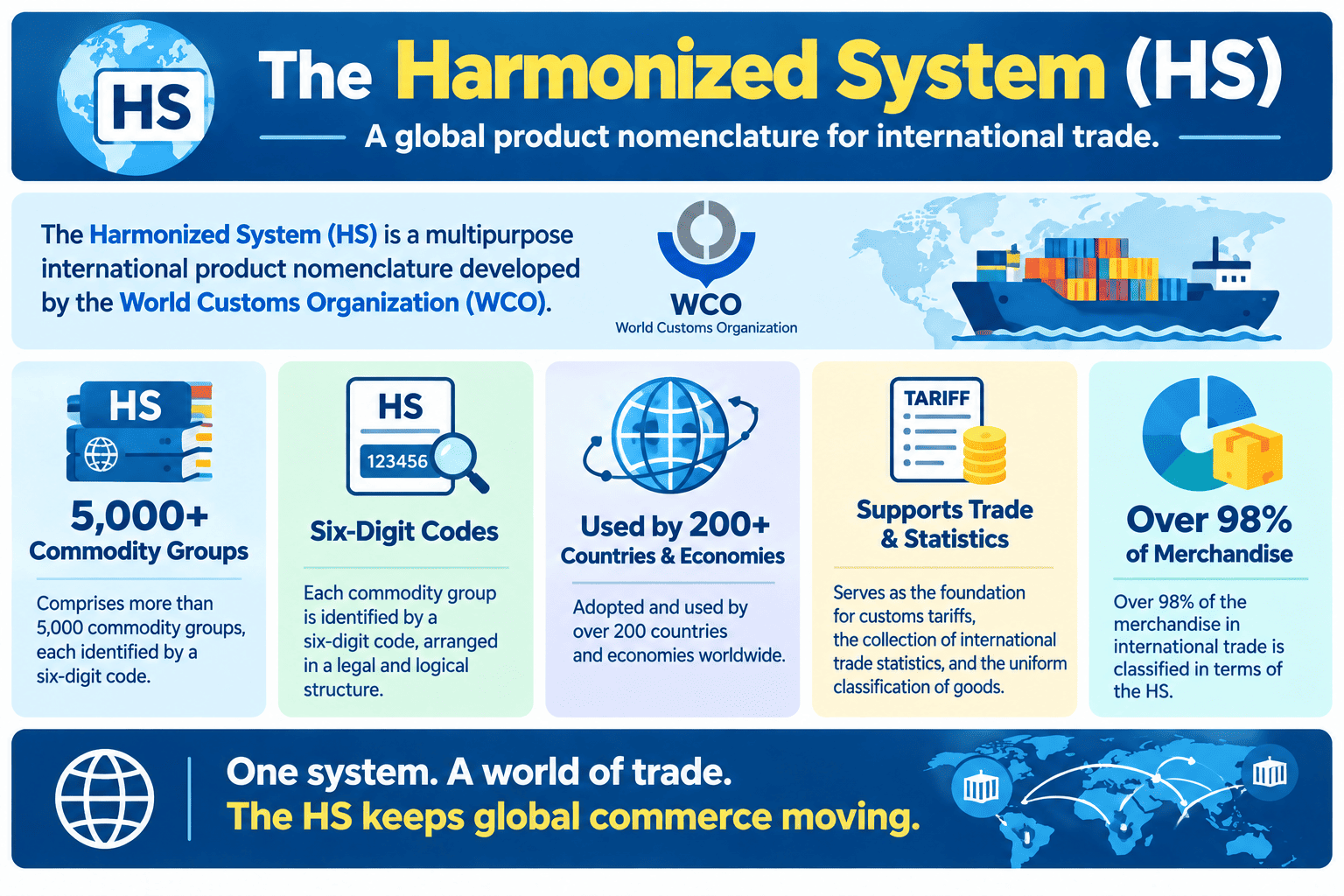
Over 98% of the merchandise in international trade is classified in terms of the HS. This makes it the single most important classification system for global commerce, directly influencing tariff rates, trade statistics, and regulatory compliance.
Understanding the Structure of an HS Code
The HS code is a six-digit number that follows a hierarchical structure. The first two digits identify the chapter, the next two digits identify the heading within that chapter, and the final two digits identify the subheading. This logical structure allows for uniform classification across all participating countries.
| Digit Position | What It Identifies | Example |
|---|
| First 2 Digits | Chapter — general category of the product | 09 (Coffee, Tea, Maté and Spices) |
| Next 2 Digits | Heading — specific product type within the chapter | 0901 (Coffee, whether or not roasted) |
| Last 2 Digits | Subheading — detailed classification of the product | 0901.21 (Coffee, roasted, not decaffeinated) |
Countries are allowed to add longer codes to the first six digits for further classification. For example, the United States requires a 10-digit number to classify products being imported or exported.
HS vs. HTS vs. Schedule B
HS Code vs. HTS Code vs. Schedule B: What’s the Difference?
While the first six digits of an HS code are universal, different countries extend the code for their own purposes. The United States uses two different 10-digit extensions: the Harmonized Tariff Schedule (HTS) for imports and the Schedule B for exports.
| Code Type | Used For | Administered By | Number of Digits |
|---|
| HS Code | International classification of traded products | World Customs Organization (WCO) | 6 digits |
| HTS Code (US) | Classifying products imported into the United States | US International Trade Commission (USITC) | 10 digits |
| Schedule B (US) | Classifying products exported from the United States | U.S. Census Bureau | 10 digits |
📌 Note on International Variations
The first six digits (the HS Subheading) are the same across all countries. However, different countries add additional digits for local requirements. For example, ASEAN countries follow the ASEAN Harmonized Tariff Nomenclature (AHTN) with 8 digits, while the UK and EU use Customs Commodity Codes. Always verify the specific requirements of your destination country.
How to Find Your HS Code
Step-by-Step Guide to Finding Your Product’s HS Code
Finding the correct HS code is the responsibility of the shipper or exporter. The process requires careful attention to detail, as an incorrect classification can lead to delays, unexpected duties, or even rejection of your shipment at the border.
1
Understand Your Product
Identify the exact nature of your product: its material composition, function, and intended use. The more detailed your understanding, the more accurate your classification will be.
2
Use Official Search Tools
For US exports, use the Census Bureau’s Schedule B search engine. For US imports, use the HTS search tool. For other countries, consult your national customs authority’s online database.
3
Consult the General Rules of Interpretation (GRI)
The GRI provides a three-step process for classifying composite goods, mixtures, and items sold in sets. This is essential for complex products.
4
Use the Customs Rulings Online Search System (CROSS)
For difficult-to-classify products, CROSS contains official, legally binding rulings from requests for HTS numbers for products importing into the United States. The first 6 digits of an HTS number are the same as the HS code.
5
Verify with a Customs Broker or Expert
If you are still uncertain, consult a licensed customs broker or trade compliance expert. The cost of a consultation is far less than the cost of a customs delay or penalty.
6
Document and Review
Once you have your HS code, document it and include it on your commercial invoice and shipping documents. Review your classification periodically, as the HS is updated every five years.
Practical Applications
How HS Codes Are Used in International Trade
HS codes are used for a wide range of purposes beyond just customs clearance. They are a critical data point for market research, trade policy, and business strategy.
| Application | Description |
|---|
| Customs Tariffs & Duties | HS codes determine the tariff rate applied to your product upon import. They also determine eligibility for preferential tariff rates under free trade agreements. |
| Trade Statistics & Market Research | HS codes are used to compile international trade statistics, enabling businesses to conduct global market research for manufacturers and identify export opportunities. |
| Regulatory Compliance | HS codes help customs authorities identify controlled goods, apply quotas, and enforce health, safety, and environmental regulations. |
| Shipping Documentation | HS codes are required on shipping documents such as the shipper’s letter of instructions, commercial invoice, and certificate of origin. They also help determine the correct Incoterms 2020 rules for your shipment. |
| Trade Agreement Qualification | HS codes are used to determine if a product qualifies for preferential tariff treatment under a free trade agreement, based on rules of origin. |
Real-World Example
HS Code Example: Men’s Cotton Shirts
The following is a condensed example illustrating how a single product category can have multiple HS codes based on its specific characteristics.
📄 HS Code Reference: Men’s Shirts
Product: Men’s shirts
HS Chapter: 61 (Articles of apparel and clothing accessories, knitted or crocheted) or 62 (Articles of apparel and clothing accessories, not knitted or crocheted)
Heading: 6105 or 6205 (Men’s or boys’ shirts)
Subheading Examples:
• 6105.10 — Of cotton
• 6105.20 — Of man-made fibres
• 6105.90 — Of other textile materials
Note: There are approximately 10 different codes for the item “shirt,” demonstrating the precision required for accurate classification.
Risks & Mitigation
Common Risks of Incorrect HS Classification & How to Mitigate Them
⚠️
Unexpected Duties and Taxes
Mitigation: Verify your HS code with a customs broker or use a legally binding ruling from CROSS. Ensure your commercial invoice clearly states the HS code and product description.
⚠️
Customs Delays and Rejection
Mitigation: Include accurate HS codes on all shipping documents. For complex shipments, consider using a customs broker to manage clearance and mitigate the risk of breach of contract with your buyer.
⚠️
Penalties and Legal Liability
Mitigation: Conduct commercial due diligence on your supply chain partners. Understand the penalties for misclassification in your destination market and ensure your contracts address liability for customs compliance.
FAQ
Frequently Asked Questions About HS Codes
QWhat is an HS code?
An HS code, or Harmonized System code, is a standardized numerical method of classifying traded products. It is a six-digit code used by customs authorities worldwide to identify goods for the purpose of assessing duties, taxes, and for gathering trade statistics.
QHow do I find the HS code for my product?
You can find your product’s HS code by using your country’s official customs website or a searchable database like the US Census Bureau’s Schedule B search engine. For difficult-to-classify items, you can consult the Customs Rulings Online Search System (CROSS) for legally binding rulings on similar products.
QWhat is the difference between HS, HTS, and Schedule B codes?
The HS code is the first six digits and is used internationally. The HTS (Harmonized Tariff Schedule) code is used by the US for imports and extends the HS code to 10 digits. The Schedule B code is used by the US for exports and also extends the HS code to 10 digits. The first six digits are the same across all three.
QHow often are HS codes updated?
The HS is maintained by the World Customs Organization and is updated every five to six years to reflect developments in technology and changes in trade patterns. The most recent major update was in 2022, with the next expected in 2027.
QIs it mandatory to include an HS code on shipping documents?
While it is not always mandatory in every country, it is always recommended to include the HS code on your commercial invoice to ensure a clear and accurate representation of the contents of your shipment. This helps avoid customs delays and ensures correct duty assessment.