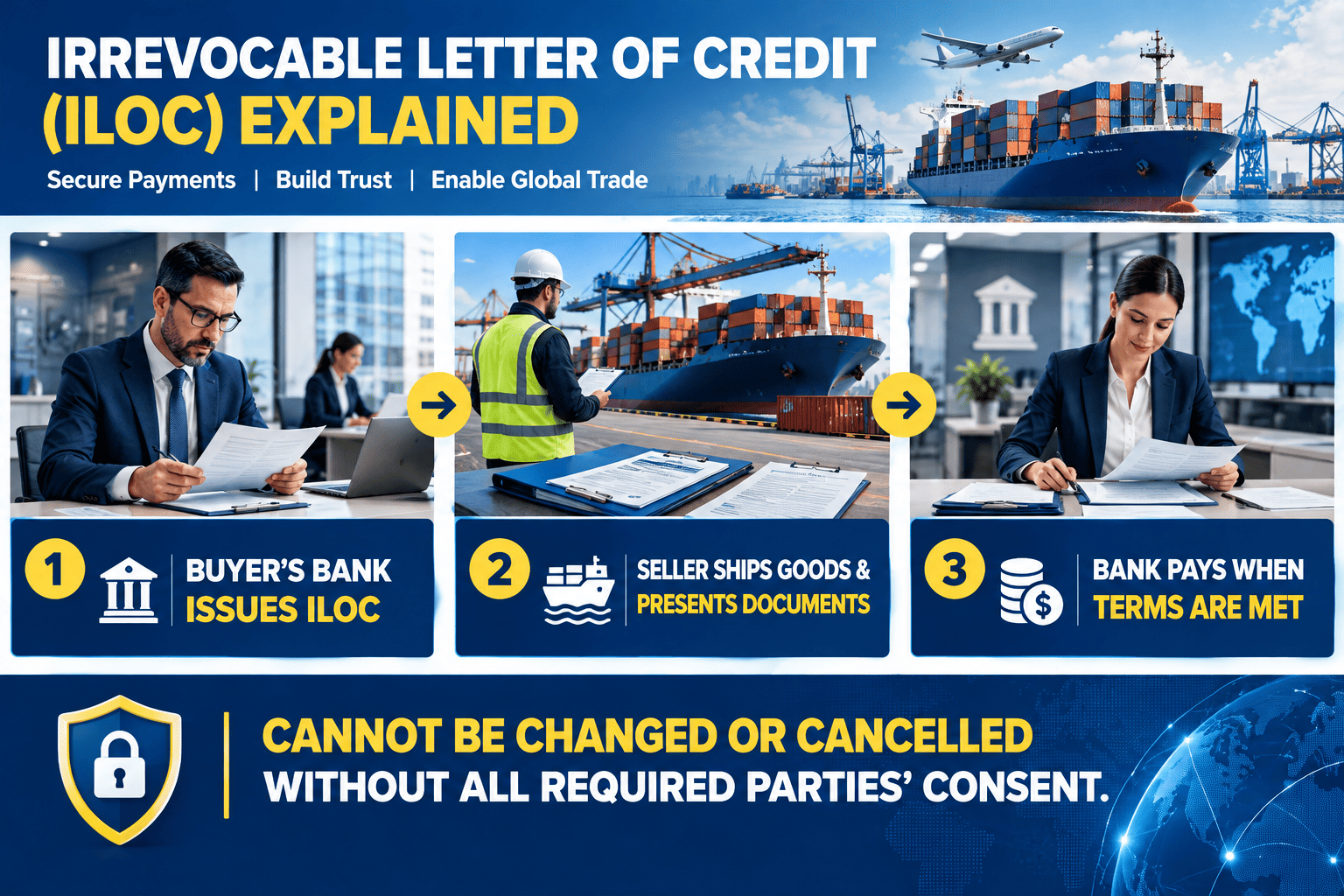
Why the Irrevocable Letter of Credit Matters in Global Trade
In international trade, buyers and sellers are often thousands of miles apart, may not know each other, and operate under different legal systems. Trust is scarce, and the risk of non-payment or non-delivery is real. An irrevocable letter of credit bridges that gap. It substitutes the credit of the buyer with the credit of a reputable bank, giving the seller a guarantee of payment and the buyer assurance that payment is only released against compliant documents. This mutual security reduces disputes, builds trust, and facilitates cross-border transactions that might otherwise never happen. As supply chains globalize and regulatory scrutiny intensifies, the ILOC remains a critical tool for managing payment risk.
📊 Key Statistic
Letters of credit are used in a significant share of global trade, particularly in commodities, capital goods, and cross-border manufacturing. Bank fees for issuing an LC typically range from 1% to 8% of the value of the goods, depending on the buyer’s creditworthiness and country risk.
How an Irrevocable Letter of Credit Works
A letter of credit typically involves five parties: the importer (buyer) and its bank (issuing bank), the exporter (seller) and its bank (advisory or confirming bank), and a carrier. The process is document-driven—payment is made against documents, not against goods. Here is the step-by-step flow.
1
Buyer Requests the Letter of Credit
The importer applies to its bank (the issuing bank) for an irrevocable letter of credit in favor of the exporter. The bank assesses the importer’s creditworthiness and may require collateral or a cash margin.
2
Issuing Bank Issues and Transmits the LC
The issuing bank issues the ILOC and sends it to the exporter, often through an advisory bank in the exporter’s country. The exporter now has a bank guarantee of payment if compliant documents are presented.
3
Exporter Ships the Goods
The exporter consigns the goods to a carrier and obtains a bill of lading and other required documents (invoice, packing list, certificate of origin, etc.).
4
Exporter Presents Documents to the Bank
The exporter submits the documents to the advisory or confirming bank. The bank checks that the documents strictly comply with the LC terms.
5
Bank Pays the Exporter
If documents comply, the advisory bank pays the exporter (for a sight LC) or accepts the documents for future payment (for a deferred payment LC). The advisory bank then forwards the documents to the issuing bank for reimbursement.
6
Issuing Bank Releases Documents to Importer
The issuing bank presents the documents to the importer, who uses the bill of lading to claim the goods. The importer reimburses the issuing bank according to the terms of the LC agreement.
📌 The Key to This System: Document Precision
Payment under a letter of credit is made against documents, not goods. All details across the sales contract, the LC, and the bill of lading—credit amounts, payment deadlines, product descriptions, serial numbers, weights, and shipment dates—must match perfectly. Discrepancies can delay or void payment. Exporters should review every document meticulously before presentation.
Types of Letters of Credit
Common Types of Irrevocable Letters of Credit
Letters of credit come in several varieties. It is essential for exporters to know exactly what kind of letter the importer has obtained, as each offers different levels of security and flexibility.
| Type | Description |
|---|
| Commercial Letter of Credit | The most common type, used for international trade to guarantee payment once the seller meets the agreed conditions. Funds are released only when the required documents are presented. |
| Standby Letter of Credit (SBLC) | Serves as a backup payment guarantee. It is only used if the buyer fails to fulfill payment obligations, making it a financial safety net rather than a direct payment method. |
| Confirmed Letter of Credit | Includes a guarantee from a second bank, often in the seller’s country, in addition to the issuing bank’s commitment. Provides extra security, especially for transactions in high-risk regions. |
| Revolving Letter of Credit | Allows multiple transactions under the same agreement without needing a new credit arrangement for each one. Useful for ongoing trade relationships and repeated shipments. |
| Transferable Letter of Credit | Enables the original beneficiary (seller) to transfer all or part of the payment guarantee to another party, such as a supplier. Commonly used when intermediaries are involved. |
| Red Clause Letter of Credit | Provides the seller with an advance payment before shipment of goods. The issuing bank includes a clause allowing partial withdrawals, helping suppliers finance production. |
| Back-to-Back Letter of Credit | Used when intermediaries are involved: two linked LCs—one issued to the intermediary and another to the final supplier—facilitating multi-party deals. |
| Sight Letter of Credit | Payable as soon as the required documents have been presented. Usually, seven days are allowed for the banks to examine documents in detail. |
| Deferred Payment Letter of Credit | Allows the importer to take possession of goods by agreeing to pay the issuing bank or advisory bank at a future date (e.g., 60 days after shipment). Serves as a financing instrument for the importer. |
Protection & Risk Mitigation
Protecting Both Parties in International Trade
The primary benefit of an irrevocable letter of credit is that it offers security for both parties. The buyer’s bank issues the letter to ensure that the buyer will pay upon completion of the agreed-upon terms, provided that the seller submits the correct documents. The seller can be confident they will receive payment as long as they meet the requirements specified in the letter.
On the other hand, the buyer is protected from the risk of paying for goods or services that do not meet the terms of the agreement. If the seller fails to meet their obligations, the buyer has the right to refuse payment or seek amendments to the letter. This mutual security reduces the likelihood of disputes and builds trust between the two parties.
Ensuring Timely Payment and Mitigating Risk
- Savings Account Protection: The buyer may need to keep a savings account or another form of liquid assets to cover the money required for the transaction, ensuring they can meet payment obligations.
- Go-Between Role: The buyer’s bank acts as a go-between, ensuring funds are transferred according to the agreed terms. The bank verifies the presentation of the necessary documents before transferring money to the seller.
- Beneficiary’s Security: The seller is protected by the letter, as payment is released only when all conditions are met. Clearly defining the transaction’s subject—whether goods or services—helps prevent confusion.
Legal Framework
Legal Framework of Irrevocable Letters of Credit
International trade is governed by various regulations, and one of the most recognized sets of rules is the Uniform Customs and Practice for Documentary Credits (UCP), published by the International Chamber of Commerce (ICC). This set of guidelines governs documentary credits and ensures standardization across international transactions. By adhering to the UCP, parties can confidently submit the necessary paperwork—such as the bill of lading or invoice—knowing that their documents will be verified against an internationally recognized standard. This standardization helps avoid conflicts between the respective banks of the parties involved and ensures that all transactions are completed according to applicable laws.
📜 UCP 600
The current version, UCP 600, came into effect in 2007 and is widely adopted in international trade. It defines key terms such as “issuing bank,” “confirming bank,” and “nominated bank,” and sets rules for document examination, discrepancy handling, and payment obligations. Contracts and LCs should explicitly state that they are subject to UCP 600 to ensure consistency.
Pros & Cons
Pros and Cons of Letters of Credit
For exporters, letters of credit offer guaranteed payment; the exporter receives the issuing bank’s promise to pay, to back up the importer’s promise to pay. This can be a significant factor when dealing with unknown customers and/or risky countries. In many cases, exporters have no choice but to require an importer to obtain a letter of credit—it might be a legal requirement in the importing country, or a requirement of the exporter’s credit insurer.
However, letters of credit have drawbacks. They are potentially costly to the importer, which could make the exporter uncompetitive vis-à-vis other exporters who do not demand letters of credit. Moreover, in many cases the importer asks to transfer part or all of the bank fees to the exporter. If a confirmed letter is used, the confirmation costs could add another 2%–8% to the final tally of bank fees. There is also a cost to exporters in terms of the time required to check documents and ensure they are error-free and internally consistent. Payment will only be made if the terms of the letter are met precisely.
| Pros | Cons |
|---|
| Guaranteed payment from a reputable bank | Bank fees can be significant (1%–8% of goods value) |
| Reduces risk with unknown customers and high-risk countries | Time-consuming document checking and compliance |
| Provides assurance to both buyer and seller | Any discrepancy can delay or void payment |
| May be required by law or credit insurer | Confirmation costs add another 2%–8% |
| Facilitates access to financing | Importer may pass fees to exporter, affecting competitiveness |
Points to Consider
Key Considerations When Using Letters of Credit
The key to successful use of letters of credit is proper documentation. This requires paying close attention to the fine print on matters such as description of the goods, deadlines for delivery of goods and payment, price of goods, etc. All the details of the sales contract, letter of credit, and bill of lading must be consistent. Common sources of errors include details such as the number of items shipped, the weight of goods, the shipment dates, product serial numbers, and document reference numbers.
The terms of a letter of credit should allow sufficient time for the payment flows to take place—otherwise the letter could be nullified due to missed deadlines. If necessary, exporters should ask for a clause in the letter that allows an extension of time in case of delays in electronic bank-to-bank transfers. A letter of credit is used as a guarantee in case of doubts surrounding the importer’s ability or willingness to pay. With that in mind, exporters should consider the degree of risk involved before asking for a letter of credit. For example:
- What is the value of the order, and would the bank fees be out of proportion to the value?
- What is the credit rating of the importer, and is this importer entirely unknown to the exporter?
- What is the country risk of the importing country?
- How credit-worthy is the issuing bank?
- What is the usual practice in trading with this country or in this line of products?
- Should additional protective measures be taken, such as credit insurance?
📌 Alternatives to Letters of Credit
There is a broad range of alternatives, each posing different degrees of risk. Under advance payment, the exporter bears no risk because the importer pays in advance. With an open account, the exporter bears all the risk. In between are arrangements such as documentary collection, where documents (including a bill of exchange) are sent through the banking system. Many exporters also choose credit insurance, which typically covers up to 90% of the invoice value and is less time-consuming than a letter of credit.
Contractual Context
Key Contractual Clauses Related to Letters of Credit
Letters of credit interact with other important contract provisions. Understanding these relationships is essential for drafting a cohesive international trade agreement.
| Clause | How It Relates to Letters of Credit |
|---|
| Master Services Agreement (MSA) | Payment terms and security instruments like LCs are often governed by the MSA in ongoing service relationships. |
| Warranty Clause | Warranties on goods must align with the documents required under the LC (e.g., quality certificates). |
| Breach of Contract | Failure to honor an LC or present compliant documents can constitute a breach, with remedies including damages and termination. |
| Material Breach | Non-payment or failure to provide an LC as required may be deemed a material breach, allowing the counterparty to terminate. |
| Termination for Convenience | Termination provisions must address outstanding LCs and any liabilities arising from cancellation. |
| Consequential Damages | Delays or failures related to LC processing can lead to consequential damages (e.g., lost profits from delayed shipment), often waived or capped. |
| Asset Purchase Agreement | L/Cs may be transferred or assumed in asset sales, and the agreement must address outstanding LCs. |
FAQ
Frequently Asked Questions About Irrevocable Letters of Credit
QWhat is an irrevocable letter of credit?
An irrevocable letter of credit (ILOC) is a payment guarantee issued by a bank on behalf of a buyer that cannot be amended or cancelled without the consent of all parties involved. It assures the seller of payment as long as they present compliant documents within the validity period. The issuing bank’s obligation is independent of the buyer’s willingness to pay.
QWhat happens if the buyer fails to meet the terms of the irrevocable letter of credit?
If the buyer fails to meet the terms, the seller has the right to claim payment from the bank, provided they submit the necessary documentation proving the transaction conditions were met. The issuing bank’s obligation is independent of the buyer’s willingness to pay, so the bank must honor the LC if documents comply.
QCan an irrevocable letter of credit be amended after it’s issued?
No. An irrevocable letter of credit cannot be amended without the explicit agreement of all parties involved, including the seller, buyer, issuing bank, and any confirming bank. This ensures the terms remain fixed unless all stakeholders consent to changes.
QWhat is the difference between an irrevocable and a revocable letter of credit?
An irrevocable letter of credit cannot be altered or cancelled without the consent of all parties, while a revocable letter of credit can be modified or revoked by the buyer’s bank at any time without notice. Letters of credit are automatically considered irrevocable unless expressly stated otherwise.
QWhat types of transactions are best suited for an irrevocable letter of credit?
Irrevocable letters of credit are particularly useful in high-value, high-risk international transactions where both the buyer and seller want to ensure payment and delivery are guaranteed before completing the deal. They are common in cross-border trade with unknown counterparties or in countries with higher country risk.
QHow do I verify an irrevocable letter of credit with the bank?
Verification typically involves reviewing the terms and checking that the necessary paperwork is in order. The financial institution or buyer’s bank will provide this confirmation. Exporters should ensure the LC is authentic and issued by a reputable bank, especially if the issuing bank is in a high-risk country.