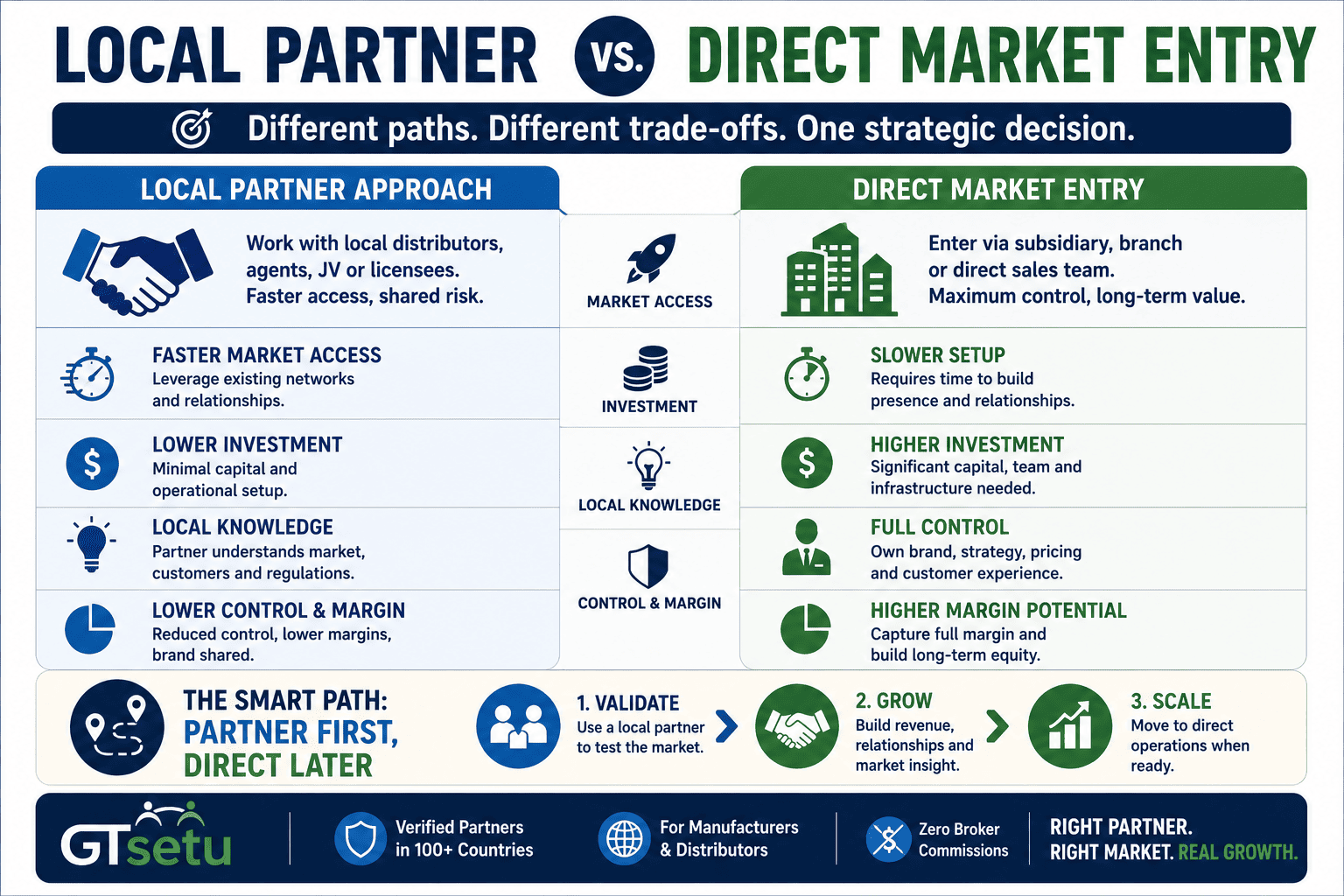
Direct Answer: The local partner vs. direct market entry decision is the single most consequential choice in international expansion. A local partner approach, through a distributor, agent, joint venture, or licensee, offers faster market access, lower capital requirements, and built-in local knowledge, but reduces your margin, control, and brand ownership. Direct entry, through a subsidiary, branch, or direct sales team, provides maximum control, full margin capture, and long-term strategic ownership, but requires significantly more capital, time, and local management capacity. Most companies benefit from a partner-first, direct-later sequence: use a verified local partner to validate the market, build relationships, and generate initial revenue, then transition to direct operations once volume and strategic importance justify the investment. GTsetu helps manufacturers and distributors find verified partners for either path, with zero broker commissions.
📅 June 2, 2026⏱ 20 min read✍️ GT Setu Editorial Team🔄 Updated regularly
~70%
of first international expansions use a local partner first
3–5×
higher upfront cost for direct vs. partner entry in most markets
50%
of international partnerships fail due to poor partner selection
0%
GTsetu broker commission on every partnership formed
The first major decision in any international expansion programme is not which country to enter, it is how to enter. This single choice determines your speed to revenue, your capital commitment, your brand control, your long-term margin structure, and your exposure to market risk. Get it right and international expansion compounds into a strategic advantage. Get it wrong and you spend years unwinding a misaligned entry structure while competitors build the market relationships you should have established first.
The debate between local partner and direct market entry is not new, but the rise of verified B2B platforms, the growth of cross-border digital commerce, and the post-pandemic reconfiguration of global supply chains have significantly changed the conditions under which each approach makes sense. This guide gives you a complete framework for making this decision correctly, covering trade-offs, sector fit, risk factors, hybrid approaches, and the partner selection process that determines whether the local partner route delivers on its promise. See also our guide on the challenges of global expansion and the true cost of global expansion for the broader context this decision sits within.
🎯 Who Is This Guide For?
This guide is written for manufacturers, industrial companies, technology providers, and B2B distributors planning their first or next international expansion, particularly those evaluating whether to appoint a local distribution or technology partner versus establishing a direct company presence in a target market. It is equally relevant for companies currently operating through local partners who are evaluating the case for transitioning to direct operations, and for those exploring international market entry for manufacturers and distributors as a discipline.
SECTION 1
1 The Core Question: What Are You Actually Choosing Between?
🎯 The Fundamental Trade-Off
At its core, the local partner vs. direct entry decision is a trade-off between speed and local access (partner advantage) and control and long-term economics (direct advantage). Neither approach is universally superior, the right answer depends on your market maturity, product complexity, capital position, risk tolerance, and strategic time horizon. Understanding the trade-off clearly is the prerequisite for making it correctly.
3–9mo
Typical time-to-first-revenue via local partner in most markets
12–24mo
Typical time-to-first-revenue via direct subsidiary establishment
15–40%
Typical margin difference between direct and partner-channel pricing in B2B markets
Both the local partner approach and direct market entry encompass a spectrum of specific models. Understanding these sub-categories is important because the trade-offs vary significantly within each broad category. A joint venture partnership, for example, has very different economics and risk profile than a simple distributor appointment, even though both are “local partner” approaches. Similarly, a branch office operated by home-country staff has very different implications than a fully staffed local subsidiary. The market entry partnerships guide covers the full taxonomy in depth.
SECTION 2
2 The Local Partner Approach: Models, Pros & Cons
The local partner approach encompasses several distinct structures, each with different levels of commitment, control, and commercial alignment. Understanding which local partner model fits your situation is as important as the partner vs. direct decision itself.
🤝Most Common
Distributor / Channel Partner
The distributor purchases your product and resells to end customers in their territory at a markup. They handle stock, logistics, sales, and often after-sales service. You earn a transfer price; the distributor earns the margin between transfer price and resale.
Best for: industrial goods, capital equipment, standardised products
📋Low Commitment
Sales Agent / Manufacturer’s Rep
The agent sells on your behalf for a commission but does not take title to goods. You retain the customer relationship and handle fulfilment directly. Lower cost than a distributor but also lower market penetration and commitment from the partner.
Best for: high-value, low-volume products; markets where inventory investment is impractical
⚖️Shared Equity
Joint Venture
A new jointly owned legal entity, shared governance, shared P&L, shared risk. Provides deep local integration and market access, but requires extensive upfront negotiation of governance, ownership, and exit terms. Most complex local partner structure to establish and exit.
Best for: markets with mandatory local ownership requirements; large-scale manufacturing
📄IP Monetisation
Licensing / Technology Transfer
You grant a local company the right to manufacture or sell using your IP, technology, or brand, in exchange for royalty payments. Minimal capital commitment; no operational presence required. Risk: limited quality control and potential for IP misuse.
Best for: software platforms, proprietary processes, markets where local production is essential
🔗Flexible
Strategic Alliance
A formal collaboration agreement between your company and a local partner, sharing resources, distribution networks, or customer relationships for a defined purpose without creating a new legal entity. More flexible than a JV; typically for specific market access or capability objectives.
Best for: technology co-development, co-marketing, accessing specific customer segments
🏷️Brand Neutral
OEM / Contract Manufacturing
A local manufacturer produces your product under your brand or their brand, for local supply or export. Reduces import costs, qualifies for local content requirements, and can access government incentives for local production without you establishing a factory.
Best for: physical goods with significant import duties; markets with local content requirements
Advantages of the Local Partner Approach
Faster time to market, leverage the partner’s existing customer relationships and distribution infrastructure instead of building from scratch
Lower capital requirement, the partner funds inventory, local staff, and market development investment, reducing your upfront commitment
Built-in local knowledge, navigate regulatory complexity, cultural norms, and buying behaviour through a partner who already understands the market
Regulatory compliance, in many markets (Middle East, China, India, Africa), local representation or ownership is legally required for commercial activity
Risk sharing, market development, credit, and operational risks are shared with or transferred to the local partner
Scalable testing, validate market demand before committing to direct establishment capital
Existing customer relationships, the right partner brings immediate access to decision-makers at target accounts you could not reach independently
Disadvantages of the Local Partner Approach
Reduced margin, the partner’s markup reduces your realised price and long-term profit in the market
Limited control, brand positioning, pricing, customer experience, and after-sales quality are all mediated through the partner’s capabilities and priorities
Market intelligence dependency, you see the market through the partner’s reporting rather than direct observation, creating information asymmetry
Partner commitment risk, multi-brand distributors may not prioritise your products if competing lines offer higher margins or easier sales
IP exposure, sharing technical data, product specifications, and pricing with partners creates IP and confidentiality risk
Exit complexity, terminating a local partner relationship, especially an exclusive one, can be commercially and legally painful
Partner selection risk, the wrong partner costs years of lost market development and can damage brand reputation
SECTION 3
3 The Direct Entry Approach: Models, Pros & Cons
Direct market entry also encompasses a spectrum of models, from a lightweight representative office to a full greenfield manufacturing facility. The capital commitment, timeline, and operational complexity vary enormously across these structures.
🏢Lightweight
Representative / Liaison Office
A non-commercial presence focused on market research, relationship-building, and supporting existing overseas customers with local operations. Cannot generate revenue directly. Lowest-cost direct presence; useful for market assessment and relationship investment before full commitment.
Best for: early-stage market assessment; supporting large existing customers with local presence
📊Commercial
Branch Office
A commercial extension of your home-country entity, can generate revenue and sign contracts but is legally part of the parent company. Parent bears full liability. Faster to establish than a subsidiary; appropriate for limited commercial activity without full local company incorporation.
Best for: modest commercial activity; markets where subsidiary incorporation is slow or complex
🏛️Full Control
Wholly Owned Subsidiary
A locally incorporated company with 100% foreign ownership, full commercial and operational control. Separate legal entity with liability ring-fencing. The standard direct entry structure for long-term market commitment; enables full access to local investment incentives, contracts, and banking.
Best for: validated, large markets requiring long-term strategic commitment
🏭Production
Greenfield Manufacturing
Building your own production facility in the target market, for local supply or regional export. Maximum capital requirement and longest timeline; but unlocks local content benefits, government manufacturing incentives (SEZ, PLI, OIZ equivalents), and the lowest long-term per-unit cost for high-volume production.
Best for: large-scale manufacturing; markets with significant import duties or local content requirements
🛒Digital-First
Direct E-Commerce / Digital Sales
Selling directly to end customers through your own e-commerce platform, marketplace, or direct digital sales process, without a local physical presence. Works well for standardised products with global fulfilment capability; limited for complex B2B products requiring technical sales support.
Best for: standardised products; digital goods; markets with strong e-commerce infrastructure
🏗️Acquisition
Acquiring a Local Company
Purchasing an existing local business to gain an instant customer base, distribution infrastructure, local management team, and market credibility. The fastest route to direct market presence with established operations, but requires significant due diligence and integration management. See our guide on the collaboration agreement vs joint venture comparison.
Best for: markets where organic direct entry would take too long; acquiring strategic capabilities
Advantages of Direct Market Entry
Full control over brand positioning, pricing strategy, customer experience, and after-sales quality
Maximum margin capture, no partner markup between your transfer price and the customer’s purchase price
Direct customer relationships, you own the data, the relationship, and the loyalty rather than the partner
Full market intelligence, direct observation of customer behaviour, competitive dynamics, and market trends without information intermediaries
Long-term strategic ownership, the market presence you build belongs entirely to you and compounds over time
IP protection, no requirement to share technical data, pricing, or product roadmaps with a third-party intermediary
Qualification for government incentives, many manufacturing incentive programmes (SEZ, PLI) require direct local entity establishment
Disadvantages of Direct Market Entry
High capital requirement, establishing a local entity requires legal, tax, HR, and office/facility costs that partners absorb in the partner model
Longer time to revenue, building a direct sales team, establishing customer relationships, and navigating local regulations from scratch takes 12–24+ months
Local management talent risk, finding, hiring, and retaining qualified local management is one of the most challenging aspects of direct entry
Regulatory complexity, local entity establishment, tax compliance, employment law, and sector-specific licensing must all be navigated without a local partner’s institutional knowledge
No built-in market access, you start with zero customers, zero local brand recognition, and zero distribution relationships
Higher risk concentration, all execution risk rests with your organisation rather than being shared with a local partner
Difficult to exit, closing or selling a local subsidiary is more complex, costly, and time-consuming than terminating a distribution agreement
SECTION 4
4 Head-to-Head Comparison Across 10 Dimensions
DimensionLocal PartnerDirect Entry
Time to first revenue
✓ 3–9 months typical
✗ 12–24+ months typical
Upfront capital requirement
✓ Low, partner absorbs most costs
✗ High, entity, staff, infrastructure
Brand and pricing control
✗ Limited, mediated by partner
✓ Full, you set every parameter
Long-term margin potential
✗ Reduced by partner markup (15–40%)
✓ Full margin to your P&L
Local market knowledge access
✓ Immediate via partner’s experience
✗ Must be built, takes years
Regulatory navigation
✓ Partner knows local compliance landscape
✗ Must engage local lawyers and advisors
IP protection
✗ Risk from sharing sensitive data with partner
✓ No third-party IP exposure
Customer relationship ownership
✗ Partner owns key relationships
✓ Your company owns every relationship
Scalability and exit flexibility
✓ Easier to exit or restructure a partnership
✗ Closing a subsidiary is complex and costly
Government incentive eligibility
~ Limited, partner may access them; you do not directly
✓ Direct eligibility for SEZ, PIZ, PLI, and similar programmes
SECTION 5
5 The Decision Framework: 7 Questions to Answer First
Before choosing between local partner and direct entry, answer these seven questions honestly. Your pattern of answers will indicate which approach, or which hybrid sequence, is right for your specific situation.
01
How well do you actually know this market?
Be honest. Do you have existing customer relationships, revenue track record, or direct operational experience in this market? Or are you extrapolating from secondary research and conference presentations? If you cannot name five real prospects by company name and contact, you do not know the market well enough to go direct. A local partner is not just a distribution channel, it is market intelligence infrastructure. The limitations of partner discovery become critical when you lack the market knowledge to evaluate candidates.
02
What is your realistic capital budget for this market?
Direct entry, even a lean subsidiary with 3–5 local staff, typically requires $150,000–$500,000 in the first year when you account for legal establishment, office costs, staff salaries, travel, marketing, and working capital. A local partner approach requires a fraction of this. If you have not budgeted the full cost of direct entry realistically, use our guide on the true cost of global expansion before committing to either path.
03
Does this market legally require local representation?
Many markets, including Saudi Arabia, UAE (for certain activities), Kuwait, Egypt (for certain sectors), China (for specific licences), and India (for some regulated products), either require local representation or provide significant commercial advantages to companies with local registration. If your target market has mandatory local agent or representation requirements, the local partner question may be partially answered for you. Check with local legal counsel via a cross-border business tax and regulatory guide specific to your target jurisdiction.
04
How technically complex is your product or service?
Complex industrial products, capital equipment, automation systems, specialty chemicals, medical devices, require application engineering support, demonstration capability, and post-sales commissioning that most local distributors cannot credibly provide without significant training investment. The more technically complex your offering, the more your entry strategy depends on either finding an unusually technically capable local partner, or investing in a direct technical team. Simpler, more standardised products are more partner-channel friendly.
05
How critical is this market to your long-term strategy?
If this market represents a small optional revenue stream, a local partner is almost always the right approach, the capital and management overhead of direct entry is hard to justify for a peripheral market. If this market is strategically critical, a major revenue source, a manufacturing hub, or a beachhead for regional expansion, then direct entry becomes more compelling over a 3–5 year horizon even if you start with a partner. Your long-term partner management approach should reflect this strategic importance from day one.
06
Can you find and hire capable local management?
Direct entry stands or falls on local management quality. A poorly managed local subsidiary performs worse than a well-managed distributor in every dimension. Before committing to direct entry, honestly assess whether you have identified, recruited, or developed a local general manager or country head with the combination of technical knowledge, commercial capability, cultural authority, and language skills required. Many direct entry failures trace back to underinvestment in local management talent.
07
What does your competitive set tell you?
How do your most successful competitors operate in this market? If market leaders use the local partner model and consistently generate strong results, it suggests a capable partner ecosystem exists and the model works, making direct entry harder to justify against a proven alternative. If competitors have gone direct and captured the premium positioning that comes with direct brand ownership, the competitive incentive for direct entry is clearer. Understanding the competitive entry model landscape is foundational to your own choice. See our common red flags in international partnerships guide for signals that suggest the partner landscape is weak.
SECTION 6
6 When the Local Partner Approach Wins
🌏
You Are Entering a New or Unfamiliar Market
When your organisation has limited prior exposure to the target market, its regulatory environment, cultural purchasing norms, distribution landscape, and competitive dynamics, a local partner’s institutional knowledge is genuinely irreplaceable in the first 2–3 years. The cost of the partner’s margin is typically lower than the cost of the mistakes you make without local guidance.
Partner Wins
⚡
Speed to Market Is a Strategic Priority
When competitive timing matters, a window of opportunity exists, a new sector is opening up, or a regulatory change creates first-mover advantage, the 3–9 month partner route versus 12–24 month direct route can be the decisive factor. A verified local partner with existing customer relationships and distribution infrastructure can begin generating revenue in months, not years. Build your distributor network to activate speed advantages deliberately.
Partner Wins
💰
Capital Is Constrained or Better Deployed Elsewhere
For growing companies, capital allocation is a zero-sum decision. Every dollar allocated to direct market establishment in one country is a dollar unavailable for product development, marketing, or expanding in markets where you are already profitable. If capital is constrained, the partner route’s dramatically lower upfront requirement often produces a better overall return on global capital deployed.
Partner Wins
🔬
You Need to Validate Market Demand First
Before committing the capital and management bandwidth of direct establishment, a local partner provides a low-cost, low-risk mechanism to test market demand, identify genuine customer segments, and discover the gaps between your product offer and local market requirements. Launching with a partner and observing actual buying behaviour over 12–18 months is far more valuable, and far cheaper, than any market research report. See our guide on trialling and scaling production for the validation framework.
Partner Wins
⚖️
Local Ownership or Representation Is Legally Required
In markets that require local agency, local ownership, or local licence-holder registration for commercial activity, the local partner approach is not a choice, it is a legal prerequisite. Many Middle Eastern markets, some African jurisdictions, and specific regulated sectors globally require local entities or registered local partners. Confirm legal requirements via a company TIN and verification check before structuring your entry.
Mandatory
🏗️
The Local Partner Ecosystem Is Mature and Capable
In markets with a well-developed distribution and system integration industry, where there are multiple capable, technically qualified partners competing for principal relationships, the partner approach can sustain long-term commercial performance without requiring direct establishment. Some markets have such strong partner ecosystems that a well-managed distribution channel consistently outperforms direct operations in cost-efficiency and customer reach. Use our partnership evaluation criteria to identify capability maturity.
Partner Wins
SECTION 7
7 When Direct Market Entry Wins
📊
Market Demand Is Already Validated
If you have prior export history, a completed partner phase, or strong inbound demand from the market, the validation phase is complete. You know enough about the market to make direct entry decisions correctly, and the ongoing cost of the partner’s margin begins to outweigh the value of their market access once you have established relationships of your own.
Direct Wins
🏆
Brand Control Is Strategically Non-Negotiable
For premium or highly technical brands where positioning, pricing discipline, and customer experience are core to competitive differentiation, the loss of control that comes with the partner model can permanently damage the brand in a market. If a partner’s mis-positioning or discounting behaviour in Year 1 creates pricing expectations that take years to correct, direct entry from the start may be the right call, even at higher cost.
Direct Wins
🔐
IP Is Highly Sensitive and Sharing Creates Unacceptable Risk
Some technologies, particularly in defence, pharmaceuticals, semiconductors, and proprietary process industries, cannot be safely shared with a local partner without creating material IP risk. Even with robust NDAs and limited information sharing, the act of engaging a local partner in the application and sale of your technology creates exposure. In these cases, direct entry with controlled internal teams is the only defensible approach. See our guide on why trust breaks in global deals.
Direct Wins
🌍
The Market Is Large Enough to Justify Direct Overhead
Direct establishment costs are relatively fixed, a local subsidiary requires a minimum of 3–5 staff, local legal and accounting, and office infrastructure regardless of revenue volume. If the market can realistically generate enough revenue to cover this overhead within 2–3 years and deliver meaningful incremental profit versus the partner model thereafter, direct entry is financially justified. The economics of the international business development model depend heavily on this revenue coverage calculation.
Direct Wins
🏭
Government Manufacturing Incentives Require Local Entity
Investment incentive programmes, India’s PLI scheme, Poland’s PIZ/SEZ CIT exemptions, Turkey’s OIZ incentives, ASEAN investment zone benefits, typically require a locally incorporated entity as the direct recipient. If your strategic plan includes accessing these incentives for a manufacturing or assembly operation, direct establishment is not optional, it is the condition for accessing the programme economics. See our guides on China+1 strategy for the supply chain diversification context.
Direct Wins
💸
Partner Ecosystem Is Weak or Misaligned
In some markets, the available local partner ecosystem simply does not have companies capable of credibly representing your product, technically, commercially, or geographically. In these markets, the partner approach produces a compromise outcome: a technically unqualified partner misrepresents your product, damages early customer impressions, and makes direct entry harder later. If no capable local partner exists, building your own direct capability, even at higher cost, may be the only viable path to genuine market success. Use our guide on limitations of partner discovery to assess ecosystem quality.
Direct Wins
SECTION 8
8 The Hybrid Path: Partner-First, Direct-Later
🔄 The Most Common Successful Sequence
The majority of successful international expansions follow a partner-first, direct-later sequence, using a local partner to validate the market, build initial customer relationships, and generate revenue, then transitioning to direct operations once the market is proven and volume justifies the investment. This hybrid path is not a compromise, it is the strategically correct sequence for most situations, because it reduces the two largest risks in international expansion: committing major capital before demand is validated, and leaving a validated market in the hands of a partner when direct ownership would create more value.
The Partner-First, Direct-Later Sequence in Practice
01
Phase 1: Partner Market Entry (Year 1–2)
Appoint 1–2 verified local distributors or technology partners. Use this phase to validate demand, identify the highest-value customer segments, understand the competitive landscape from the inside, and build initial reference installations or customer relationships. Structure the partner agreement to preserve your transition options: avoid permanent or irrevocable exclusivity; retain key account designation rights for large strategic customers; and ensure your distribution agreement includes a transition assistance clause. Use GTsetu’s verified platform for partner discovery to ensure you enter this phase with the most qualified available partner rather than the most available partner.
02
Phase 2: Parallel Direct Capability Building (Year 2–3)
While the partner is generating revenue, begin building direct market capability in parallel: hire a local key account manager or technical sales engineer who works alongside your partner (not in competition with them); establish your brand directly with the top 10–15 largest potential accounts even if the partner manages the day-to-day relationship; begin the legal and regulatory groundwork for local entity establishment; and identify the local management talent who could lead a direct operation. This parallel investment means your direct transition can happen in months rather than years when the time comes.
03
Phase 3: Transition Trigger Evaluation (Year 2–3)
Evaluate the direct transition case against four criteria: (1) Revenue volume, does the market generate enough to cover direct entry overhead within 24 months? (2) Strategic importance, has this market proven to be a core rather than peripheral part of your global strategy? (3) Partner performance, is the current partner maximising market potential, or is partner performance now the ceiling on market growth? (4) Direct talent availability, have you identified or developed a local team capable of running a direct operation? If three of four criteria are met, the transition case is strong. See our guide on supplier switching risks for the transition risk framework.
04
Phase 4: Managed Transition to Direct Operations (Year 3–5)
Structure the partner exit carefully, a poorly managed transition destroys the market equity you have spent years building. Key transition elements: agree on a transition timeline with adequate notice (typically 6–12 months); negotiate a phased handover of key account relationships; arrange inventory buyback at fair terms; consider retaining the former partner as a non-exclusive service partner for after-sales support in their core geographic area; and ensure your new direct team is fully operational before the partner relationship ends. The ending a business partnership contract guide covers every step of this process.
💡 Design Your Partner Agreement for the Hybrid Path
The most common failure in the partner-first, direct-later sequence is appointing a partner under agreement terms that make the eventual transition prohibitively expensive or legally impossible. Avoid this by designing your initial distribution agreement with transition rights explicitly included: no permanent exclusivity (tie exclusivity to performance and time-limit it); key account designation provisions (you retain the right to designate certain accounts as direct); transition assistance obligations (the partner agrees to support handover if the relationship ends); and a clear termination notice and buyback mechanism. The business partnership contract guide covers every clause that matters for a transition-ready agreement.
SECTION 9
9 Sector-by-Sector Fit: Which Approach Works Where
The optimal entry approach is not universal, sector characteristics, buying behaviours, and partner ecosystem quality vary significantly across industries. Here is a sector-by-sector assessment of when each approach tends to win.
Sector
Typical First Entry
Why
Transition to Direct?
Industrial Automation & Controls
Local distributor / system integrator partner
High application expertise requirement; strong existing integrator ecosystems in most markets; technical service requires local presence that a partner more efficiently provides in early stages
Yes, when volume exceeds ~$2–5M annual revenue per market; direct key account management for top OEM and end-user accounts
Manufacturing Equipment / Capital Goods
Local agent or distributor with technical service capability
Long sales cycles require local relationship continuity; after-sales service and spare parts logistics require local infrastructure; buying decisions involve multiple stakeholders who prefer a local contact
Selectively, direct for key accounts; retain agent/distributor for territory coverage and service
Pharmaceuticals & Medical Devices
Local regulatory distributor / importer of record
Regulatory registration requires a local licence-holder in most markets; complex reimbursement landscapes require local expertise; clinical relationships are locally managed
Typically yes for significant markets, local entity enables direct regulatory ownership and brand control in healthcare systems
Consumer Electronics & FMCG
Varies, distributor for new markets; direct for large strategic markets
Scale and market size are the primary drivers; e-commerce channels are disrupting traditional distributor models in many markets
Direct in top 5 markets by volume; distributor in secondary markets
B2B Software / SaaS
Direct (digital) or local value-added reseller (VAR)
Digital delivery removes the logistics argument for partners; but local language support, implementation services, and regulatory compliance (data localisation) often require local partners or direct local entities
Direct entity often established early for GDPR/data compliance; partner channel retained for SME sales
Chemicals & Specialty Materials
Local distributor with technical and regulatory expertise
REACH, MSDS, and import regulatory compliance requires a local entity or regulatory agent; technical application development requires local customer intimacy
Direct for large industrial accounts; distributor retained for territory coverage and regulatory functions
Defence & Aerospace
Government-approved local partner (often mandatory)
Many defence markets mandate local offset or partnership requirements; security clearances may require local company incorporation; government procurement favours locally-structured bids
Often stays in structured local partner model due to regulatory requirements; JV is common transition for major programmes
Food Processing Equipment
Local distributor with food industry customer relationships
Fragmented food processing customer base requires broad territory coverage that only a network of local partners can efficiently provide
Direct for major dairy, brewery, or food conglomerate national accounts; distributor for mid-market coverage
SECTION 10
10 The Real Risks of the Local Partner Approach
The local partner route’s appeal is real, but so are its risks. Understanding these risks clearly enables you to structure partnerships that mitigate them rather than discovering them expensively after the fact.
😴
Partner Passivity & Low Commitment
A partner carrying 20–30 brands will allocate attention in proportion to margin, ease of sale, and principal engagement. Without active investment in partner enablement, joint customer visits, technical training, co-funded marketing, and performance accountability, your product line becomes a passive catalogue item. See our guide to long-term supplier management for the engagement structure that prevents this.
🏆
Competitive Portfolio Conflicts
Many distributors carry competing brands. Without explicit non-compete provisions in your distribution agreement, your partner may actively favour a competing product that offers them higher margin or simpler sales cycles. Audit your potential partner’s existing portfolio rigorously before signing, see our common red flags in international partnerships guide for the signals to look for.
🔐
IP and Data Security Exposure
Every product specification, pricing document, and customer list you share with a local partner is data that could be misused, shared with competitors, used to develop competing products, or leveraged in renegotiation. Always execute a robust NDA before sharing any sensitive data. Use encrypted platforms rather than unprotected email. GTsetu’s built-in NDA workflow and encrypted workspace protect every technical exchange. See our why trust breaks in global deals guide.
🚪
Exit and Transition Complexity
Terminating a local partner relationship, particularly an exclusive one, can trigger legal disputes, claims for compensation, inventory disputes, and customer relationship conflicts. In some jurisdictions, local commercial agency laws give agents significant termination rights regardless of contract terms. Structure your exit provisions carefully from day one. Read our guide on ending a business partnership contract before you sign.
📊
Information Asymmetry
You see the market through your partner’s eyes and reporting. This creates structural information asymmetry, you may not know which customer segments exist that your partner is not pursuing, what pricing the competition is using, or where your product is being positioned. Build direct market intelligence mechanisms: customer surveys, reference site visits, attendance at local trade shows, and regular direct engagement with major end-users even when the partner manages the formal relationship.
💸
Margin Compression Over Time
As markets mature and competition intensifies, distributors often face pressure to compete on price, and push margin pressure back up to principals through requests for lower transfer prices, volume rebates, and co-marketing contributions. What begins as an acceptable margin structure can compress significantly over a 3–5 year period if not managed proactively. See our global partner portal types and features for how digital partner management reduces this friction.
SECTION 11
11 The Real Risks of Direct Market Entry
👤
Local Management Quality Risk
Direct entry stands or falls on the quality of your local management hire. A poorly chosen country manager or commercial director can damage brand reputation, lose key customers, mismanage budgets, and create compliance exposures that take years and significant cost to resolve. The talent risk in direct entry is higher, more concentrated, and harder to recover from than partner performance risk.
🏛️
Regulatory and Compliance Risk
Local entity establishment, tax compliance, employment law, sector-specific licensing, and commercial regulations in an unfamiliar market create multiple compliance exposure points. Errors, particularly in employment law, tax filing, or product safety compliance, can result in fines, reputational damage, or operational disruption. Use our cross-border business tax guide and engage local legal counsel from day one.
⏱️
Long Runway to Break-Even
Direct establishment costs are front-loaded and fixed, you pay for a local team, office, and operations before a single customer order arrives. Achieving break-even on direct entry overhead typically takes 18–36 months even in a well-executed programme. If market conditions deteriorate in this window, you are carrying overhead without the revenue to cover it, with no partner to share the burden. Use the true cost of global expansion calculator before committing.
🔗
Relationship-Building Starts From Zero
Direct entry means starting with no customer relationships, no distribution relationships, and no local brand recognition. Building these from scratch in a market where competitors have established relationships takes significantly longer than the financial model typically assumes. Be realistic about market development timelines, not optimistic.
🔒
Exit Is Complex and Costly
Closing or selling a local subsidiary is significantly more complex than terminating a distribution agreement. Employee notice periods and severance requirements, lease obligations, tax clearances, and regulatory de-registration processes can make exit take 6–18 months and cost significantly more than expected. The difficulty of exit should be factored into the entry decision, see our guide on supplier switching risks for the exit cost framework.
🌐
Cultural and Operational Missteps
Without the cultural buffer that a local partner provides, a direct operation managed primarily by home-country expatriate leadership can make culturally misaligned decisions, in hiring, customer engagement, pricing negotiation, and relationship management, that create unnecessary friction with customers and local talent. The local knowledge that a good partner provides for free takes years to build organically in a direct operation.
SECTION 12
12 Finding and Qualifying the Right Local Partner
If the local partner approach is the right starting point for your market entry, either as a permanent strategy or as the first phase of a partner-first, direct-later sequence, the quality of your partner selection is the single biggest determinant of whether the approach succeeds. Up to 50% of international partnerships fail not because the approach was wrong, but because partner selection was insufficiently rigorous. Here is the complete qualification framework.
01
Define Your Ideal Partner Profile Before You Search
Before engaging any partner candidates, write a specific ideal partner profile: geographic coverage requirements (national, regional, city-specific); sector and application expertise (automotive OEM vs. food processing vs. defence vs. pharmaceutical); technical capability (engineering headcount, certifications, service infrastructure); existing customer base (which accounts they currently serve that overlap with your target customers); financial capacity (inventory investment capability, credit rating); language capability; and portfolio constraints (which competing brands they carry). The more specific your profile, the more efficiently your discovery process will surface genuinely qualified candidates. See our guide on B2B matchmaking tools for platform selection guidance.
02
Verify Business Identity Before Any Substantive Engagement
Before sharing any product data, pricing, or market strategy, verify the legal and commercial identity of every partner candidate: company registration in the local national registry; tax identification number; relevant import licences; industry certifications (ISO, sector-specific); and authority letter confirming the person you are dealing with is authorised to enter commercial agreements. GTsetu pre-verifies all of these for every company on its platform, eliminating the due diligence burden and the fraud risk from unverified directories. See our company TIN verification guide for independent verification steps.
03
Execute NDA Before Sharing Any Sensitive Data
The moment you begin sharing product specifications, pricing, market strategy, or competitive analysis with a partner candidate, you have created IP and confidentiality exposure. Execute a robust mutual NDA, governed by local law, with enforceable jurisdiction clauses, before any sensitive exchange. On GTsetu’s platform, the NDA workflow is built in and enforced before the encrypted workspace unlocks. Use our guide on B2B secure collaboration for the data security framework that protects every exchange.
04
Conduct a Structured Partner Assessment
Evaluate shortlisted partners across six dimensions: (1) financial standing, can they fund the inventory and operations required? (2) sector expertise, do they have genuine application knowledge in your target vertical? (3) geographic coverage, does their presence match your target territory? (4) customer relationships, do they have access to the accounts that matter most? (5) technical capability, can they provide the pre-sales and after-sales support your product requires? (6) portfolio alignment, does their existing product portfolio complement or conflict with yours? See our complete partnership evaluation criteria framework and factory audit methodology where production capability is relevant.
05
Structure the Agreement for Long-Term Success
A partner agreement that seems balanced on day one but does not account for growth, performance issues, and eventual transition creates the conditions for future disputes. Critical agreement elements: territory and exclusivity terms (time-limited, performance-conditional); minimum purchase commitments (realistic for development phase, ratcheting for growth years); pricing and currency risk allocation; IP and confidentiality obligations; warranty and after-sales service obligations; key account designation rights; and termination provisions including transition assistance. See our complete guides on cross-border business partnerships and B2B business network structure for the full framework.
⚠️ The Most Common Partner Selection Mistakes
The most common reasons local partner strategies fail: (1) Appointing the first available partner rather than the best qualified partner because time pressure overrides rigour; (2) Granting permanent national exclusivity without performance conditions or transition rights; (3) Sharing sensitive technical data before an NDA is signed; (4) Choosing a partner with impressive names on their client list but no actual technical capability in your product category; (5) Neglecting ongoing partner enablement investment after the initial appointment. See our common red flags in international partnerships guide to identify each of these before they cost you.
SECTION 13
13 How GTsetu Helps: Verified Partner Discovery at Zero Commission
🌍 GTsetu, Verified B2B Platform for Global Market Entry
Find Verified Local Partners for Your Market Entry, Whatever Path You Choose
Whether you are entering a new market through a local distribution partner, qualifying candidates for a joint venture, finding a contract manufacturer for a direct-entry production strategy, or building the verified partner network that supports a hybrid expansion programme, GTsetu provides direct access to compliance-verified manufacturers, distributors, system integrators, and technology partners across 100+ countries. Every company in GTsetu’s network has been verified through business registration, tax ID, import licences, and industry certifications before appearing in the platform. You discover, qualify, and engage, without broker intermediaries and without broker commissions. Explore our guide to global partner portal types and features and see how GTsetu compares with B2B matchmaking tools across the market.
🏛️
Multi-Layer Compliance Verification
Business registration, tax ID, import licences, industry certifications, all verified by GTsetu’s compliance team before any company appears in the network.
🕵️
Anonymous Discovery
Browse verified partner profiles without revealing your identity. Protect your market entry strategy until you choose to engage, not possible on open directories.
📄
Built-In NDA Workflow
Digital mutual NDA with timestamped signatures activated before sensitive data exchange, before the encrypted workspace unlocks. Governed by applicable local law.
🔐
Encrypted Document Workspace
AES-256 encryption at rest, TLS in transit. Role-based access controls. Full audit trail. Exchange product specs, pricing, and proposals securely.
🚫
Zero Broker Commission
GTsetu charges zero commission on any partnership formed. All commercial economics stay between you and your partner, always.
🌏
100+ Countries
Verified partners across all major manufacturing and industrial markets globally, from key manufacturing hubs in Asia to European nearshoring destinations to EMEA and Americas markets.
QWhat is the difference between local partner and direct market entry?
Local partner market entry means working with an established company in your target market, a distributor, agent, joint venture partner, licensee, or strategic alliance, to reach customers. The local partner contributes market knowledge, relationships, regulatory navigation, and distribution infrastructure while you provide the product, technology, or service. Direct market entry means your company builds its own presence in the target market, through a wholly owned subsidiary, branch office, direct sales team, or greenfield manufacturing facility, without relying on an intermediary partner. The core trade-off: local partners provide faster, cheaper access to the market but reduce your control, margin, and long-term ownership of customer relationships. Direct entry provides maximum control and margin but requires significantly more capital, time, and local management capacity. Most successful international expansion programmes use a partner-first, direct-later sequence, starting with a verified local partner to validate demand and build initial revenue, then transitioning to direct operations once the market is proven.
QWhen should you use a local partner instead of going direct?
A local partner strategy is typically the better choice when: the target market is new and unfamiliar; cultural, language, or regulatory complexity is high; capital for direct establishment is limited or better deployed in higher-return activities; speed to market is a priority; mandatory local representation or ownership requirements exist; you need to validate market demand before a larger capital commitment; or your product requires local technical service that you cannot provide remotely. A local partner also makes strong strategic sense when the partner brings specific customer relationships or distribution infrastructure that would take 3–5 years to replicate independently. See our full framework in the market entry partnerships guide.
QWhen should you enter a market directly without a local partner?
Direct market entry is typically the better choice when: market demand is already validated through prior partner or export experience; maintaining full brand and pricing control is strategically critical; your product is highly technical and requires proprietary application support that a third-party partner cannot credibly provide; the market is large enough to justify the capital and management overhead of direct establishment; you have identified capable local management talent; IP is too sensitive to share with a third-party intermediary; or government manufacturing incentive programmes require a local entity. The decision is rarely binary, most companies begin with a partner and transition to direct entry once the market proves its strategic importance. Consult our challenges of global expansion guide for the full decision context.
QWhat are the main risks of using a local partner for market entry?
The main risks of the local partner approach are: (1) Partner passivity, multi-brand distributors allocate attention in proportion to margin and ease of sale; without active enablement investment, your product becomes a passive catalogue item. (2) Competitive portfolio conflicts, the partner may also carry competing brands that receive preferential attention. (3) IP exposure, sharing technical data and pricing with a partner creates information risk that NDAs mitigate but do not fully eliminate. (4) Exit complexity, terminating an exclusive local partnership can be legally and commercially painful if not structured correctly from the start. (5) Information asymmetry, you see the market through the partner’s reporting rather than direct observation. (6) Market intelligence dependency, you may not discover key customer segments, competitive dynamics, or pricing realities that a partner does not report. These risks are significantly reduced by rigorous partner selection (using GTsetu’s verified platform), a well-structured distribution agreement, NDA-protected data exchange, and regular performance reviews. See our common red flags in international partnerships guide.
QWhat is the partner-first, direct-later approach and why is it the most common successful sequence?
The partner-first, direct-later approach uses a verified local partner to enter a new market, validating demand, building initial revenue and customer relationships, and generating market intelligence, before transitioning to a direct company presence once the market is proven and volume justifies the investment. This sequence is the most common successful international expansion pattern because it reduces the two largest risks in global expansion simultaneously: committing major capital before demand is validated (solved by the partner phase), and leaving a validated market in the hands of a partner when direct ownership creates more long-term value (solved by the direct transition). The key to making this sequence work is designing the initial partner agreement with transition rights built in, no permanent exclusivity, key account designation provisions, and clear transition assistance obligations. The ending a business partnership contract guide covers how to execute the transition professionally.
QHow do I find a qualified local partner for market entry?
Finding a qualified local partner requires a structured discovery and verification process rather than opportunistic engagement with the first available candidate. The most efficient approach: (1) Define a specific ideal partner profile, sector expertise, geographic coverage, technical capability, customer access, and financial capacity. (2) Use GTsetu’s compliance-verified B2B platform to discover anonymous partner candidates who have already been verified through business registration, tax ID, import licences, and industry certifications. (3) Execute a mutual NDA before sharing any sensitive data, GTsetu’s built-in NDA workflow enforces this before the encrypted workspace unlocks. (4) Conduct a structured six-dimension assessment: financial standing, sector expertise, geographic coverage, customer relationships, technical capability, and portfolio alignment. (5) Structure the agreement with transition rights for the eventual direct entry phase. See our complete guides on international wholesale distributors, partnership evaluation criteria, and B2B matchmaking tools.
Ready to Find the Right Local Partner for Your Market Entry?
Discover verified manufacturers, distributors, and technology partners across 100+ countries on GTsetu, with compliance-backed verification, anonymous discovery, built-in NDA workflows, and zero broker commissions on every partnership formed.
They represents the product, and research team behind GTsetu, a global B2B collaboration platform built to help companies explore cross-border partnerships with clarity and trust. The team focuses on simplifying early-stage international business discovery by combining structured company profiles, verification-led access, and controlled collaboration workflows.
With a strong emphasis on trust, and disciplined engagement, Team GTsetu shares insights on global trade, partnerships, and cross-border collaboration, helping businesses make informed decisions before entering deeper commercial discussions.