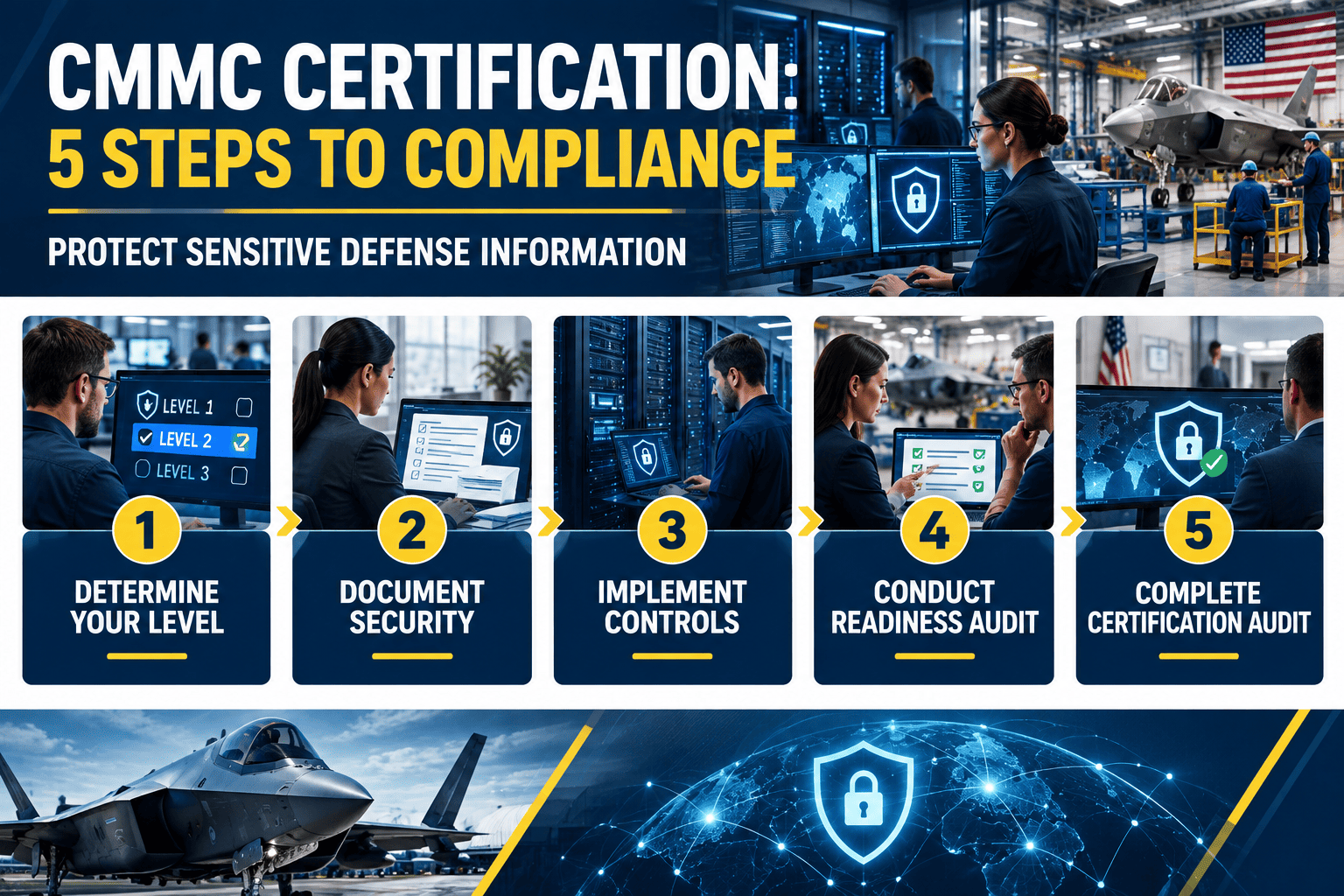
Direct Answer: CMMC (Cybersecurity Maturity Model Certification) is a U.S. Department of Defense (DoD) program that certifies Defense Industrial Base (DIB) contractors meet specific cybersecurity standards to protect sensitive information. Getting certified involves a 5-step process: Preparation (determining your level, gap analysis, management support), Documentation (System Security Plan, POA&M, policies), Implementation (deploying NIST SP 800-171 controls, staff training), Internal Audit (readiness assessment to verify compliance), and Certification Audit (a formal assessment by a C3PAO for Levels 1 & 2 or the DoD for Level 3, followed by certificate issuance). The process typically takes 6–18 months, with costs ranging from $30,000–$100,000+ for a Level 2 assessment. This guide walks you through every step, with practical tips for a smooth certification journey for defense contractors.
📅 May 5, 2026⏱ 16 min read✍️ GT Setu Editorial Team🔄 Updated regularly
80K+
DIB Contractors Requiring Assessment
3
CMMC 2.0 Compliance Levels
6–18
Months (Typical Timeline)
0%
GTsetu Broker Commission
The Cybersecurity Maturity Model Certification (CMMC) is a U.S. Department of Defense (DoD) program that applies to Defense Industrial Base (DIB) contractors. It is a unifying standard and certification framework to ensure that DoD contractors properly protect sensitive information, specifically Federal Contract Information (FCI) and Controlled Unclassified Information (CUI). Administered by the Office of the Under Secretary of Defense for Acquisition and Sustainment (OUSD(A&S)), CMMC is the DoD’s response to increasingly frequent and complex cyberattacks targeting the defense supply chain.
For manufacturers, distributors, and industrial companies that work with the DoD, CMMC certification is now a mandatory requirement. It signals that your organization has implemented robust cybersecurity controls, risk management, and incident response processes to protect national security information. This guide covers the complete certification process, from initial preparation through to the final C3PAO assessment, and provides practical, actionable advice for a smooth journey. See our related guides on ISO 22301 business continuity and ISO 27001 information security to understand how CMMC integrates with other management systems.
🛡️ Who Is This Guide For?
This guide is written for CISO, IT managers, compliance officers, quality managers, and anyone responsible for implementing or maintaining CMMC compliance in their organization. It covers both the DIY approach (using templates and internal resources) and the consultant-led route. It is equally relevant for prime contractors, subcontractors, and SMEs seeking certification to bid on DoD contracts. For related partnership structures, see our guides on cross-border manufacturing partnerships and manufacturing certifications for international trade.
SECTION 1
1 What Is CMMC & Why Get Certified?
🛡️ The Framework Explained
CMMC is a certification framework developed by the U.S. Department of Defense to ensure that its contractors and subcontractors in the Defense Industrial Base (DIB) adequately protect Federal Contract Information (FCI) and Controlled Unclassified Information (CUI). It combines various cybersecurity standards and best practices, primarily based on NIST SP 800-171, and evaluates the maturity of cybersecurity processes across organizations. The framework has three key features: a tiered model with progressively advanced levels, an assessment requirement to verify implementation, and implementation through contracts. Certification is awarded only after a formal assessment by an authorized third party (C3PAO) or the DoD, depending on the level of certification. As of 2025, CMMC is mandatory for all entities doing business with the DoD who store, transmit, or process FCI or CUI.
🏛️
Mandatory for DoD Contracts
CMMC certification is now a condition of contract award for all new DoD solicitations and contracts. Without it, contractors cannot bid on or win work that involves FCI or CUI.
🛡️
Protects National Security
The framework ensures that sensitive government data is protected from cyber threats, especially from nation-state actors and advanced persistent threats (APTs).
🤝
Builds Supply Chain Trust
Compliance builds confidence within the defense supply chain. Prime contractors and government agencies are more likely to trust and collaborate with vendors that maintain cybersecurity standards.
📈
Competitive Advantage
Achieving compliance sets your company apart from competitors. Many defense contractors prefer to work only with compliant businesses, giving you a clear edge in winning contracts.
SECTION 2
2 Key Benefits of CMMC Certification
CMMC certification delivers tangible benefits across operational, commercial, and regulatory dimensions. For defense contractors, CMMC is not just a certification, it is a license to operate and a foundation for business success in the defense sector.
100%
Eligibility for DoD contracts requiring CMMC compliance
50%
Reduction in cyber insurance premiums reported by compliant organizations
90%
Reduction in risk of data breaches and unauthorized access with implemented controls
🏷️
Eligibility for DoD Contracts
To participate in DoD contracts, cybersecurity compliance is mandatory. Without meeting these requirements, businesses cannot bid on or win contracts with the U.S. Department of Defense.
Commercial
🛡️
Stronger Cybersecurity Posture
Compliance strengthens your organization’s defense against cyber threats by enforcing policies that protect Controlled Unclassified Information (CUI) and Federal Contract Information (FCI), reducing exposure to costly incidents.
Security
🔗
Supply Chain Trust
Compliance builds confidence within the defense supply chain. Prime contractors and government agencies are more likely to trust and collaborate with vendors that maintain cybersecurity standards.
Partnership
📊
Improved Reputation
Being compliant with cybersecurity standards signals that your company is serious about protecting data and maintaining ethical business practices, increasing credibility with clients and partners.
Reputation
⚖️
Regulatory Compliance
By aligning your systems with frameworks like NIST SP 800-171 and CMMC, your business is prepared to meet both current and future regulatory requirements, avoiding potential disqualifications or penalties.
Compliance
📉
Risk Reduction
Implementing cybersecurity controls helps mitigate risks such as data theft, system breaches, financial loss, and legal liabilities. It lowers the likelihood of costly incidents that could damage your operations or reputation.
Risk
SECTION 3
3 CMMC 2.0 Levels Explained
The CMMC 2.0 framework streamlines requirements into three levels of cybersecurity – Foundational, Advanced, and Expert – and aligns the requirements at each level with well-known and widely accepted NIST cybersecurity standards. Understanding which level applies to your organization is the critical first step.
CMMC LevelApplicabilityAssessment
Level 1 (Foundational)
✓ Companies with FCI only
✓ Annual self-assessment
Level 2 (Advanced)
✓ Companies with CUI
✓ Triennial C3PAO assessment
Level 3 (Expert)
✓ Highest-priority CUI programs
✓ Triennial DoD assessment
💡 The Three Levels in Detail
CMMC Level 1 (Foundational): Includes basic cybersecurity appropriate for small companies using a subset of universally accepted common practices. It requires 17 basic safeguarding practices based on FAR 52.204-21. Level 1 is now a self-assessment only.
CMMC Level 2 (Advanced): For contractors that handle CUI. It requires the 110 practices from NIST SP 800-171. “Critical” handlers of CUI will need a third-party assessment by a C3PAO for certification every three years. Level 2 processes must be documented and managed to protect CUI.
CMMC Level 3 (Expert): For organizations with the highest-priority programs with CUI. It adds additional requirements pulled from NIST 800-172 in addition to the Level 2 requirements. Organizations will be required to be assessed by the DoD directly every three years for Level 3 requirements.
SECTION 4
4 Step 1: Preparation, Foundation & Planning
🏗️ Building the Foundation
The preparation phase sets the foundation for your entire CMMC certification project. The goal is to ensure you have the knowledge, resources, and support in place before beginning the detailed work of documentation and implementation. This phase typically takes 4–8 weeks for a small organization, longer for larger or more complex operations.
1.1
Determine Your CMMC Level
Identify whether your organization handles FCI, CUI, or both. Level 1 is for contractors and subcontractors processing FCI. Level 2 is for organizations processing CUI. Only organizations working on the DoD’s most sensitive programs will be expected to achieve Level 3 certification. This determines the scope of your compliance efforts.
1.2
Secure Executive Support
Top management commitment is critical. They must “walk the talk” by allocating resources, supporting the project, and communicating its importance. Provide executives with a concise overview of CMMC’s role in the business and the benefits certification will deliver, including market access and risk reduction. For related legal considerations, see our guide on risk allocation in cross-border deals.
1.3
Define Your CMMC Goals & Scope
Define the specific operational and commercial benefits you want from certification (e.g., DoD contract eligibility, improved security posture). Clearly define the scope of your CMMC system: which business units, locations, and systems will be included? You can exclude certain areas, but consider the pros and cons of limiting the scope. See our guide on partnership evaluation criteria for a framework that also applies to scope definition.
1.4
Conduct a Gap Analysis
Assess how compliant your organization already is with the required NIST SP 800-171 controls and identify gaps. This helps you prioritize efforts and create a more accurate project plan. You can do this internally or with a consultant. A thorough gap analysis should cover all 14 control families and 110 practices for Level 2.
1.5
Create a Simple Project Plan
Plan your implementation steps, milestones, target dates, and responsibilities. For small and medium organizations, avoid complex Gantt charts; focus on a clear, simple plan that everyone understands. Define who will be the CMMC point person (CISO or Compliance Manager) responsible for achieving and maintaining certification.
1.6
Generate Employee Awareness
Inform your staff about the CMMC project early to prevent rumors and build engagement. Explain how certification benefits the company and individual employees, addressing concerns about job security and work processes. This creates buy-in and transforms staff into stakeholders in the project’s success.
💡 Pro Tip: Start with a Readiness Assessment
Before diving into documentation and implementation, consider a formal readiness assessment with a C3PAO. This provides an independent evaluation of your current cybersecurity posture against CMMC requirements and helps you develop a realistic roadmap for compliance. This is a critical step for avoiding costly surprises during the formal assessment. For international business development, see our guide on international business development consulting.
SECTION 5
5 Step 2: Documentation, Building Your SSP
Documentation is often considered the most challenging phase of CMMC certification. It requires aligning documents with the standard’s technical requirements while tailoring them to your company’s unique context and needs. The goal is to create a documentation set that is useful, practical, and compliant, not a bureaucratic burden. CMMC documentation is critical for demonstrating control over your cybersecurity environment and ensuring auditability.
Document Type
Description
Key Consideration
System Security Plan (SSP)
The central document of your CMMC program. It outlines the system boundary, describes the system environment, and details how each NIST SP 800-171 control is implemented.
For each control, the SSP must explain how it’s met, who is responsible, and what evidence exists. This is the primary document reviewed by assessors.
Plan of Action & Milestones (POA&M)
A document that identifies any controls that are not yet fully implemented and outlines the plan, timeline, and milestones for achieving them.
A POA&M is required for a CMMC assessment. It allows you to receive a conditional certification if a small number of controls are not yet fully met.
Cybersecurity Policies
Formal, approved statements that define the organization’s approach to cybersecurity, covering areas like access control, incident response, and risk management.
Policies must be approved by management, communicated to staff, and reviewed at planned intervals.
Network & Data Flow Diagrams
Visual representations of your network architecture and how FCI/CUI flows through your systems.
These diagrams are critical for defining the scope of your CMMC assessment and are reviewed in detail by assessors.
Asset Inventory
A comprehensive list of all hardware, software, and data assets that are in scope for the CMMC assessment.
Maintaining an accurate asset inventory is a requirement of NIST SP 800-171 and a key input for scoping the assessment.
Incident Response Plan
A documented plan detailing how the organization will detect, respond to, and recover from cybersecurity incidents.
The plan must be tested and updated regularly. Incident response is a key domain in the CMMC framework.
Configuration Management Plan
A document that establishes and maintains the baseline configurations of your systems and manages changes to them.
Configuration management is essential for ensuring the security of your systems and is a control family in NIST SP 800-171.
Training Records
Documentation of all security awareness and role-based training provided to personnel.
All personnel must be trained on cybersecurity principles and their specific responsibilities. Training must be documented and tracked.
Audit Logs & Records
System logs that record user activity, system events, and security incidents. These logs must be retained and protected.
NIST SP 800-171 requires the creation, protection, and retention of audit logs. These are critical evidence of control implementation.
💡 Documentation Best Practices
DO: Look for the simplest way to meet a requirement and adapt it to your business. Use your company’s vernacular and avoid “CMMC language.” Use diagrams and illustrations rather than long-winded text. Use a visually appealing and easy-to-understand layout. Integrate your CMMC documentation with existing policies and procedures where possible.
DON’T: Include time-consuming references to other documents. Include bureaucratic requirements that are not suitable for your company’s circumstances or culture. Create documents that don’t add value to your operations.
Consider using documentation templates, pre-written documents designed to be tailored to your company’s needs. They save time, reduce errors, and provide a reliable starting point. This approach is also effective when drafting Master Services Agreements (MSAs) or managing contracts with international wholesale distributors.
SECTION 6
6 Step 3: Implementation, Deploying Controls
Implementation is where your carefully designed CMMC program becomes a reality. This phase involves deploying the required NIST SP 800-171 controls across your organization, training staff, and integrating cybersecurity into daily operations. The goal is seamless integration into daily IT operations, supported by a compelling incentive for adopting the new processes.
📢
Implement Technical Controls
Deploy technical security controls such as multi-factor authentication (MFA), access control lists (ACLs), encryption, and endpoint protection. These are foundational for protecting CUI and FCI. Many organizations leverage cloud service providers like AWS to inherit controls and simplify compliance.
Technical
🎓
Provide Security Awareness Training
All personnel must be trained on cybersecurity principles, their roles in protecting CUI, and how to identify and report security incidents. Training should be documented, and competency should be assessed. This is a mandatory requirement of NIST SP 800-171.
Training
📋
Implement Process Controls
Implement non-technical and process-based controls, such as an incident response plan, configuration management process, and risk assessment program. These processes must be documented and followed consistently.
Process
🔄
Execute and Manage Controls
Ensure all controls are not just implemented but also operating effectively. This includes monitoring system logs, managing user access, and regularly reviewing security configurations.
Operations
✍️
Maintain Evidence & Records
For each control, maintain evidence that demonstrates it is implemented and effective. This includes system screenshots, log files, policy documents, and training records. This evidence will be the focus of the C3PAO assessment.
Documentation
📁
Implement Risk Management
Establish a formal risk assessment and management process. Periodically assess risks to your CUI, implement mitigation strategies, and monitor their effectiveness.
Compliance
📣
Prepare for Assessment
Conduct mock assessments to prepare for the C3PAO audit. Ensure that all documentation is complete, personnel are trained, and controls are operating effectively. Address any gaps identified during mock assessments.
Readiness
SECTION 7
7 Step 4: Internal Audit, Readiness Assessment
🔍 Verifying Your CMMC Compliance
Internal audits (also called readiness assessments) are a critical step in ensuring the effectiveness of your CMMC program. These self-inspections involve observing work processes, interviewing management and staff, and examining records. The objective is to verify compliance not only with CMMC requirements but also with your own policies and procedures. Internal audits must be conducted before seeking certification. They can be performed by trained internal staff or outsourced to expert consultants. For related legal considerations, see our guide on material breach.
📋
Set Up the Audit Program
Develop an audit schedule and methods for planning and preparing your audits. Create documents, forms, and checklists that support the audit process. Consider using a certified assessor to conduct a mock audit.
👤
Appoint Qualified Auditors
Small businesses often rely on their CISO, IT manager, or compliance officer. Larger companies may form an audit team. Auditors should be objective and impartial, they cannot audit their own work. Being an auditor is typically an additional responsibility, not a full-time role.
🎓
Provide Auditor Training
Auditors must be familiar with the CMMC framework and NIST SP 800-171 controls, possess strong auditing skills, be capable of reporting findings and following up on corrective actions, and ideally, promote best practices and add operational value. Consider formal assessor training for your team.
🔄
Start Audits Early
Use internal audits as training tools to support implementation. You can start auditing during Step 3, focusing on specific controls or domains initially, and expanding the scope as the system matures. This early start helps identify and fix issues before the formal certification audit.
✅
Conduct a Complete Internal Audit
To be eligible for CMMC certification, you must complete a comprehensive internal audit covering your entire CMMC scope. The audit can be divided into multiple partial audits, focusing on specific control families at a time. Address all identified nonconformities before proceeding to the certification audit.
📄
Outsource If Needed
If you lack internal audit expertise, you can outsource the pre-certification internal audit to experienced auditors. This ensures that all issues with your CMMC program are identified and addressed, increasing confidence in passing the certification audit.
💡 Internal Audit as a Management Tool
Many organizations view internal audits purely as a certification requirement, but they are a powerful management tool. Use them to identify process improvements, uncover hidden inefficiencies, and engage employees in cybersecurity thinking. A well-conducted internal audit provides valuable insights that go far beyond compliance. This same principle applies to commercial due diligence and other business assessments.
SECTION 8
8 Step 5: Certification Audit, C3PAO Assessment
The certification audit is the final step in obtaining CMMC certification. It is conducted by an independent, third-party assessor from a C3PAO (for Levels 1 & 2) or by the DoD (for Level 3). The audit is similar to your internal audits but with a regulated scope and number of audit days. Successful completion results in the issuance of your CMMC certificate, valid for three years.
Audit Stage
What Happens
Key Focus
Pre-Assessment (Readiness)
The C3PAO reviews your SSP, POA&M, and other documentation and may conduct a high-level review of your environment to ensure you are ready for the formal assessment.
Completeness and adequacy of documentation. Identification of any major gaps that must be addressed before the formal assessment.
Formal Assessment (On-Site or Virtual)
The C3PAO conducts a thorough assessment of your implementation of the required controls. They will interview employees, observe processes, and review records and system configurations.
Effective implementation of the controls. Evidence that policies are being followed and that the system is achieving its objectives. Verification that pre-assessment nonconformities have been addressed.
Assessment Report & Decision
Following the assessment, the C3PAO prepares a report detailing findings. If no major nonconformities are found, or if corrective actions are successfully implemented, the C3PAO issues your CMMC certificate.
Overall conformity assessment. The certificate is valid for three years from the date of issue.
Annual Affirmations
During the three-year certificate validity period, you must annually affirm your continued compliance with CMMC requirements.
Ongoing compliance. The affirmation is a signed statement that your organization remains compliant.
Recertification Audit
After three years, you must undergo a recertification audit to renew your certificate. This is typically a comprehensive audit similar to the initial assessment.
Full system re-assessment. You must demonstrate that your CMMC program remains effective and has evolved to meet changing requirements.
💡 Preparing for the Certification Audit
Prepare your organization and staff: Ensure all documentation is current and retrievable. Staff should be prepared for the assessor’s questions and should answer truthfully. Conduct mock assessments to identify and address any gaps. Ensure all evidence for controls is easily accessible.
Select your C3PAO: Choose a C3PAO authorized by the Cyber AB. Compare quotes, check their reputation, and ensure they have experience in your industry. See our guide on due diligence for a framework that also applies to C3PAO selection. This is a critical partnership, much like evaluating any cross-border business partnership.
SECTION 9
9 Costs & Timeline: What to Expect
The cost and timeline for CMMC certification vary significantly based on target level, company size, complexity, existing cybersecurity maturity, and the C3PAO. Understanding these variables upfront helps in planning and budget setting.
More employees, systems, and locations increase the scope and cost of the assessment
Larger, more complex organizations require more time for implementation and assessment
Current Cybersecurity Maturity
Organizations with a mature security posture require less investment in technology and consulting
A mature posture can significantly shorten the timeline
Technology Solutions
Costs for MFA, endpoint protection, SIEM, and other tools can add $10,000–$50,000+
Procurement and deployment of technology can be a long lead-time item
Consultant Involvement
Full consultant support: adds $20,000–$100,000+ to cost; DIY with templates: lower cost
Consultant can accelerate timeline by providing expertise and templates
C3PAO Assessment Fee
The C3PAO’s fee for the formal assessment is a significant cost component for Level 2
Scheduling the assessment with a C3PAO can be a bottleneck due to high demand
📋 Leveraging Cloud & Managed Services
Many organizations reduce the cost and complexity of CMMC compliance by leveraging cloud service providers (CSPs) like AWS, Azure, and Google Cloud. These providers offer environments that are already compliant with FedRAMP and other federal frameworks, allowing you to inherit a significant number of security controls. This can dramatically reduce the scope of your own compliance efforts. When evaluating such options, use the same commercial due diligence you would apply to any B2B engagement.
SECTION 10
10 How to Choose a C3PAO
Choosing the right C3PAO is a critical decision that affects the cost, timeline, and success of your certification. A C3PAO is authorized by the Cyber AB to conduct CMMC assessments. The selection process should mirror the rigor you would apply when choosing any business partner. For a broader framework, see our guide on partnership evaluation criteria.
🏛️
Authorization & Accreditation
Ensure the C3PAO is authorized by the Cyber AB. This is a non-negotiable requirement. Verify their status on the Cyber AB website.
🏭
Industry Experience
Choose a C3PAO with assessors who have experience in your specific industry and with federal compliance frameworks like FedRAMP and NIST. They will understand your processes and risks, leading to a more relevant and valuable assessment.
📋
Quality & Reputation
Look for a C3PAO with a reputation for high-quality, thorough assessments. They should provide detailed feedback that helps you improve your security posture, not just check boxes.
💰
Cost & Value
Compare quotes from multiple C3PAOs. The cheapest option is not always the best, consider the value of the assessment, the assessor’s expertise, and the C3PAO’s reputation. Ensure you understand what is included in the quoted fee.
⚙️
Efficiency & Technology
Look for a C3PAO that uses technology to streamline the assessment process. This can accelerate the process and minimize disruptions to your business.
⏱️
Timing & Availability
With a limited number of C3PAOs and high demand, scheduling can be a challenge. Inquire about their availability and lead times. Early engagement is key to avoiding delays.
💡 C3PAO Selection Checklist
When evaluating C3PAOs, ask: Are you authorized by the Cyber AB? Do you have assessors with experience in my industry? What is your assessment process and how many days do you typically allocate? What is included in your fee and are there additional costs? How do you handle nonconformities and what is the process for issuing the certificate? Can you provide references from clients in my industry? How do you conduct annual affirmations? Use this information alongside your global market research to make an informed decision. This is a critical partnership, much like evaluating a business development consultant.
SECTION 11
11 Common Mistakes & How to Avoid Them
📋
Underestimating the Scope
Failing to accurately define the scope of the CMMC assessment, leading to missed controls and a failed audit. The scope must include all systems that process, store, or transmit CUI.
Avoid: Work with a qualified consultant or C3PAO to define your assessment boundary accurately. Create detailed network and data flow diagrams.
🏛️
Lack of Management Commitment
When leadership does not actively support the CMMC program, it becomes a compliance exercise for IT rather than a strategic initiative, leading to poor implementation and audit failures.
Avoid: Secure top management commitment from the start. Ensure they understand the business case for certification and communicate their support visibly to the organization.
📖
Treating it as an IT Project Only
CMMC is a business-wide initiative, not just an IT project. It requires involvement from legal, HR, operations, and all other departments that handle CUI.
Avoid: Establish a cross-functional CMMC team with a senior sponsor. Communicate the importance of compliance to the entire organization.
🔄
Treating Certification as the End Goal
Focusing solely on passing the audit rather than building a sustainable cybersecurity program. This leads to a system that is maintained only for the assessor, not for actual security.
Avoid: Design your CMMC program to solve real security problems. Use internal audits and continuous monitoring for genuine improvement, not just audit readiness.
🎓
Inadequate Staff Training
Employees who do not understand their cybersecurity responsibilities will not follow policies consistently, leading to nonconformities and audit findings.
Avoid: Invest in training at all levels. Explain the “why” behind the policies. Make training engaging and relevant to employees’ daily work. Consider using MSA principles for structured training programmes.
📊
Ignoring the POA&M
Failing to properly document and manage the Plan of Action & Milestones, which is a critical document for a successful assessment and for managing any remaining gaps.
Avoid: Treat your POA&M as a living document. Update it regularly and ensure all milestones are met on time. Address all findings promptly. See our guide on material breach for related risk management.
SECTION 12
12 How GTsetu Supports Your CMMC Certification Journey
🔗 GTsetu, Verified B2B Platform
Connect with Verified Partners & Build a Resilient Supply Chain
CMMC certification is a powerful tool for demonstrating cybersecurity maturity to the DoD and prime contractors. GTsetu complements your certification by connecting you with verified manufacturers, distributors, and suppliers who meet rigorous quality and security standards. Our platform provides:
✅
Verified Company Profiles
Every company on GTsetu is verified on 6 key data points (Name, Address, Registration Number, Company Status, Company Type, Date of Incorporation) using government tie-ups, complementing your CMMC due diligence.
🕵️
Anonymous Discovery
Browse verified partner profiles without revealing your identity until you’re ready to engage, protecting your sourcing strategy and commercial confidentiality.
📄
Built-In NDA Workflow
Digital mutual NDA with timestamped signatures, activated before any sensitive commercial or technical data is exchanged, supporting your IP protection and confidentiality commitments under CMMC.
🔐
Encrypted Document Workspace
AES-256 encryption at rest, TLS in transit, role-based access controls, and full audit trail, ensuring the secure exchange of controlled unclassified information with partners.
🚫
Zero Broker Commission
GTsetu charges zero commission on any partnership formed. All commercial value stays between you and your verified partner, supporting the cost management objectives of your compliance program.
🌏
Global Network of Verified Partners
Access verified manufacturers, distributors, and suppliers across 100+ countries, supporting your supply chain resilience objectives and enabling you to build a network of CMMC-aligned partners.
QWhat is CMMC certification and why is it important?
CMMC (Cybersecurity Maturity Model Certification) is a U.S. Department of Defense (DoD) program that applies to Defense Industrial Base (DIB) contractors. It is a unifying standard and certification framework to ensure that DoD contractors properly protect sensitive information, specifically Federal Contract Information (FCI) and Controlled Unclassified Information (CUI). Certification is mandatory to bid on or win certain DoD contracts, ensuring your company is recognized as a secure and reliable vendor that meets the federal government’s cybersecurity standards. For related legal considerations, see our guide on warranty clauses.
QWhat are the 5 main steps to get CMMC certified?
The 5 main steps are: (1) Preparation, determine your CMMC level, conduct a gap analysis, and secure management support. (2) Documentation, create your System Security Plan (SSP), Plan of Action and Milestones (POA&M), and cybersecurity policies. (3) Implementation, implement the required NIST SP 800-171 controls and train staff. (4) Internal Audit, conduct a self-assessment or readiness assessment to verify compliance. (5) Certification Audit, undergo a formal assessment by a C3PAO (for Levels 1 & 2) or the DoD (for Level 3) and receive your certificate. This structured approach is similar to building any Master Services Agreement, start with a solid foundation and build methodically.
QHow long does it take to get CMMC certification?
The timeline varies by company size and readiness. For a small organization (under 50 employees) targeting Level 1 or 2, the process typically takes 6-9 months. Larger organizations (50-250 employees) usually take 9-18 months to implement the required controls and prepare for assessment. Large, complex organizations may take 18-24 months. The timeline includes preparation, documentation, implementation, internal audit, and the final C3PAO assessment. Using templates or digital tools can significantly reduce the time to certification.
QHow much does CMMC certification cost?
The cost varies significantly based on target level, company size, and current cybersecurity maturity. Costs include: gap analysis, technology solutions (e.g., cloud security, endpoint protection), consultant fees, and the C3PAO assessment fee. For a small to medium business, a readiness assessment may cost $10,000-$30,000, and the formal C3PAO assessment for Level 2 can range from $30,000 to $100,000+. Investment in CMMC is substantial but necessary for market access to DoD contracts. For related cost considerations, see our guide on consequential damages.
QWhat documents are required for CMMC certification?
Key required documents include: System Security Plan (SSP) which details how each NIST SP 800-171 control is implemented; Plan of Action and Milestones (POA&M) which outlines how and when any unimplemented controls will be met; Cybersecurity policies and procedures; network diagrams and data flow diagrams; asset inventory; incident response plan; and training records. All documentation must be detailed and demonstrate a mature and implemented cybersecurity program. Using templates can help ensure completeness and reduce the burden of starting from scratch, much like using an Asset Purchase Agreement template saves time in M&A transactions.
QWhat is the difference between CMMC Level 1, Level 2, and Level 3?
CMMC 2.0 has three levels: Level 1 (Foundational) applies to companies that handle only Federal Contract Information (FCI) and requires 17 basic safeguarding practices based on FAR 52.204-21; it is a self-assessment. Level 2 (Advanced) applies to companies that handle Controlled Unclassified Information (CUI) and requires 110 practices from NIST SP 800-171; it requires a third-party assessment by a C3PAO. Level 3 (Expert) is for the highest-priority programs with CUI, requiring a subset of NIST SP 800-172 controls and is assessed by government officials. The selection process should mirror the rigor you would apply when using partnership evaluation criteria to choose any business partner.
QHow do I choose a C3PAO for my CMMC assessment?
Choose a C3PAO that is authorized by the Cyber AB (the CMMC Accreditation Body). Evaluate their expertise in federal compliance frameworks (like FedRAMP, NIST), their quality of assessments, their use of technology to streamline the process, and their timing and availability. Since the number of C3PAOs is limited, it is important to start validating your readiness and selecting a C3PAO as early as possible. Look for a partner that provides thorough assessments and detailed feedback to help improve your cybersecurity posture. The selection process should mirror the rigor you would apply when using risk allocation frameworks for any business partnership.
Ready to Build a Secure & Resilient Supply Chain?
Connect with verified manufacturers, distributors, and suppliers on GTsetu, compliance-backed verification, anonymous discovery, built-in NDA workflows, and zero broker commissions. Find partners who share your commitment to security and quality.
They represents the product, and research team behind GTsetu, a global B2B collaboration platform built to help companies explore cross-border partnerships with clarity and trust. The team focuses on simplifying early-stage international business discovery by combining structured company profiles, verification-led access, and controlled collaboration workflows.
With a strong emphasis on trust, and disciplined engagement, Team GTsetu shares insights on global trade, partnerships, and cross-border collaboration, helping businesses make informed decisions before entering deeper commercial discussions.