Local Sourcing vs Global Sourcing: How to Choose the Right Strategy
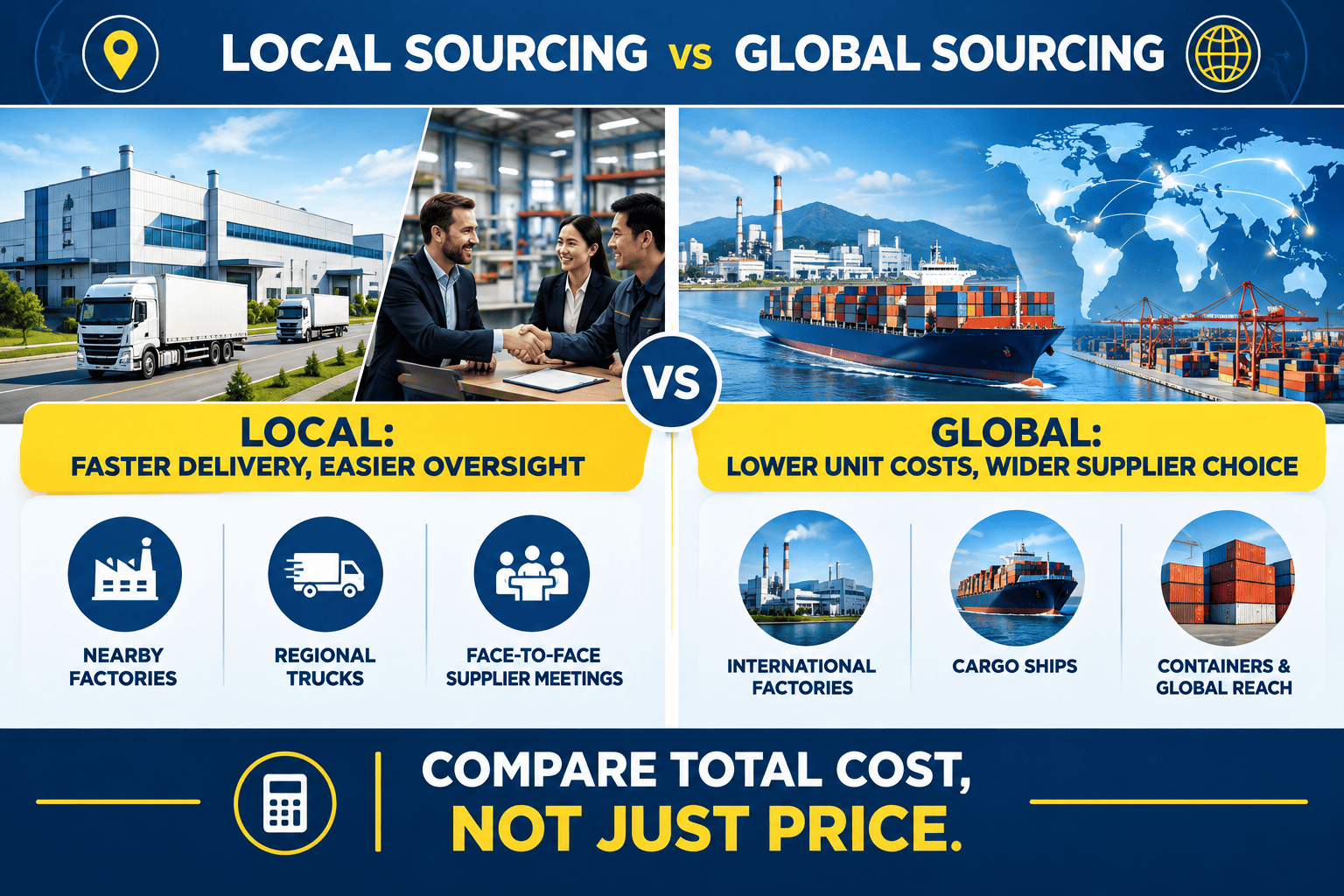
Direct Answer:Local sourcing buys from suppliers near your operations, usually in the same country or region, and typically gives you shorter lead times, easier quality oversight, lower logistics complexity and a smaller carbon footprint, at the price of higher unit costs and a narrower supplier pool. Global sourcing buys from suppliers beyond your borders and typically gives you lower unit costs, wider choice, scalability and access to specialised capabilities, but adds longer lead times, tariffs, logistics complexity, hidden costs and geopolitical exposure. Neither is always better. High-volume, standardised products often favour global sourcing, while perishable, customised or time-sensitive goods often favour local sourcing. Many companies now use a hybrid or nearshoring model, and decide using total cost of ownership rather than unit price. GTsetu helps you find government‑tie‑up verified suppliers, distributors and manufacturing partners across 100+ countries, with built-in NDA workflows and zero broker commission.
📅 Published October 14, 2026🔄 Updated October 14, 2026⏱ 17 min read✍️ GTsetu Editorial Team
70%
Of Surveyed CPG & Retail Firms Regionalising Suppliers
⅔
Of Surveyed Firms Keeping or Growing China Sourcing in 2025
81%
Say ESG Criteria Matter More in Supplier Selection
3
Models: Local, Global, Hybrid
Few procurement decisions shape cost, resilience and customer experience as much as where you buy from. Years after the worst pandemic disruptions, supply chains are still under pressure from conflict, rising costs, tariffs and shifting demand. That has pushed many procurement teams to ask a blunt question: should we source locally or globally?
The honest answer is that both approaches involve trade-offs in cost, efficiency, risk and environmental impact. This guide compares local sourcing vs global sourcing side by side, explains where nearshoring and hybrid models fit, gives you a step-by-step framework to decide, and shows how to verify suppliers and protect yourself contractually. For related context, see our guides on global market research for manufacturers, cross-border manufacturing partnerships and cross-border business partnerships.
💡 Who This Guide Is For
Procurement and sourcing managers, supply chain leaders, founders and SME owners deciding where to buy materials, components or finished goods, and suppliers or exporters who want to understand how buyers weigh local and global options.
⚖️ Disclaimer
This guide provides general commercial education based on publicly available industry sources, including NetSuite, Dragonsourcing and Infosys BPM. Survey figures are as reported by those publishers and change over time. Some sources are sourcing-service providers with their own commercial perspective, so test every claim against your own data. This is not legal, tax or financial advice.
SECTION 1
1 What Are Local Sourcing and Global Sourcing?
🎯 Definitions
Local sourcing is purchasing goods or services from suppliers geographically close to your operations, typically within the same country or region. Global sourcing is purchasing from suppliers located beyond your home country’s borders, usually in search of lower costs, specialised expertise and a broader choice of suppliers. Hybrid sourcing blends the two.
Global sourcing is common in manufacturing, mass retail and consumer electronics. Apple designs iPhones in the US but sources components from countries such as Japan, Taiwan and South Korea, and automakers build vehicles with globally sourced parts. Local sourcing is common where speed and regional control matter most, such as food service, fashion and parts of manufacturing. A restaurant buying produce from nearby farms, or an apparel brand partnering with regional textile mills, are typical examples.
It also helps to separate global sourcing from importing. Importing is the act of bringing goods into a country. Global sourcing is the wider strategy of finding and managing international suppliers to meet cost, quality and capacity goals.
SECTION 2
2 Local vs Global Sourcing at a Glance
Here are the six dimensions that matter most when you compare the two approaches. Each is explored in detail in the sections that follow.
1
Cost
Global often wins on unit price; local often wins on freight, duties and hidden costs. Compare total cost of ownership.
💰 TCO Matters
2
Lead Time
Local shrinks delivery windows from weeks to days, cutting safety stock. Global adds transit and customs time.
⏱ Speed
3
Quality Control
Proximity supports easier oversight and faster fixes. Distant suppliers need inspections and clearer specifications.
🔍 Oversight
4
Risk
Global exposes you to geopolitics, tariffs and logistics shocks. Local exposes you to regional events and concentration.
🛡️ Different Risks
5
Scale & Expertise
Global offers larger capacity and niche capabilities. Local may lack specialised skills or surge capacity.
📈 Capability
6
Sustainability
Shorter distances can cut transport emissions. Supplier practices matter as much as distance.
🌱 ESG
Factor
Local Sourcing
Global Sourcing
Unit cost
Often higher (labour, regulation, raw materials)
Often lower where labour and utilities are cheaper
Logistics & duties
Lower; no international freight, customs or tariffs
Higher; freight, duties, port fees, complexity
Lead time
Days, sometimes hours
Weeks, with more variability
Responsiveness
Fast communication and fixes
Time zones and distance slow problem-solving
Supplier choice
Limited local pool
Broad, competitive pool
Specialised expertise
May be unavailable locally
Access to regional centres of excellence
Scalability
May struggle with demand spikes
Larger capacity; shift orders across regions
Main risks
Regional disruption, concentration, cost
Geopolitics, tariffs, shipping shocks, IP exposure
Carbon footprint
Typically lower transport emissions
Typically higher transport emissions
✨ GTsetu Insight
The table shows tendencies, not rules. A well-run overseas supplier can beat a poorly managed local one, and the reverse is also true. What matters is how well you evaluate partners against clear criteria before you commit.
SECTION 3
3 Advantages of Global Sourcing
Despite disruption and geopolitical tension, companies have not retreated from global trade. NetSuite cites a QIMA survey of more than 650 companies in which two-thirds planned to maintain or expand business with Chinese suppliers in 2025, even amid tariff concerns. The reason is that the advantages often outweigh the risks.
💰
Cost Savings and Economies of Scale
Raw materials, labour and utilities can cost significantly less in places such as Vietnam, India or Mexico. Bulk purchasing also lowers per-unit costs and strengthens your bargaining position.
📈
Scalability
Instead of depending on one local supplier limited by capacity or labour, you can shift orders across regions with available resources and faster turnaround times.
🔬
Supplier Specialisation
Regions build deep expertise: Germany and Japan in precision engineering, South Korea and Taiwan in semiconductors. Global sourcing lets you tap capabilities that may be unavailable or too costly at home.
🌏
Market Access
International vendors can offer insight into local consumer preferences, regulations and pricing, helping you enter new markets more smoothly and build a wider brand presence.
🔀
Supply Chain Diversification
A multi-region supplier base reduces dependence on any one supplier or region, so a single flood, strike or policy change is less likely to halt production.
💡
Access to Innovation
Working with suppliers in innovation hubs supports collaboration, shared knowledge and co-development of new products and processes.
📌 Example: India as a Sourcing Base
India is one of several lower-cost, high-capability sourcing destinations. For a sector-by-sector view of what Indian manufacturers produce at scale, read which manufacturing is in demand in India.
SECTION 4
4 Disadvantages & Risks of Global Sourcing
NetSuite reports that one-third of companies worldwide expected supply chain disruptions to worsen in 2025, and that overall sourcing optimism was at its lowest level in four years according to the QIMA survey. These are the risks behind that caution.
🚢
Supply Chain Disruptions
Geopolitical tension, extreme weather, regulatory shifts and infrastructure breakdowns can make cross-border flows unpredictable, causing delays and higher costs.
🧩
Logistics Complexity
Evolving trade rules and long routes mean even a minor delay in one region can ripple through the network and cause missed deadlines.
🔓
Security and IP Exposure
Suppliers in regions with weaker oversight can increase the risk of data breaches, IP theft and unauthorised access to sensitive information.
🧾
Hidden Costs
Tariffs, exchange-rate swings, compliance costs, extra quality control and the overhead of managing distant suppliers can erode headline savings.
🗣️
Cultural and Language Gaps
Misaligned expectations can cause production delays, quality issues and strained supplier relationships.
📦
Longer Lead Times and Inventory Risk
Longer pipelines increase inventory risk and reduce responsiveness when demand shifts faster than replenishment cycles.
✨ GTsetu Insight
Most global sourcing failures are partner and contract failures rather than price failures. Our guide on risk allocation in cross-border deals explains how to decide who carries which risk before something goes wrong. If you export to the EU, also consider the carbon-cost implications covered in our CBAM guide for Indian manufacturers.
SECTION 5
5 Advantages of Local Sourcing
With global supply chains vulnerable to delays, many companies are turning to nearby suppliers. NetSuite cites a Capgemini survey of more than 300 consumer product and retail organisations in which 70% were regionalising and localising their supplier bases, and a 2025 survey in which 85% of American automotive manufacturers planned to do more business with North American suppliers through 2026.
1
Lower Logistics Costs
No international freight, customs duties, tariffs or port fees, plus simpler coordination and lower warehousing costs thanks to shorter delivery and storage timelines.
Freight, duties, storage
2
Faster Transit Times
Delivery windows shrink from weeks to days or hours, so you can replenish quickly and hold less safety stock. This is vital in food and beverage.
Just-in-time delivery
3
Greater Responsiveness
Closer suppliers mean faster communication, easier collaboration and quick fixes, such as a replacement part within a day.
Agility in fast-moving sectors
4
Better Quality Oversight
Proximity allows closer oversight of production processes and supplier performance, and quicker corrective action.
Site visits, audits
5
Support for Local Economies
NetSuite cites a 2024 Supplier.io study finding each dollar paid to a local supplier generated an additional $1.80 of economic activity.
Community and brand value
6
Lower Environmental Impact
Shorter transport distances reduce emissions and can support sustainability goals and consumer expectations.
Transport emissions
SECTION 6
6 Disadvantages of Local Sourcing
Local sourcing is not a free lunch, especially amid inflation, labour shortages and regional disruptions. Infosys BPM also notes that localisation is often presented as risk reduction without enough attention to its structural limits.
✅ What Local Does Well
✅Speed: shorter lead times and faster replenishment.
✅Control: easier audits, communication and issue resolution.
✅Simplicity: fewer customs, tariff and currency complications.
✅Freshness: ideal for perishable and time-sensitive goods.
⚠️ Where Local Struggles
⚠️Higher production costs: labour, regulatory and raw material costs can be higher, making it hard to compete with globally sourced rivals.
⚠️Expertise gaps: local suppliers may lack specialised skills, technology or capacity.
⚠️Less competition: a small supplier pool can mean higher prices and slower innovation.
⚠️Regional disruption: floods, strikes or political instability can still halt a concentrated local supply base.
⚠️Scaling limits: sudden demand spikes can cause stockouts or force costly buffer stock.
📌 The Concentration Trap
Local sourcing may be immune to global shocks, but depending on too few local suppliers simply swaps one concentration risk for another. Whether you source locally or globally, the aim is to avoid over-reliance on any single source or region.
SECTION 7
7 Nearshoring & Hybrid Sourcing
🎯 The Middle Ground
Nearshoring relocates parts of the supply chain to geographically closer countries or regions. It keeps some of the cost advantage of global sourcing while shortening shipping distances and lead times. A hybrid (or “glocal”) model blends the scale and specialisation of international suppliers with the speed and agility of nearby partners.
Infosys BPM describes nearshoring as a practical middle ground: relatively lower labour costs than fully local sourcing, shorter delivery cycles than distant sourcing, and better supplier collaboration thanks to proximity. It also helps diversification by moving production closer to end markets. The trade-offs are that nearby supplier ecosystems may be smaller or less specialised, infrastructure varies, and cost savings are often lower than those from distant low-cost regions.
NetSuite cites a QIMA report that nearly half of US businesses planned to increase nearshoring in 2025, with many shifting from China to Mexico to sidestep tariffs. Apple has moved some iPhone production from China to India and Vietnam, and many textile companies have widened sourcing from China to countries such as Bangladesh and Vietnam. Nearshoring to Central Europe is also common for industrial products. For one example of cross-border industrial expansion, see our guide on how to expand a manufacturing and industrial automation business in the Czech Republic.
FeatureLocalNearshoreGlobalHybrid
Unit cost
Higher
Moderate
Lowest
Balanced
Lead time
Shortest
Short
Longest
Varies
Specialised capability
Limited
Moderate
Broadest
Broad
Geopolitical exposure
Low
Medium
High
Managed
Management complexity
Low
Medium
High
High
✨ GTsetu Insight
A hybrid model multiplies the number of supplier relationships you must vet and manage. That is exactly where a verified network helps. If you also want advisory support on entering new supplier markets, read our guide on international business development consulting.
SECTION 8
8 Sourcing Trends Shaping the Decision
Diversify
Companies are reducing overreliance on any one source or region, global or domestic
Glocalise
Blending global scale with the responsiveness of nearby markets
81%
Of respondents in a Thomson Reuters survey cited by NetSuite said ESG criteria are increasingly important
AI
Used to forecast demand, optimise supplier selection and flag risks early
Supplier diversification: geopolitical tension, trade wars and natural disasters are pushing companies to spread risk across suppliers and regions.
Sustainability as a must-have: consumers, investors and regulators expect low-emission, fair-labour suppliers. Continuity planning is part of resilience too. See how to get ISO 22301 certification for business continuity management.
Digital visibility: analytics and real-time supply chain visibility tools let procurement teams detect disruptions early and switch suppliers faster.
There is no one-size-fits-all answer. The best option depends on product characteristics, demand patterns, supplier availability and your risk tolerance. Use this six-step framework.
1
Define Your Business Objectives
Are you cutting costs, speeding time to market, improving quality or building resilience? A fast-scaling start-up may prioritise affordability, while a premium brand may value tight quality control.
2
Evaluate Product and Service Requirements
Highly specialised components may need global expertise. Perishables benefit from local partners that can deliver quickly. Research the supplier landscape first with global market research.
3
Compare Total Cost of Ownership
Look beyond the sticker price to shipping, import duties, inventory holding, compliance, quality inspection and management overhead. Hidden costs often decide the real winner.
4
Assess Your Risk Exposure
Map vulnerabilities from natural disasters, political instability and regulatory change. Build contingency plans and a diversified supplier base. Run commercial due diligence on shortlisted suppliers.
Tap regional centres of excellence not available at home.
If you want
Lower cost with shorter lead times
Nearshore
A balance of moderate cost, faster delivery and easier collaboration.
If you want
Resilience plus efficiency
Hybrid
Global core suppliers backed by local or regional alternates.
📌 Selling, Not Just Buying
If you sell to buyers in other markets, they are running this same analysis on you. Showing short lead times, verified credentials and clear terms makes you a safer choice. For channel strategy, see our guide on international wholesale distributors.
SECTION 10
10 Contracts & Trade Terms for Cross-Border Sourcing
A sourcing strategy is only as strong as the paperwork behind it. Global sourcing in particular adds legal, customs and liability questions that local deals often avoid. These are the building blocks to get right.
Clause 01
Trade Terms
Define who pays for freight, insurance and risk transfer. Start with Incoterms 2020, and consider FCA (Free Carrier) as a practical option for many shipments.
Clause 02
Master Services Agreement
For ongoing supply relationships, a master services agreement (MSA) sets the framework, with individual orders layered beneath it.
Clause 03
Warranty
Specify quality standards, defect remedies and claim periods in a clear warranty clause. Distance makes vague quality terms costly.
If local sourcing is not enough and you decide to bring a critical supplier in-house, understand what an asset purchase agreement is before acquiring a supplier’s assets. Vertical integration is a sourcing choice too.
SECTION 11
11 Finding & Verifying Suppliers
Whichever model you choose, the weakest link is usually supplier trust. Trade fairs, directories and cold outreach are slow and often unverified, and fake or misrepresented suppliers are a real risk in international sourcing.
🔍
Verify Identity First
Confirm legal name, registered address, registration number, company status, company type and incorporation date from official sources before you share anything.
📜
Check Certifications Directly
Ask for quality and compliance certificates and validate them with the issuing body. GTsetu does not verify these, so due diligence stays with you.
📄
Sign an NDA Early
Protect designs, specifications and pricing before detailed discussions, especially when sourcing across borders.
🧪
Start with a Pilot Order
Test quality, communication and delivery performance on a small order before committing volume.
🔀
Qualify a Backup
Keep at least one qualified alternate supplier, ideally in a different region, to avoid single-source dependence.
Your Verified Gateway to Local, Regional and Global Suppliers
Whether you source locally, globally or both, you need partners who are real, reachable and reliable. GTsetu connects buyers, manufacturers, distributors and technology partners with government‑tie‑up verified companies across 100+ countries, with built-in NDA workflows and encrypted collaboration. Every company on GTsetu is verified using direct government tie‑ups across six essential credentials: legal name, registered address, registration number, company status, company type, and date of certificate of incorporation. GTsetu does not verify industry certifications, product quality, delivery performance or financial standing; those must be exchanged and validated directly between partners.
✅
Government Tie‑Up Verification
6‑point verification: legal name, registered address, registration number, company status, company type, incorporation date.
📜
Certifications & Quality
GTsetu does not verify these. They must be exchanged directly between partners during due diligence.
🕵️
Anonymous Discovery
Explore verified supplier and partner profiles without revealing your identity until mutual interest is confirmed.
📄
Built-In NDA Workflow
Formalise confidentiality before sharing designs, specifications, pricing or proprietary information, with a full digital audit trail.
🚫
Zero Commission
No broker fees on any deal, whether a supply contract, distribution agreement or technology partnership.
🔐
Encrypted Collaboration
All documents and communications encrypted in transit and at rest. Secure B2B collaboration from first contact.
🌍
100+ Countries
Active verified network for distributors, manufacturers and supply chain partners.
QWhat is the difference between local sourcing and global sourcing?
Local sourcing means buying goods or services from suppliers near your operations, typically in the same country or region. Global sourcing means buying from suppliers beyond your home country’s borders. Local sourcing usually offers shorter lead times, easier oversight and lower logistics complexity, while global sourcing usually offers lower unit costs, wider supplier choice and access to specialised capabilities.
QIs global sourcing cheaper than local sourcing?
Global sourcing often has lower unit costs because labour, materials and utilities can cost less in some countries. However, tariffs, freight, currency swings, compliance, quality inspection, longer inventory holding and management overhead can erode those savings. Compare total cost of ownership rather than unit price alone.
QWhat are the main risks of global sourcing?
The main risks are supply chain disruptions, logistics complexity, longer lead times, tariffs and trade restrictions, hidden costs, intellectual property and data security exposure, and cultural or language misunderstandings. Supplier verification, clear contracts and diversification help reduce them.
QWhat are the main risks of local sourcing?
Local sourcing can mean higher production costs, a smaller supplier pool, limited access to specialised skills or technology, and exposure to regional disruptions such as floods, strikes or political instability. Local suppliers may also struggle to scale during sudden demand spikes.
QWhat is nearshoring and how does it fit between local and global sourcing?
Nearshoring moves parts of the supply chain to geographically closer countries or regions. It keeps some of the cost advantages of global sourcing while shortening shipping distances and lead times, which makes it a practical middle ground between fully local and fully global sourcing.
QWhat is a hybrid sourcing strategy?
A hybrid sourcing strategy blends global suppliers for cost, scale and specialised capabilities with local or regional suppliers for speed, flexibility and resilience. Many companies use it to balance efficiency against risk, often called glocalisation.
QHow do I choose between local and global sourcing?
Define your objectives, assess product requirements, compare total cost of ownership, map your risk exposure, factor in ESG goals, and monitor results continuously. High-volume standardised products often suit global sourcing, while perishable, customised or time-sensitive goods often suit local sourcing.
QHow can GTsetu help with global sourcing?
GTsetu helps buyers and suppliers find verified partners across 100+ countries. Companies are verified through government tie-ups on six credentials (legal name, registered address, registration number, company status, company type, incorporation date), with anonymous discovery, built-in NDA workflows, encrypted collaboration and zero broker commission.
Ready to Find Verified Suppliers Worldwide?
Join 500+ verified manufacturers, exporters, and importers already building cross-border partnerships on GTsetu, with government‑tie‑up verification of six core credentials, built-in NDA workflows, and zero broker fees across 100+ countries. Start building a resilient sourcing network today.
They represents the product, and research team behind GTsetu, a global B2B collaboration platform built to help companies explore cross-border partnerships with clarity and trust. The team focuses on simplifying early-stage international business discovery by combining structured company profiles, verification-led access, and controlled collaboration workflows.
With a strong emphasis on trust, and disciplined engagement, Team GTsetu shares insights on global trade, partnerships, and cross-border collaboration, helping businesses make informed decisions before entering deeper commercial discussions.