How to Prioritise Countries for International Business Expansion: A Scoring Framework (2026) | GTsetu
Home ›
Blog ›
Prioritise Countries for International Expansion
🧭 Global Trade & Strategy
How to Prioritise Countries for International Business Expansion
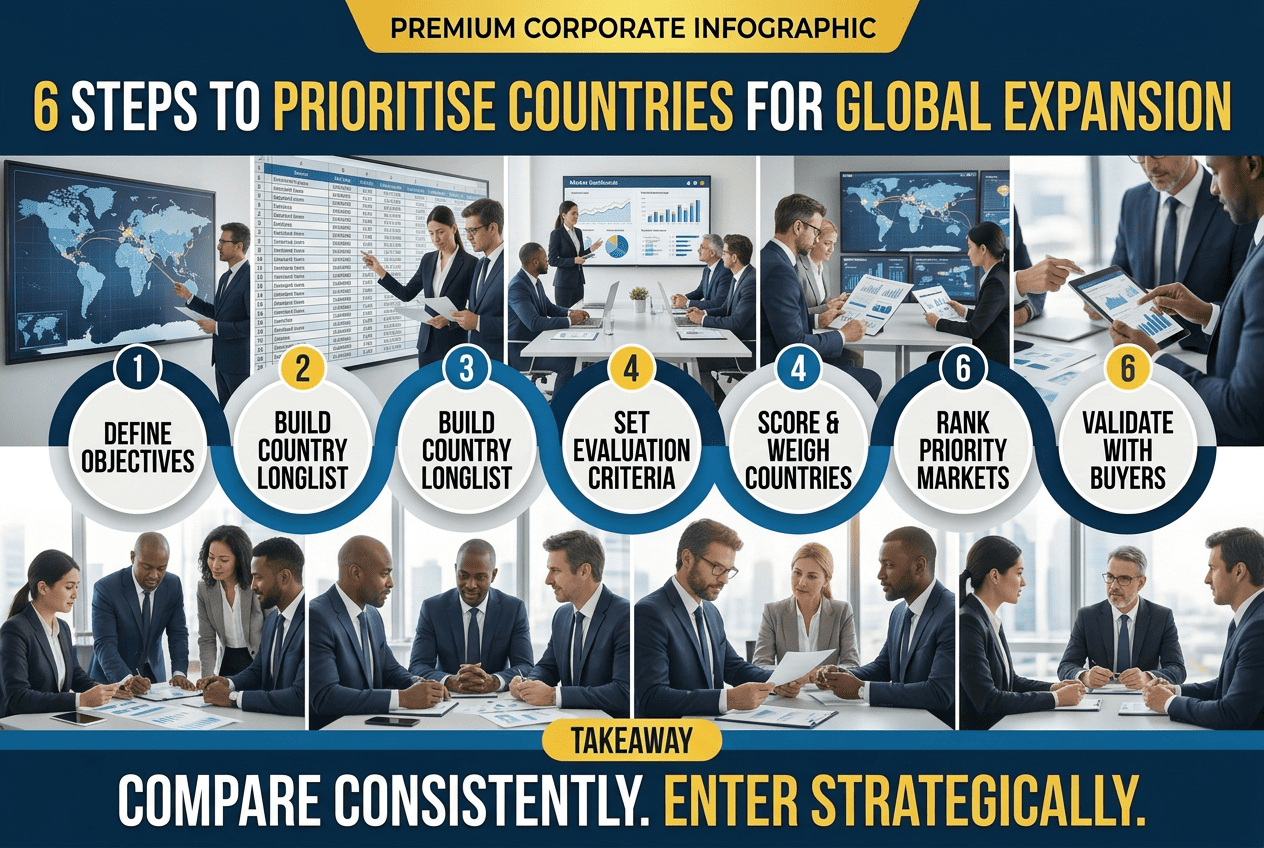
Direct Answer: To prioritise countries for international expansion, follow six steps. First, define your objectives and business model, because they set what “best” means. Second, build a longlist and remove poor fits with knock-out filters. Third, choose clear criteria: demand, competition, regulation, trade terms, logistics, risk, partner availability and cultural fit. Fourth, score each country with weights so the comparison is consistent. Fifth, group results into priority tiers and sequence your entry. Sixth, validate the top countries with real buyers, partners and quotes, then review the ranking regularly. GTsetu helps manufacturers find government‑tie‑up verified distributors and partners across 100+ countries, with anonymous discovery, built-in NDA workflows and zero broker commission.
📅 Published October 16, 2026🔄 Updated October 16, 2026⏱ 15 min read✍️ GTsetu Editorial Team
6
Prioritisation Steps
8
Scoring Criteria
100+
Countries on GTsetu
0%
Broker Commission
Most companies do not lack options for international growth. They lack a way to choose between them. A strong enquiry from one country, a trade-fair contact or a competitor’s move can pull a team towards a market that looks exciting but fits poorly. A structured approach replaces gut feel with a comparison you can defend, and revisit when facts change.
Founders, export managers and business development teams deciding where to expand next, and leaders who need to explain to a board or investors why one country comes before another.
⚖️ General Information Disclaimer
This guide provides general commercial education and does not constitute legal, tax, financial or regulatory advice. The scoring example uses hypothetical countries and numbers purely to show the method. Trade rules, tariffs, regulations and country risk change over time, so verify current facts with official sources and qualified advisers before committing.
SECTION 1
1 What Is Country Prioritisation?
🎯 Definition
Country prioritisation is the process of comparing candidate countries against the same criteria, ranking them by how well they fit your goals and resources, and deciding the order and depth of entry. It usually combines objectives, knock-out filters, weighted scoring, priority tiers and real-world validation.
Market research tells you what each country looks like. Prioritisation tells you what to do about it. A country can be large and attractive and still rank low for your company, because of certification burden, entrenched competitors, payment risk or a lack of credible partners.
SECTION 2
2 Why Prioritising Beats Spreading Thin
🎯
Focus Your Limited Team
A small export team supports a few markets well. Spread across many, partners get little attention and learning slows.
💸
Protect Cash
Certification, samples, travel and long payment cycles add up. Prioritising stops money flowing to low-return markets.
⚖️
Make Decisions Defensible
A written scoring model lets you explain choices to boards, investors and partners, and revisit them when facts change.
🔁
Learn Faster
Concentrated effort produces references and lessons you can reuse in the next country, instead of scattered, shallow results.
“Best country” has no meaning until you say best for what. A company seeking quick revenue ranks countries differently from one seeking low-cost production, strategic technology access or a long-term brand position.
1
Primary Goal
Revenue growth, margin, diversification away from one market, access to talent or technology, or supply-chain resilience.
One main goal, ranked
2
Business Model
Direct export, distributor-led, contract manufacturing, licensing or a local subsidiary each favour different country traits.
Model shapes weights
3
Resource Limits
Budget, team size, management time and production capacity decide how many countries you can serve well.
Be honest on capacity
4
Risk Appetite
Decide how much currency, political, payment and regulatory risk the business can absorb and for how long.
Set a ceiling
5
Time Horizon
A 12-month revenue goal and a five-year market-building goal point to different countries and entry modes.
Short vs long game
6
Existing Assets
List current customers, diaspora and industry links, certifications and partner contacts that give you a head start.
Start from strengths
SECTION 4
4 Step 2: Build a Longlist & Apply Knock-Out Filters
Start broad, then narrow quickly. Build a longlist of 10 to 20 countries from trade statistics, competitor presence, inbound enquiries and existing contacts. Then remove any country that fails a hard requirement, before you spend time scoring it.
1
Gather Candidates from Several Sources
Use export statistics, competitor footprints, trade-fair contacts, inbound enquiries and trade-promotion agencies. Our guide to global market research for manufacturers lists data sources and methods.
2
Set Knock-Out Filters
Examples: sanctions or export-control barriers, prohibitive tariffs, mandatory local ownership you cannot accept, no workable payment channel, or a minimum market size below your break-even.
3
Apply Filters Consistently
Document why each country was removed. A written reason makes the decision easy to revisit if circumstances change.
4
Keep a Shortlist of 5 to 8
A shortlist this size is large enough to compare, and small enough to research properly.
SECTION 5
5 Step 3: Choose Your Criteria
Use the same criteria for every country. These eight cover most manufacturing and export decisions. Define a measurable indicator for each, so scores come from evidence rather than impressions.
Criterion
What to Measure
Typical Evidence
1. Demand & Growth
Import volumes, sector size and growth, willingness to pay
Trade statistics, industry reports, buyer interviews
2. Competition
Local and foreign rivals, price bands, market concentration
Catalogue and shelf checks, distributor lists, tender data
3. Regulation & Certification
Standards, licences, registration time and cost, labelling
Authority websites, standards bodies, local counsel
Transit time, port quality, last-mile reach, cost per shipment
Freight quotes, forwarder advice
6. Payment & Country Risk
Currency stability, payment norms, political and legal risk
Credit insurers, bank guidance, country-risk reports
7. Partner Availability
Number and quality of credible distributors, agents or JV partners
Association lists, verified platforms, partner conversations
8. Cultural & Language Fit
Working language, relationship norms, time zone, existing contacts
Local advisers, trade bodies, existing customers
✨ GTsetu Insight
Add or swap criteria that matter to your sector, such as access to research talent, local content rules or proximity to key customers. Regional innovation clusters can change the picture; for an example in India, see how Maharashtra’s FTI is shaping quantum technology in Pune.
SECTION 6
6 Step 4: Build a Weighted Scoring Matrix
A weighted scoring matrix turns your criteria into a single, comparable number per country. The method has three parts: assign weights that add up to 100 according to what matters most, score each country from 1 (poor) to 5 (excellent) on every criterion, then multiply and sum. Score risk and effort so that higher always means better, for example 5 for lowest regulatory burden.
Criterion
Weight
Country A
Country B
Country C
Demand & Growth
20%
5
4
3
Competition
10%
2
3
4
Regulation & Certification
15%
3
4
5
Tariffs & Trade Terms
10%
4
3
5
Logistics & Infrastructure
10%
4
3
5
Payment & Country Risk
15%
4
3
5
Partner Availability
15%
3
5
3
Cultural & Language Fit
5%
3
4
5
Weighted Score (out of 100)
100%
73
74
84
📌 How to Read the Example
These countries and scores are hypothetical. Country C leads on this weighting because it is the easiest to operate in, even though its demand is smaller. Country A has the biggest demand but scores lower on competition and regulation, and Country B stands out on partner availability. A and B finish within a point of each other, so treat them as a tie and let validation (Step 6) decide rather than trusting a single number. Try doubling the demand weight to see whether the ranking changes: that is the sensitivity test described below.
Making the Matrix Reliable
Agree weights before scoring: setting weights after seeing the results invites bias towards a favourite country.
Use evidence for every score: write the source or indicator next to each number so others can challenge it.
Score as a group: have sales, operations, finance and compliance score independently, then compare differences.
Test sensitivity: change the top two weights by a few points. If the ranking flips, the decision is not yet robust.
Keep it simple: eight to ten criteria are plenty. More criteria rarely improve the decision.
SECTION 7
7 Adjusting Weights to Your Business Model
The same eight criteria carry different importance depending on how you plan to sell. Use these as starting points, then adjust to your own situation.
🧭 Where to Weight Heavily
Industrial or B2B equipment exporter
Technical buyers, long cycles
Partners · Regulation
Qualified distributors and certification burden usually decide success.
Consumer or fast-moving goods
Price-sensitive, channel-driven
Demand · Competition
Market size, price bands and channel access outweigh technical factors.
Contract or local manufacturing
Production abroad
Logistics · Risk
Infrastructure, input costs, IP protection and legal stability dominate.
New or unproven product
Learning is the goal
Culture · Low Effort
Favour accessible markets where you can test, learn and build references cheaply.
Heavy or high-value shipments
Freight and payment exposure
Trade Terms · Payment Risk
Landed cost and payment security matter more than headline demand.
Regulated sectors (food, health, chemicals)
Approvals take time
Regulation · Lead Time
Approval time and cost can outweigh market attractiveness.
SECTION 8
8 Step 5: Tier Countries & Sequence Entry
Rank first, then group. Tiers translate scores into action and stop the team from treating the number-four country as equal to number one.
Tier 1
Launch Now
Top-scoring countries that also pass validation. Commit people, budget and partner time. Usually one to three at once.
Invest
Tier 2
Prepare Next
Strong scores held back by timing or a blocker. Start certification, research and partner conversations in the background.
Prepare
Tier 3
Monitor
Mid-range or uncertain. Respond to inbound enquiries opportunistically; track triggers that could move them up.
Watch
Park
Not Now
Fail a knock-out filter or score low. Record why, and the change that would make you reconsider.
Revisit later
Sequencing Tips
Cluster by similarity: countries that share language, regulation or logistics hubs let you reuse certification, content and partners.
Balance learning and size: consider one accessible market to learn quickly alongside one larger, more demanding target.
Choose entry mode per tier: Tier 1 may justify a joint venture or local presence; Tier 2 may start with a distributor. If acquiring a local business is on the table, see what is an asset purchase agreement.
If you lack in-house capacity to research several countries, outside support can speed the shortlist. Compare outsourced and in-house routes in our guide to international business development consulting.
SECTION 9
9 Step 6: Validate with Buyers & Partners
A spreadsheet ranking is a hypothesis. Test it against reality before committing. The question to answer is simple: can we win here, at an acceptable cost, with the people and partners we can realistically get?
1
Talk to Buyers and Industry Bodies
Run interviews in each top country. Ask what they use today, what they pay, what frustrates them and what would make them switch.
Two criteria are most often underestimated in country ranking: how long and costly approval will be, and what the real landed price looks like once trade terms are applied. Check both before you finalise Tier 1.
Confirm duty rates, preferential treatment and the origin evidence needed to claim it.
Check 05
Incoterms
Decide who bears freight, insurance and clearance. Name the rule and version, e.g. Incoterms 2020.
Check 06
Handover Point
A rule such as FCA (Free Carrier) gives a clear handover and suits containerised exports.
SECTION 11
11 Contracts & Risk Once You Commit
Prioritising a country is the start. Once you pick partners there, put every material relationship into a written agreement and plan for things going wrong while you still have leverage.
✅ Protect Yourself
✅Register IP first: secure trademarks and patents in the target country before selling.
✅Sign an NDA early: before sharing prices, drawings or strategy.
✅Define warranty clearly: scope, duration and claims handling. See warranty clause.
✅Structure service duties: for ongoing support, consider an MSA structure.
✅Choose dispute rules deliberately: many international deals use arbitration for neutrality and enforceability.
⚠️ Common Traps
⚠️Generic templates: they often miss mandatory local rules, such as statutory termination compensation.
⚠️Vague breach standards: define a material breach and the cure period.
⚠️No exit plan: without clear terms you may be stuck with an underperforming partner.
⚠️Assuming home courts: your home jurisdiction is not automatically the best forum.
Exit Terms to Agree Up Front
Grounds:breach of contract, non-performance, insolvency, regulatory problems and change of control.
Convenience exits: whether either side may leave without cause, and on what notice. See termination for convenience.
After termination: unsold inventory, customer information, product registrations and trademark use.
Local law check: some countries impose notice or compensation rules regardless of contract wording. Confirm with local counsel; our international distribution agreement checklist goes clause by clause.
SECTION 12
12 Common Mistakes That Skew Rankings
Most bad country choices come from process flaws, not bad data. Watch for these before you trust a ranking.
🚩
Choosing on Market Size Alone
Big markets are often the most competitive and demanding. Size without access or a realistic share is not an opportunity.
🚩
Falling for the Loudest Enquiry
One enthusiastic buyer or contact can drag a country up the list without evidence of wider demand.
🚩
Weights Set After the Fact
Adjusting weights until a favourite wins turns analysis into justification.
🚩
Ignoring Effort and Time to Revenue
Certification, partner search and slow payment cycles can push first revenue well beyond plan.
🚩
Unverified Partner Assumptions
Scoring partner availability on a directory list, without checking that the companies exist and are credible.
🚩
Set and Forget
Tariffs, currencies, regulation and competitors change. A ranking that is never revisited goes stale.
✨ GTsetu Insight
Identity gaps and weak early diligence sit behind many failed partnerships. See our guide on why trust breaks in global deals for the failure patterns to avoid.
Keep the Ranking Alive
Quarterly
Check Tier 1 results against goals: pipeline, margin, delivery and cash.
Annually
Re-score the full shortlist with fresh data and updated weights.
On Triggers
Re-score after new tariffs, regulation, currency swings or major customer wins.
Exit Rules
Agree in advance what results move a country down a tier or out.
SECTION 13
13 The Final Prioritisation Checklist
Use this list before you commit resources to a country. If you cannot tick an item, resolve it first.
Area
Confirm Before Committing
Objectives
Primary goal, business model, resource limits and risk appetite written down.
Longlist & Filters
Candidates drawn from several sources; knock-out filters applied and documented.
Criteria
Eight to ten criteria defined with measurable indicators, used identically for every country.
Weights & Scores
Weights agreed before scoring; each score backed by evidence; sensitivity tested.
Tiers
Countries grouped into launch, prepare, monitor and park, with an entry mode for each.
Validation
Buyers, partners and quotes checked in top countries; ranking updated with real evidence.
Compliance & Trade
Certification time and cost, duties, Incoterms and landed cost confirmed.
Partners
Identity, ownership and references verified independently before any agreement.
Contracts & IP
IP registered, NDA signed, warranty, liability and exit terms agreed with legal advice.
Review
Review cadence, triggers and exit rules agreed.
PLATFORM
14 How GTsetu Helps Manufacturers Find Partners
🌐 Platform Spotlight, GTsetu
Your Verified Gateway to Distributors & Partners
Partner availability is one of the hardest criteria to score honestly, and one of the most important. GTsetu connects manufacturers with government‑tie‑up verified distributors and partners across 100+ countries, with built-in NDA workflows and encrypted collaboration, so you can test your shortlist with real companies. Every company on GTsetu is verified through direct government tie‑ups across six credentials: legal name, registered address, registration number, company status, company type, and date of certificate of incorporation. GTsetu does not verify industry certifications, financial standing, sales capability or references; those must be checked directly between partners during due diligence.
✅
Government Tie‑Up Verification
6‑point verification: legal name, registered address, registration number, company status, company type, incorporation date.
📜
Certifications & Financials
GTsetu does not verify these. Exchange and validate them directly between partners.
🕵️
Anonymous Discovery
Explore partner profiles without revealing your identity until mutual interest is confirmed.
📄
Built-In NDA Workflow
Formalise confidentiality before sharing pricing, specifications or strategy, with a full digital audit trail.
🚫
Zero Commission
No broker fees on any deal, whether a distribution agreement, supply contract or technology partnership.
🔐
Encrypted Collaboration
Documents and communications encrypted in transit and at rest. Secure B2B collaboration from first contact.
🌍
100+ Countries
A verified network of distributors, importers and supply chain partners.
QHow do I prioritise countries for international expansion?
Start by defining your objectives and business model, build a longlist of countries, remove poor fits with knock-out filters, then score the remaining countries on weighted criteria such as demand, competition, regulation, trade terms, logistics, risk, partner availability and cultural fit. Group the results into priority tiers, validate the top choices with primary research and real partner conversations, and review the ranking regularly.
QWhat criteria should I use to compare countries?
Common criteria include market size and growth, competition, regulatory and certification burden, tariffs and trade terms, logistics and infrastructure, payment and country risk, availability of qualified partners, and language and cultural fit. Choose the criteria and weights that reflect your product and goals, and use the same criteria for every country.
QHow many countries should I enter at once?
Most companies are better off focusing on one to three priority countries at a time, depending on resources. Spreading a small team across many markets slows learning and weakens partner support. Use tiers to decide which countries to launch in, which to prepare for and which to monitor.
QShould I choose the biggest market or the easiest one?
Neither automatically. The biggest market is often the most competitive and demanding, while the easiest may be too small to matter. A weighted score balances size against effort and risk, and many companies pick an accessible market first to learn and build references before entering a harder, larger one.
QHow do I validate a country ranking before committing?
Test the scores against primary evidence: speak to buyers, distributors, industry bodies and advisers in the top countries, check regulatory requirements with the relevant authorities, request quotes for freight and compliance, and run a small pilot where possible. If the economics only work under optimistic assumptions, change the ranking.
QHow often should I revisit my country priorities?
Review at least once a year, and sooner after major changes such as new tariffs, regulation, currency moves, geopolitical events or results from a pilot. Treat the ranking as a living document rather than a one-time decision.
QHow does GTsetu help with country expansion?
GTsetu helps manufacturers find and verify distributors and partners across 100+ countries. Every company is verified through government tie-ups on six core credentials (legal name, registered address, registration number, company status, company type, incorporation date). GTsetu offers anonymous discovery, built-in NDA workflows, encrypted collaboration and zero broker commission. GTsetu does not verify certifications, financial standing or sales capability, so those must be checked directly between partners.
Ready to Test Your Shortlist with Verified Partners?
Join 500+ verified manufacturers, exporters and distributors already building cross-border partnerships on GTsetu, with government‑tie‑up verification of six core credentials, built-in NDA workflows and zero broker fees across 100+ countries.
They represents the product, and research team behind GTsetu, a global B2B collaboration platform built to help companies explore cross-border partnerships with clarity and trust. The team focuses on simplifying early-stage international business discovery by combining structured company profiles, verification-led access, and controlled collaboration workflows.
With a strong emphasis on trust, and disciplined engagement, Team GTsetu shares insights on global trade, partnerships, and cross-border collaboration, helping businesses make informed decisions before entering deeper commercial discussions.