International Distribution Agreement Checklist: How to Choose & Contract a Foreign Distributor (2026) | GTsetu
Home ›
Blog ›
International Distribution Agreement Checklist
🌍 Global Trade & Compliance
International Distribution Agreement Checklist: How to Choose and Contract a Foreign Distributor
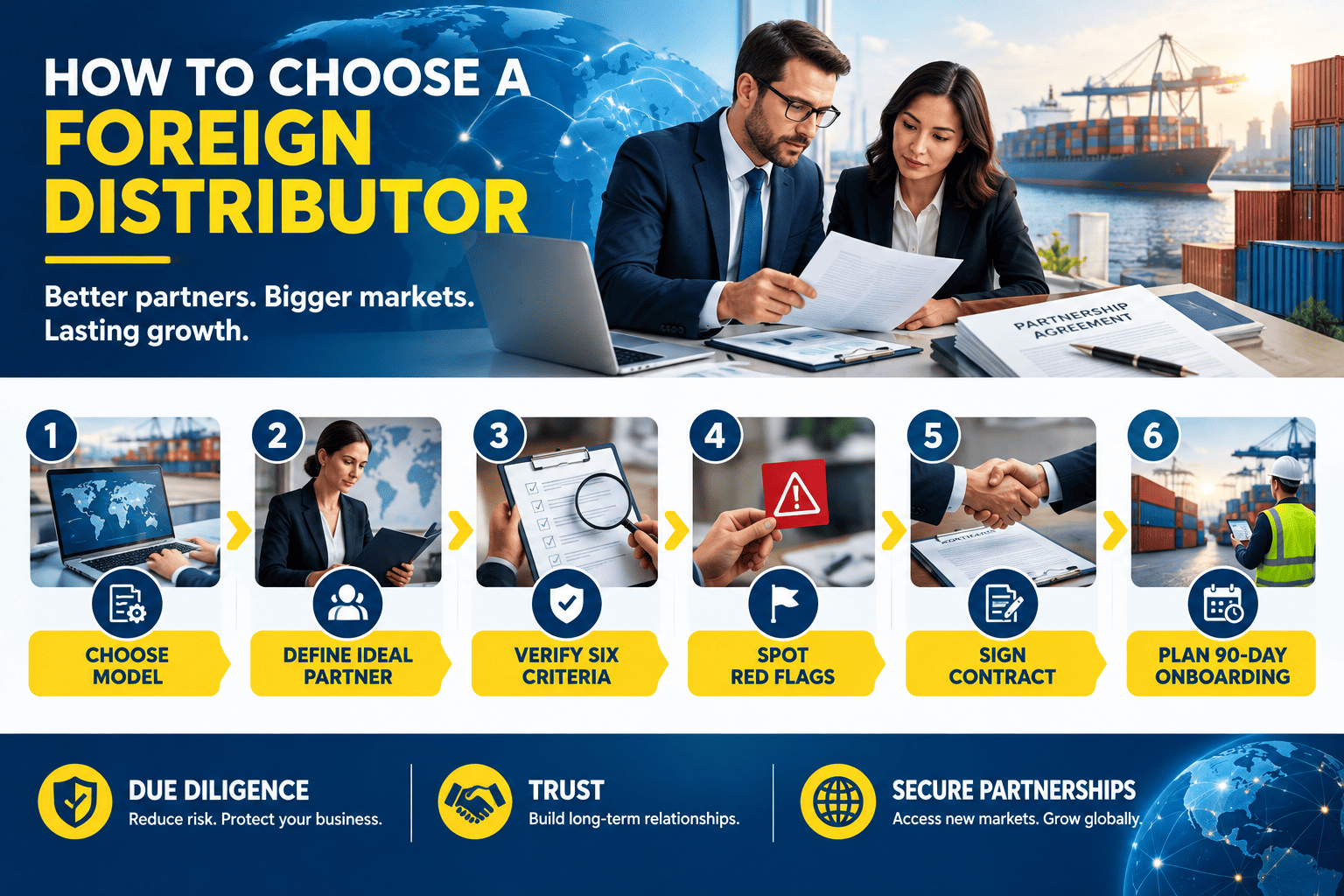
Direct Answer: To choose and contract a foreign distributor safely, follow six steps. First, decide whether a distributor, an agent, a direct team or a hybrid model fits your product. Second, define your ideal partner profile before you search. Third, qualify each candidate on six dimensions: market reach, sales capability, financial standing, compliance standing, strategic alignment and cultural fit, and verify what they tell you independently. Fourth, watch for red flags such as early demands for broad exclusivity, opaque ownership or unverifiable references. Fifth, put the deal into a written international distribution agreement that covers territory, exclusivity, performance targets, pricing, Incoterms, intellectual property, warranties, termination, governing law and dispute resolution. Sixth, run a structured 90-day onboarding and plan the exit before you need it. GTsetu helps manufacturers find government‑tie‑up verified distributors and partners across 100+ countries, with anonymous discovery, built-in NDA workflows and zero broker commission.
📅 Published October 12, 2026🔄 Updated October 12, 2026⏱ 15 min read✍️ GTsetu Editorial Team
6
Qualification Dimensions
12
Core Contract Clauses
100+
Countries on GTsetu
0%
Broker Commission
Appointing a distributor is one of the fastest ways to reach a new export market, and one of the easiest ways to get locked into a bad deal. A well-chosen partner brings customer relationships, local know-how and sales capacity. The wrong one can sit on your brand, block alternative routes to market and leave you in a dispute under unfamiliar law.
Manufacturers, exporters and business development teams planning to appoint a distributor, reseller or sales partner outside their home country. It is equally useful for distributors evaluating a new supplier and for founders deciding between a distributor, an agent and a direct sales team.
⚖️ Legal & Compliance Disclaimer
This guide provides general commercial education and does not constitute legal, tax or regulatory advice. Distribution, agency, competition, product-compliance and tax rules vary by country and sector. Always obtain advice from qualified counsel in the relevant jurisdictions before signing a distribution agreement.
SECTION 1
1 What Is an International Distribution Agreement?
🎯 Definition
An international distribution agreement is a contract between a supplier (a manufacturer or exporter) and a distributor in another country. The distributor buys, markets and resells the supplier’s products within a defined territory, and the contract sets out the rules for exclusivity, pricing, payment, delivery, intellectual property, performance, termination and dispute resolution.
There is rarely a single law that governs the whole relationship. The contract may be shaped by the laws of both countries, by treaties such as the UN Convention on Contracts for the International Sale of Goods (CISG), by competition law, by export controls and by sector-specific product rules. Some jurisdictions even give distributors statutory rights on termination, regardless of what the contract says. That is why a generic template is rarely enough.
Why the Agreement Matters
🗺️
Clear Territory & Scope
Ambiguity about where and what the distributor may sell is a common source of disputes. Precision protects both parties.
🛡️
Brand & IP Protection
Without clear IP clauses, a distributor could register your trademark locally or misuse your brand and documentation.
💰
Payment Certainty
Defined prices, currency, payment security and late-payment consequences reduce credit exposure with a new partner.
🚪
A Workable Exit
Termination, inventory and customer-data provisions let you leave an unproductive relationship without a lawsuit.
2 Distributor, Agent, Direct or Hybrid: Choosing the Model
Before you search for a partner, confirm that a distributor is the right route. The choice affects cost, speed, control, customer ownership and scalability. Also be clear on the difference between a distributor (generally buys and resells in its own name) and an agent (generally acts on your behalf without owning the goods). The legal, tax and termination consequences can differ significantly by country.
The most common selection mistake is starting the search before deciding what a good partner looks like. Without criteria, you end up comparing candidates against each other rather than against your needs. Write the profile down first.
1
Customer Base Alignment
Does the distributor already serve the buyers you want? A partner strong in one sector is not automatically right for another.
Same buyers, not just same industry
2
Complementary Portfolio
Your product should fit alongside theirs. A competing line with better margins may win their attention instead.
Check for conflicts
3
Geographic Footprint
“National coverage” is not a specification. Map where your customers actually are and test real coverage there.
Region, state or city level
4
Sales Capacity
How many people would sell your product, how many other lines do they carry, and how much time is realistic for yours?
Dedicated vs shared effort
5
Financial Capacity
Can they fund inventory, meet minimum orders and invest in local marketing under your proposed model?
Proportionate to exposure
6
Regulatory Standing
In regulated sectors such as food, healthcare or construction, check licences, registrations and who carries which responsibility.
Licences & registrations
SECTION 4
4 Step 2: Where to Find Foreign Distributors
No single directory will give you the right partner. Strong searches combine several channels and then verify every candidate independently.
1
Government Trade Promotion Bodies
Export promotion agencies and chambers of commerce offer market information and introductions. Treat them as one input to your research, not a substitute for commercial due diligence.
2
Industry Associations & Trade Fairs
Membership directories and exhibitor lists help build a longlist. At fairs, test candidates against your partner profile instead of collecting business cards.
3
Competitor Distribution Analysis
Study how competitors already reach customers in the target market. Their partners are not automatically suitable, but the pattern shows how distribution works in your sector.
4
Professional Networks & B2B Platforms
Search by industry, geography and seniority (managing directors, sales and channel heads), then verify each name independently. Our guide to international wholesale distributors explains how to evaluate them.
5
Verified Partner Platforms
Platforms such as GTsetu let you discover companies whose legal identity has already been checked against government sources, so you spend your time on commercial fit instead of basic existence checks.
5 Step 3: The Six-Dimension Qualification Framework
🎯 The Rule
A distributor can look impressive on paper and still not generate sales. Qualify every candidate on six dimensions, and independently verify the information that matters most to your decision. Match the depth of due diligence to your financial exposure. For a structured approach, see our guide on commercial due diligence and our partnership evaluation criteria.
🤝
1. Market Reach & Customers
Which target-segment customers do they supply today? Ask for references, territory coverage and sector breakdown, and call the references yourself.
📈
2. Sales Capability & Commitment
Who owns your account, how many salespeople will sell it, and what is the first-year go-to-market plan? Ask for an account plan, not promises.
🏦
3. Financial Standing
Can they meet minimum orders and finance inventory? Request trade references, financial statements or credit information as appropriate.
Why do they want your product, which customers come first, and how will they prioritise you against competing suppliers they already represent?
🌐
6. Cultural & Commercial Fit
Discuss what exclusivity means to each side, who generates leads, who funds marketing, how often performance is reviewed and what happens if targets are missed.
📌 Sector-Specific Checks
Regulated and quality-sensitive sectors need extra diligence. A food or hospitality-equipment distributor, for example, may need to evidence sanitation standards (see how to get NSF sanitation certification), and a distributor that holds your stock may need documented continuity planning (see how to get ISO 22301 certification). Ask for certificates and verify them with the issuer.
SECTION 6
6 Step 4: Red Flags to Recognise Early
Knowing what a good partner looks like is half the job. You also need clear reasons to pause or walk away. None of these signs is automatically fatal, but each deserves a direct answer before you sign.
🚩
Broad Exclusivity Requested Too Early
A distributor asking for exclusive rights before showing market access, capability or a credible plan. Exclusivity should match the commitments they make.
🚩
Opaque Ownership or Legal Structure
Unclear ownership, inconsistent company details or unexplained gaps between the registered and operating entity.
🚩
No Verifiable Customer References
Claims of extensive market access without evidence, especially when the deal involves exclusivity or inventory exposure.
🚩
Unrealistic Sales Projections
Big first-year numbers with no pipeline, named customers, sales resources or stated assumptions.
🚩
Resistance to Performance Reviews
Reluctance to accept reporting, KPIs or regular business reviews, even if rigid minimums are not agreed on day one.
🚩
Unmanaged Competitor Relationship
Representing a competitor is not disqualifying, but you need to know how conflicts, priorities and confidential information will be handled.
✨ GTsetu Insight
Opaque ownership and inconsistent company details are exactly the issues that identity verification is designed to catch early. See our guide on why trust breaks in global deals for the failure patterns behind most partnership disputes.
SECTION 7
7 Step 5: Key Clauses in the Distribution Agreement
Every agreement should be tailored to your product, market and commercial model. These twelve areas appear in almost every well-drafted international distribution agreement.
Clause 01
Parties
Full legal names, registered addresses and registration numbers of both entities, matching official records.
Clause 02
Territory
Define by country, state or province, customer segment and channel. Avoid vague regions and name any exclusions.
Clause 03
Products
List models and specifications, and state whether upgrades, new releases and related services are included.
Clause 04
Appointment & Exclusivity
Exclusive, sole or non-exclusive, and whether you keep the right to sell direct or appoint others.
Clause 05
Performance & Reporting
Minimum purchases or activity targets, KPIs, review meetings, and the consequences of missing targets.
Clause 06
Pricing & Payment
Price basis, currency, payment method and timing, discounts, review process and late-payment consequences.
Clause 07
Delivery & Risk of Loss
Incoterms, shipping, insurance, customs clearance and when risk passes to the distributor.
Clause 08
IP & Confidentiality
Trademark use, ownership of improvements, bans on registering your brand or domains, and post-termination use.
Clause 09
Warranties & Compliance
Product warranty, after-sales duties, and compliance with export controls, anti-bribery and local product rules.
Clause 10
Term & Termination
Duration, renewal, termination for cause and convenience, notice periods and post-termination handling.
Clause 11
Liability & Remedies
Caps, exclusions and consequences of breach, including treatment of indirect losses.
Clause 12
Law, Disputes & Language
Governing law, arbitration or courts, seat, rules, and which language version controls.
📌 Exclusivity Needs a Counterweight
Tie any exclusivity to measurable obligations (minimum purchases, a market plan, regular reporting) and a review mechanism, instead of granting open-ended rights. Also check local competition law, which can restrict exclusivity and resale-price provisions in some markets.
SECTION 8
8 Pricing, Payment, Incoterms & Delivery
Commercial terms are where misunderstandings turn into disputes. Spell out who pays for what, and when risk moves from you to the distributor.
Topic
What to Define
Practical Tip
Price & Margin
Distributor purchase price, discounts, commission or margin, and how prices are reviewed
Be careful with resale-price clauses; competition law in many markets restricts minimum resale prices.
Currency & Payment
Currency, payment method, due dates and late-payment charges
For new distributors, consider letters of credit, advance payment or escrow, and a clause for currency movements.
Incoterms
Who arranges transport, insurance, export and import clearance, and where risk transfers
Name the rule and version, e.g. Incoterms 2020, and the named place.
Handover Point
Where the goods are delivered to the buyer’s carrier
A rule such as FCA (Free Carrier) gives a clear handover and suits containerised exports.
Taxes & Duties
Responsibility for VAT/GST, customs duties and local charges
Confirm treatment with local tax advisers before pricing.
SECTION 9
9 Risk, Warranties, Termination & Disputes
Plan for things going wrong while you still have leverage. These provisions decide how much a failed relationship costs.
✅ Protect Yourself
✅Register IP first: secure trademarks and patents in the target country before selling, since some countries follow first-to-file rules.
✅Define warranty clearly: scope, duration, who handles claims. See warranty clause.
✅Set service duties: if the distributor provides installation or support, document it, for example under an MSA structure.
✅Choose dispute rules deliberately: many international deals use arbitration for neutrality and cross-border enforceability.
✅Keep records: store negotiations, orders, reports and signed documents securely.
⚠️ Common Traps
⚠️Generic templates: they often miss local mandatory rules, such as statutory termination compensation for distributors.
⚠️Vague breach standards: define what counts as a material breach and the cure period.
⚠️No exit plan: without clear terms, you may be stuck with an underperforming partner.
⚠️Assuming home courts: your home jurisdiction is not automatically the best forum.
Termination: What the Contract Should Cover
Grounds:breach of contract, non-performance, insolvency, regulatory problems, change of control and repeated failure to meet obligations.
Convenience exits: decide whether either party may leave without cause and on what notice. See termination for convenience.
After termination: unsold inventory (buy-back or sell-off), customer information, product registrations, marketing materials, open orders and use of your trademarks.
Local law check: some countries require notice periods or compensation on termination regardless of the contract wording, so confirm with local counsel.
✨ GTsetu Insight
If your distributor may later be acquired or may transfer its business, think about assignment and change-of-control rights up front. For background on how business transfers are documented, see what is an asset purchase agreement, and for a wider framework see risk allocation in cross-border deals.
Signing is the start of the relationship, not the end of the process. Treat the distributor as a managed commercial partnership, not a passive revenue channel. The first 90 days set the operating rhythm.
1
Weeks 1–2: Training
Cover product knowledge, target customers, positioning, objection handling, competitive differentiation and the sales process.
2
Weeks 3–4: Joint Target-Account List
Prioritise named prospects by customer fit, revenue potential, buying timeline, existing relationships and geographic coverage.
3
Month 2: Joint Customer Meetings
Attend selected meetings together to see how the distributor positions your product and how customers react.
Run regular business reviews on pipeline, wins and losses, market changes and support needs, and keep the exit provisions current.
SECTION 11
11 The Final Pre-Signing Checklist
Use this list before you sign. If you cannot tick an item, resolve it first.
Area
Confirm Before Signing
Identity
Legal names, registered addresses and registration numbers checked against official records; ownership understood.
Fit
Customer base, coverage and portfolio match your partner profile; competing lines disclosed and managed.
Evidence
References contacted, financial standing checked, licences and certifications verified with issuers.
Scope
Territory, products, channels and exclusivity defined precisely, with exclusions named.
Performance
Targets, KPIs, reporting and review schedule agreed, with consequences for missed targets.
Money
Price, currency, payment security, Incoterms and tax responsibilities documented.
IP & Confidentiality
Trademarks registered locally where needed; use, ownership and post-termination rules agreed; NDA signed.
Compliance
Export controls, anti-bribery, data and product rules addressed; local competition law reviewed.
Exit
Termination grounds, notice, inventory, customer data and registrations covered; local mandatory rules checked.
Disputes
Governing law, forum, seat, rules and contract language chosen deliberately with legal advice.
PLATFORM
12 How GTsetu Helps Manufacturers Find Distributors
🌐 Platform Spotlight, GTsetu
Your Verified Gateway to Distributors & Partners
The hardest part of a distribution deal is often the first step: finding a partner who actually exists as described, and sharing sensitive information safely. GTsetu connects manufacturers with government‑tie‑up verified distributors and partners across 100+ countries, with built-in NDA workflows and encrypted collaboration. Every company on GTsetu is verified through direct government tie‑ups across six credentials: legal name, registered address, registration number, company status, company type, and date of certificate of incorporation. GTsetu does not verify industry certifications, financial standing, sales capability or references; those must be checked directly between partners during due diligence.
✅
Government Tie‑Up Verification
6‑point verification: legal name, registered address, registration number, company status, company type, incorporation date.
📜
Certifications & Financials
GTsetu does not verify these. Exchange and validate them directly between partners.
🕵️
Anonymous Discovery
Explore distributor profiles without revealing your identity until mutual interest is confirmed.
📄
Built-In NDA Workflow
Formalise confidentiality before sharing pricing, specifications or strategy, with a full digital audit trail.
🚫
Zero Commission
No broker fees on any deal, whether a distribution agreement, supply contract or technology partnership.
🔐
Encrypted Collaboration
Documents and communications encrypted in transit and at rest. Secure B2B collaboration from first contact.
🌍
100+ Countries
A verified network of distributors, importers and supply chain partners.
An international distribution agreement is a contract between a supplier (a manufacturer or exporter) and a distributor in another country. The distributor buys, markets and resells the supplier’s products in a defined territory, and the contract sets the rules for exclusivity, pricing, payment, delivery, intellectual property, performance, termination and dispute resolution.
QWhat is the difference between a distributor and an agent?
A distributor generally buys products from the supplier and resells them in its own name, taking on the commercial risk of resale. An agent generally acts on behalf of the supplier, introducing or negotiating business without taking ownership of the goods. The legal, tax and termination consequences differ by country, so take local advice before choosing a model.
QShould I give a foreign distributor exclusivity?
Not automatically. Exclusivity makes sense when the distributor commits to measurable obligations such as minimum purchases, a market plan and regular reporting. Link exclusivity to performance targets and review periods, and check local competition law before granting it.
QWhat should an international distribution agreement include?
Core clauses include the parties, territory, products, exclusivity, minimum performance, pricing and payment terms, Incoterms and delivery, marketing and reporting, intellectual property, confidentiality, warranties, regulatory compliance, termination and its consequences, governing law and dispute resolution.
QHow do I vet an overseas distributor before signing?
Assess six dimensions: market reach and customer relationships, sales capability and commitment, financial standing, regulatory and compliance standing, strategic alignment, and cultural and commercial fit. Independently verify references, registrations and financial information instead of relying on what the distributor tells you.
QWhich dispute resolution method is best for an international distribution agreement?
Many international contracts use arbitration because it is neutral and awards are generally enforceable across borders under the New York Convention. The right choice depends on the countries involved, so choose governing law, seat, rules and language deliberately with legal advice rather than defaulting to your home courts.
QHow does GTsetu help with finding a distributor?
GTsetu helps manufacturers find and verify distributors and partners across 100+ countries. Every company is verified through government tie-ups on six core credentials (legal name, registered address, registration number, company status, company type, incorporation date). GTsetu offers anonymous discovery, built-in NDA workflows, encrypted collaboration and zero broker commission. GTsetu does not verify certifications, financial standing or sales capability, so those must be checked directly between partners.
Ready to Find a Verified Distributor?
Join 500+ verified manufacturers, exporters and distributors already building cross-border partnerships on GTsetu, with government‑tie‑up verification of six core credentials, built-in NDA workflows and zero broker fees across 100+ countries.
They represents the product, and research team behind GTsetu, a global B2B collaboration platform built to help companies explore cross-border partnerships with clarity and trust. The team focuses on simplifying early-stage international business discovery by combining structured company profiles, verification-led access, and controlled collaboration workflows.
With a strong emphasis on trust, and disciplined engagement, Team GTsetu shares insights on global trade, partnerships, and cross-border collaboration, helping businesses make informed decisions before entering deeper commercial discussions.