CNC Machining vs Injection Moulding vs 3D Printing: How to Choose the Right Process (2026) | GTsetu
Home ›
Blog ›
CNC Machining vs Injection Moulding vs 3D Printing
🏭 Manufacturing & Sourcing
CNC Machining vs Injection Moulding vs 3D Printing: How to Choose the Right Manufacturing Process
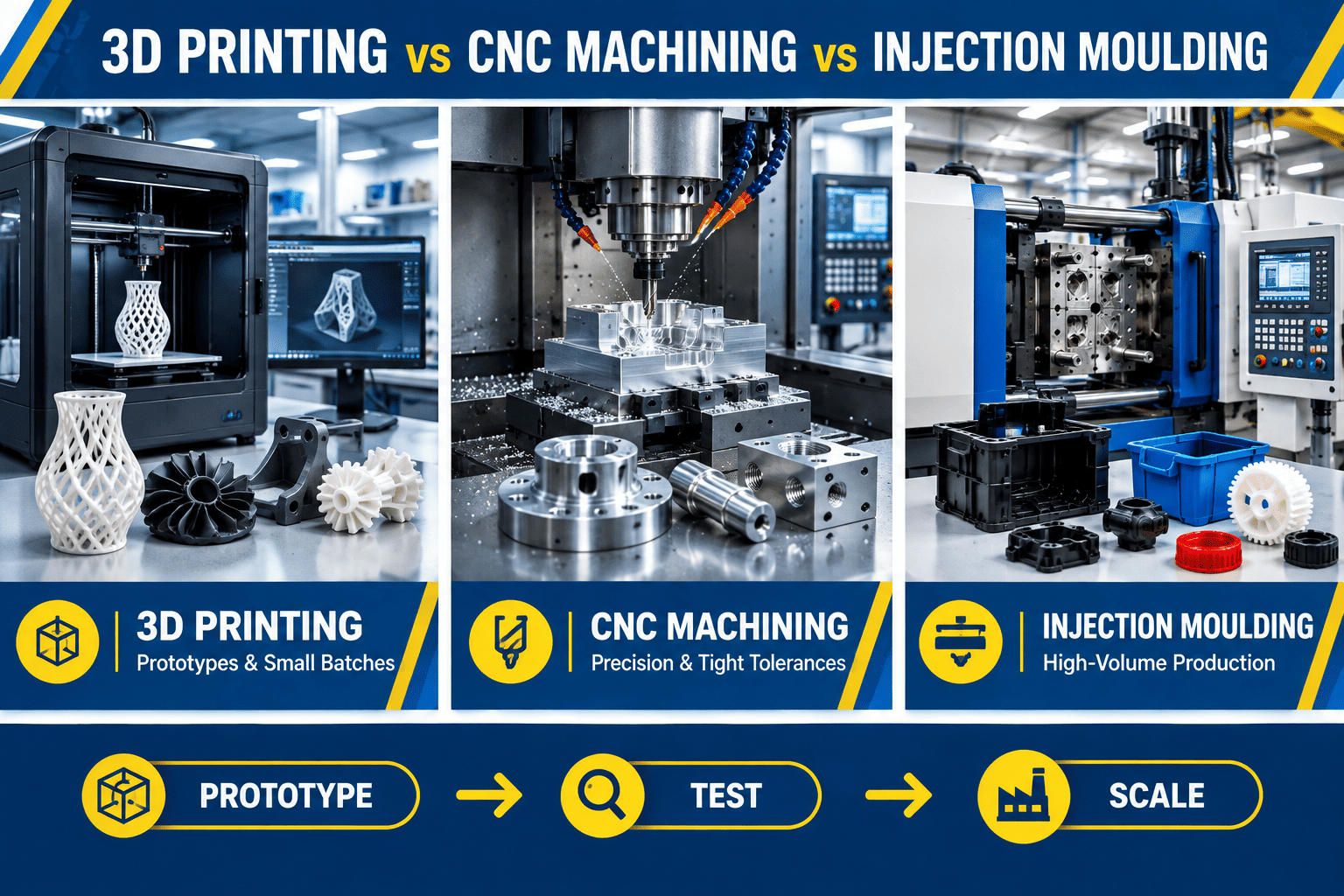
Direct Answer: Choose 3D printing when you need speed, complex geometry or one-off and very small batches, because it needs no tooling. Choose CNC machining when you need tight tolerances, production-grade metals or plastics, and low to medium volumes, because it is precise and repeatable without a mould. Choose injection moulding when you need thousands of identical plastic or elastomer parts, because the upfront tooling cost is spread across volume and the cost per part drops sharply. Most products use more than one process over their life: 3D printing for early concepts, CNC for functional prototypes, bridge tooling for pilot runs, then full moulding tools for scale. The right answer depends on your part’s quantity, material, tolerance, geometry, lead time and budget. GTsetu helps you find government‑tie‑up verified manufacturing partners across 100+ countries, with anonymous discovery, built-in NDA workflows and zero broker commission.
📅 Published October 14, 2026🔄 Updated October 14, 2026⏱ 14 min read✍️ GTsetu Editorial Team
3
Processes Compared
6
Decision Factors
100+
Countries on GTsetu
0%
Broker Commission
Few sourcing decisions have a bigger effect on cost, lead time and quality than choosing the manufacturing process. The same part can cost very little or a great deal depending on whether it is machined, moulded or printed, and a wrong early choice can lock in expensive tooling or slow a launch by months.
Product developers, engineers, procurement teams and founders deciding how to make a part, and manufacturers or contract suppliers positioning their services to international buyers.
⚖️ General Information Disclaimer
This guide provides general commercial and engineering education. Cost, tolerance and lead-time ranges vary widely by supplier, material, part geometry and region, and are illustrative only. Always obtain quotes and design-for-manufacturability feedback for your specific part, and seek professional advice for contracts and regulated products.
SECTION 1
1 The Three Processes in Plain Terms
🎯 Definition
CNC machining is a subtractive process: computer-controlled mills and lathes cut a part from a solid block. Injection moulding forces molten plastic or elastomer into a mould cavity, which must be made first. 3D printing is an additive process: a part is built layer by layer directly from a digital file with no tooling.
CNC
Subtractive
Material is cut away from a block. Excellent precision and surface quality on metals and engineering plastics.
🎯 Precision
IM
Mould-based
Molten material fills a tool. High upfront tooling cost, very low cost per part at volume.
📦 Volume
3DP
Additive
Material is added layer by layer. No tooling, fast iteration and near-free geometric complexity.
⚡ Speed
SECTION 2
2 CNC Machining: Precision and Material Range
CNC machining is the default choice when a part must hit tight tolerances or be made from a specific metal or engineering plastic. Because the part is cut from stock material, its properties match the stock, which makes results consistent and repeatable from part to part.
✅ Strengths
✅High accuracy: typically the tightest tolerances of the three processes.
✅Wide material range: many metals and plastics, including production-grade alloys.
✅No tooling cost: economical for one to a few hundred parts.
✅Good surface finish: smooth, functional surfaces straight off the machine.
⚠️ Limitations
⚠️Material waste: chips and offcuts from the removed stock.
⚠️Cost per part stays high: machine time does not fall much with volume.
⚠️Geometry limits: internal channels and undercuts are hard or impossible.
⚠️Setup and fixturing: complex parts need several set-ups.
Typical uses: engine and transmission components, aerospace airframe parts, medical instruments, jigs, fixtures and precision housings.
SECTION 3
3 Injection Moulding: Economics at Scale
Injection moulding trades a large upfront investment for a very low cost per part. Once a tool is built and proven, cycle times are short and repeatability is excellent, which is why it dominates mass-produced plastic components.
✅ Strengths
✅Lowest cost at volume: tooling is amortised over thousands of parts.
✅Consistency: highly repeatable once the process is validated.
✅Material variety: a very large catalogue of thermoplastics, thermosets and elastomers.
✅Complex features: ribs, bosses, snap-fits and textures moulded in.
⚠️ Limitations
⚠️Upfront tooling cost: and changes to a hardened steel tool are expensive.
⚠️Longest lead time: tool design, build and sampling come before the first part.
⚠️Poor fit for low volume: tooling cost may never pay back.
Typical uses: consumer product housings, automotive interior parts, caps and closures, electronic enclosures, medical disposables and connectors.
✨ GTsetu Insight
Moulded parts for food contact or hygiene-sensitive uses often need documented sanitation compliance. See our guide on how to get NSF sanitation certification to understand what suppliers in that segment should be able to show you.
SECTION 4
4 3D Printing: Speed and Design Freedom
3D printing is a family of technologies (such as stereolithography, selective laser sintering, multi jet fusion, fused deposition modelling and metal laser sintering) that all build parts layer by layer. Without tooling, you can go from file to part in days and change the design between builds at almost no cost.
✅ Strengths
✅No tooling: ideal for one-offs, prototypes and custom parts.
✅Geometric freedom: lattices, internal channels and consolidated assemblies.
✅Fast iteration: design, print, test and revise within days.
✅Lightweighting: material only where the part needs it, with less waste.
⚠️ Limitations
⚠️Narrower materials: fewer grades than moulding or machining.
⚠️Size limits: build volume caps the part dimensions.
⚠️Finish and tolerance: better surfaces usually need post-processing.
⚠️Cost per part flat: does not fall much as quantity grows.
Typical uses: concept and fit-check prototypes, tooling aids and fixtures, personalised parts, lightweight structures, replacement parts and small batches of end-use components.
SECTION 5
5 Side-by-Side Comparison
The ranges below are indicative and vary by supplier, material and part. Use them to shortlist, then confirm with quotes at several quantities.
Factor
CNC Machining
Injection Moulding
3D Printing
Best volume
One to a few hundred parts
Hundreds to many thousands
One to small batches
Upfront cost
Low (programming and fixtures)
High (mould tooling)
Very low (file only)
Cost per part at volume
Stays relatively high
Lowest
Stays relatively flat
Lead time to first part
Days
Weeks (tool build first)
Days
Tolerance & precision
Highest
High once the tool is proven
Varies by technology
Materials
Wide: metals and plastics
Very wide: plastics and elastomers
Narrower: select plastics and metals
Geometry freedom
Moderate
Constrained by mould rules
Highest
Material waste
Higher
Higher (runners, scrap)
Lower
Design changes
Easy: change the program
Costly after tooling
Easiest
SECTION 6
6 How to Choose: Six Decision Factors
🧭 Quick Process Selector
Need 1–20 parts, fast?
Prototype or custom
3D Printing
No tooling and quick turnaround for concept and fit checks.
Tight tolerances or metal?
Precision parts
CNC Machining
Best accuracy and material range without a mould.
Thousands of plastic parts?
Volume production
Injection Moulding
Tooling is amortised and cost per part drops sharply.
Design still changing?
Stay flexible
Print or Machine
Avoid committing to steel tooling until the design is frozen.
🔢
1. Quantity
The strongest driver. Request quotes at several quantities to find the crossover where tooling pays back.
🧪
2. Material
Define the required material and properties first. It may rule out a process before cost is even considered.
📏
3. Tolerance & Finish
List critical dimensions and surface needs. Tight features may need machining even on a moulded or printed part.
🧩
4. Geometry
Internal channels and lattices favour printing. Simple prismatic parts favour machining. Ribbed, thin-walled parts favour moulding.
⏱️
5. Lead Time
Tooling adds weeks before the first moulded part. If speed matters most, printing or machining usually wins.
Before committing, ask suppliers for design-for-manufacturability feedback. It flags thin walls, undersized features, undercuts and other issues for your chosen process, and is far cheaper to fix on screen than in steel.
SECTION 7
7 Using the Processes Across the Product Lifecycle
The most effective teams do not pick one process for ever. They move between them as the design matures and volumes grow.
1
Concept & Early Prototypes: 3D Printing
Print several variants quickly to test shape, fit and ergonomics. Iterate cheaply while the design is still moving.
2
Functional Prototypes: CNC Machining
Machine parts in the intended material to test strength, heat and tolerance-critical function under realistic conditions.
3
Pilot Runs: Bridge or Soft Tooling
Use lower-cost tooling or on-demand moulding for small batches, customer trials and validation before committing to production tools.
4
Scale-Up: Production Injection Moulding
Freeze the design, build production tooling and run high volumes at the lowest cost per part.
5
Maturity & Spares: Mixed
Machine or print low-volume variants, spares and custom versions, and keep tooling maintained for core production.
SECTION 8
8 Sourcing Parts Across Borders
Many buyers source machined, moulded or printed parts from suppliers in another country to reduce cost or reach specialist capability. That adds commercial questions on top of the engineering ones.
Agree who pays for transport, insurance and customs, and where risk transfers. See Incoterms 2020 and FCA (Free Carrier), which suits parts handed to a nominated carrier.
🛠️
Tooling Ownership & Location
For moulding, decide who owns the tool, where it is stored, who maintains it and how you can retrieve it if the relationship ends.
🔐
IP & Confidentiality
Drawings and CAD files are valuable. Sign an NDA before sharing them and limit what is sent to what the supplier needs.
Capability on a website is not capability on your part. Verify identity first, then test the work: order samples, check measurements, and confirm certifications with the issuer. For a structured approach, see our partnership evaluation criteria and our guide on commercial due diligence.
🚩
Quotes Far Below the Market
Unexplained low prices can signal cut corners on material, inspection or tooling quality.
🚩
No DFM Feedback
A supplier that quotes without questioning your design may not have reviewed it properly.
🚩
Unverifiable Certificates
Certificates that cannot be checked with the issuing body or do not name the right entity and scope.
🚩
Reluctance to Provide Samples
No first-article parts, inspection reports or references before you commit to tooling.
11 How GTsetu Helps You Find Manufacturing Partners
🌐 Platform Spotlight, GTsetu
Your Verified Gateway to Manufacturers & Buyers
Choosing the process is only half the job. You still need a partner who exists as described, can do the work and will protect your designs. GTsetu connects buyers and manufacturers with government‑tie‑up verified partners across 100+ countries, with built-in NDA workflows and encrypted collaboration. Every company on GTsetu is verified through direct government tie‑ups across six credentials: legal name, registered address, registration number, company status, company type, and date of certificate of incorporation. GTsetu does not verify industry certifications, manufacturing capability, part quality or financial standing; those must be checked directly between partners, for example through samples and audits.
✅
Government Tie‑Up Verification
6‑point verification: legal name, registered address, registration number, company status, company type, incorporation date.
📜
Certifications & Capability
GTsetu does not verify these. Validate them directly through samples, audits and issuer checks.
🕵️
Anonymous Discovery
Explore manufacturer and buyer profiles without revealing your identity until mutual interest is confirmed.
📄
Built-In NDA Workflow
Formalise confidentiality before sharing drawings, CAD files or pricing, with a full digital audit trail.
🚫
Zero Commission
No broker fees on any deal, whether a supply contract, tooling agreement or technology partnership.
🔐
Encrypted Collaboration
Documents and communications encrypted in transit and at rest. Secure B2B collaboration from first contact.
🌍
100+ Countries
A verified network of manufacturers, distributors and supply chain partners.
QWhat is the difference between CNC machining, injection moulding and 3D printing?
CNC machining is a subtractive process that cuts a part from a solid block using mills and lathes. Injection moulding forces molten material into a mould cavity, so it needs tooling but produces parts very cheaply at volume. 3D printing is an additive process that builds a part layer by layer directly from a digital file, with no tooling and very high design freedom.
QWhich process is best for prototyping?
3D printing is usually the fastest and cheapest route for early concept and fit-check prototypes. CNC machining suits prototypes that need tight tolerances or production-grade metals. Injection moulding prototypes (often via soft or bridge tooling) make sense when you need to validate the moulded part itself.
QAt what volume does injection moulding become cheaper than CNC or 3D printing?
There is no universal number. Injection moulding carries a tooling cost, so the break-even depends on part size, complexity, material and tooling quality. As a rule, the more parts you need, the more the tooling cost is spread out, and moulding wins at higher volumes. Request quotes at several quantities to find your own crossover point.
QWhich process gives the best precision?
CNC machining generally offers the tightest tolerances and best repeatability for critical features. Injection moulding can be very consistent once the tool is proven, but tolerances depend on material shrinkage and tool design. 3D printing tolerances vary by technology and often need post-processing for critical surfaces.
QCan I combine these processes in one product?
Yes, and many teams do. A common path is 3D printing for early concepts, CNC machining for functional prototypes, bridge tooling or low-volume moulding for pilot runs, and full production tooling once the design is stable. Some products also machine critical features onto moulded or printed parts.
QHow do I choose a manufacturing partner for these processes?
Check capability against your part (materials, tolerances, volumes), request design-for-manufacturability feedback, verify certifications directly with the issuer, ask for sample parts and references, and agree quality, tooling ownership, warranty and exit terms in a written contract. Confirm the legal identity of the company before sharing drawings.
QHow does GTsetu help with finding manufacturing partners?
GTsetu helps buyers and manufacturers find and verify partners across 100+ countries. Every company is verified through government tie-ups on six core credentials (legal name, registered address, registration number, company status, company type, incorporation date). GTsetu offers anonymous discovery, built-in NDA workflows, encrypted collaboration and zero broker commission. GTsetu does not verify certifications, capabilities, quality or financial standing, so those must be checked directly between partners.
Ready to Find a Verified Manufacturing Partner?
Join 500+ verified manufacturers, exporters and buyers already building cross-border partnerships on GTsetu, with government‑tie‑up verification of six core credentials, built-in NDA workflows and zero broker fees across 100+ countries.
They represents the product, and research team behind GTsetu, a global B2B collaboration platform built to help companies explore cross-border partnerships with clarity and trust. The team focuses on simplifying early-stage international business discovery by combining structured company profiles, verification-led access, and controlled collaboration workflows.
With a strong emphasis on trust, and disciplined engagement, Team GTsetu shares insights on global trade, partnerships, and cross-border collaboration, helping businesses make informed decisions before entering deeper commercial discussions.