How to Sell Manufacturing Equipment in Foreign Markets (2026) | GTsetu
Home ›
Blog ›
How to Sell Manufacturing Equipment in Foreign Markets
🌍 Global Trade & Compliance
How to Sell Manufacturing Equipment in Foreign Markets
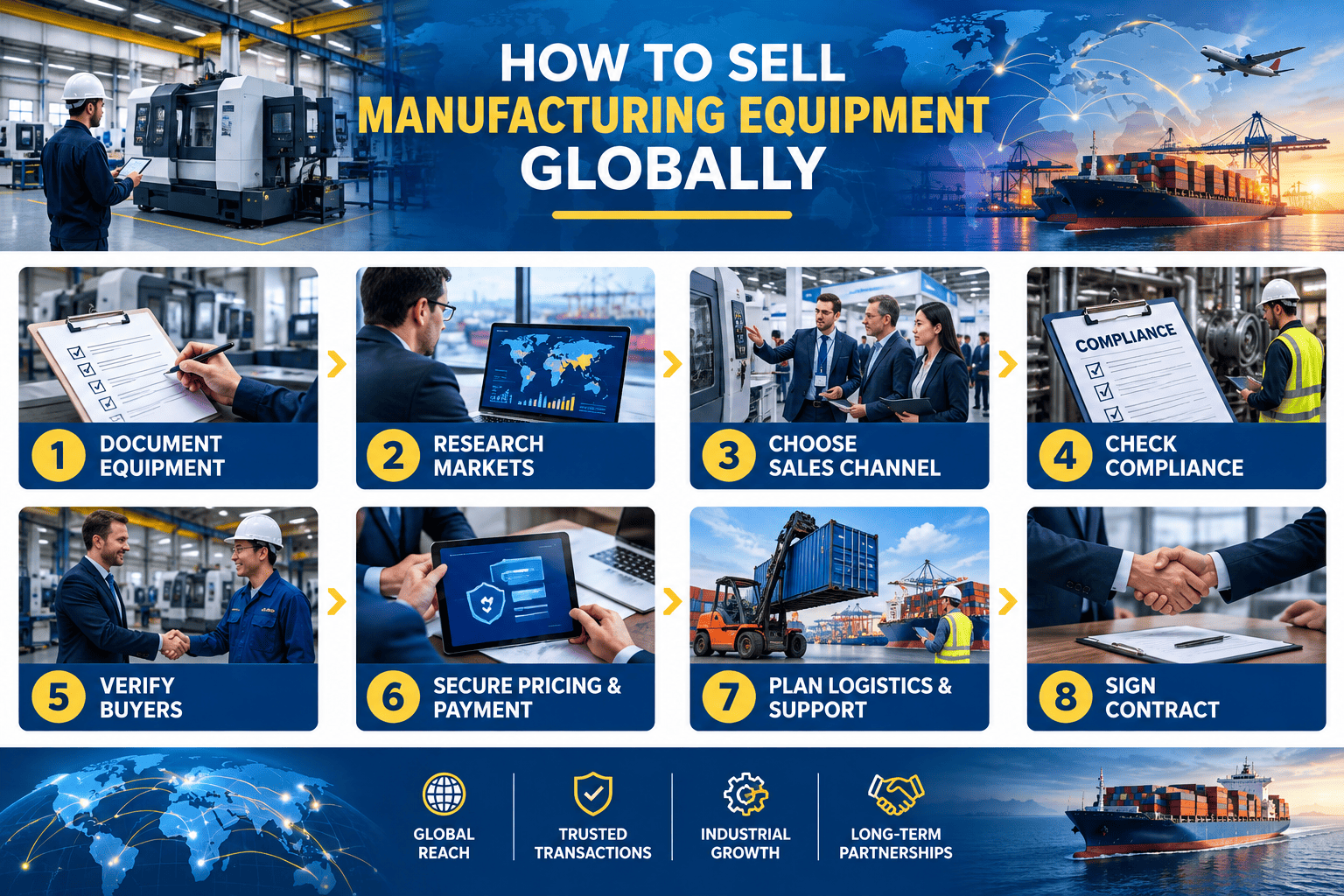
Direct Answer: To sell manufacturing equipment in foreign markets, follow eight steps. First, value and document the equipment honestly, with specifications, service history and running footage. Second, research target markets for demand, competing suppliers, duties and standards. Third, choose a sales channel: direct sales, distributors and agents, online marketplaces, auctions or brokers. Fourth, meet compliance and certification rules for the destination country, including any restrictions on used machinery. Fifth, vet the buyer before you quote or share technical data. Sixth, set pricing, Incoterms and payment security. Seventh, plan logistics, installation and after-sales support. Eighth, lock everything into a clear contract. GTsetu helps by connecting you with government‑tie‑up verified buyers, importers and distributors across 100+ countries, with built-in NDA workflows and zero broker commission.
📅 Published October 14, 2026🔄 Updated October 14, 2026⏱ 15 min read✍️ GTsetu Editorial Team
8
Steps to Sell Overseas
5
Sales Channels Compared
100+
Countries on GTsetu
0%
Broker Commission
Domestic demand for industrial machinery can be limited, seasonal, or price-sensitive. Overseas, the same CNC machine, packaging line or press may be exactly what a growing manufacturer needs, often at a better price. But selling equipment across borders is not like selling it next door: buyers cannot inspect it easily, rules differ by country, and a single payment or paperwork mistake can wipe out the margin.
Machinery manufacturers, factory owners upgrading or closing lines, equipment dealers, exporters, and business development teams who want to sell new, refurbished or used industrial equipment to buyers outside their home country.
⚖️ Legal & Compliance Disclaimer
This guide provides general commercial education. It does not constitute legal, tax, customs or regulatory advice. Export controls, import rules for used machinery, and safety standards vary by country and product. Always confirm requirements with the relevant authorities and qualified advisers before shipping.
SECTION 1
1 Why Sell Equipment in Foreign Markets
🎯 Definition
Selling manufacturing equipment in foreign markets means exporting new, refurbished or used industrial machinery to buyers in other countries. It combines market selection, technical documentation, regulatory compliance, buyer vetting, secure payment and international logistics, and often continuing support after delivery.
What Exporting Equipment Can Do for You
💰
Better Recovery Value
Markets where industries are still scaling often value machinery that is no longer a fit at home, supporting stronger prices.
🌍
Wider Buyer Pool
More potential buyers means more competition for your equipment and shorter time to sale.
🔁
Recurring Revenue
Spare parts, service contracts and upgrades turn a one-off sale into a long-term relationship.
Each step removes a different type of risk. Complete the early, low-cost steps before investing in marketing, inspections or shipping.
1
Value
Price realistically and document condition, specs and history.
📑 Preparation
2
Research
Find markets with demand, manageable duties and suitable standards.
🔎 Market
3
Channel
Pick direct sales, distributors, marketplaces, auctions or brokers.
🛒 Go-to-Market
4
Comply
Meet safety, conformity, import and export-control requirements.
🛃 Compliance
5
Vet
Verify the buyer’s identity and capacity before quoting or sharing data.
🪪 Due Diligence
6–8
Close & Deliver
Agree terms and payment, ship, install, support, and document it all in a contract.
📦 Execution
✨ GTsetu Insight
Most failed equipment exports trace back to a weak buyer or distributor, not the machine. GTsetu helps you start with government-verified counterparties. Use our partnership evaluation criteria to assess them.
SECTION 3
3 Step 1: Value & Document Your Equipment
Overseas buyers cannot walk around the machine, so your documentation does the inspecting for them. Complete, honest records build trust and justify your price.
1
Identify the Machine Precisely
Record make, model, serial number, year of manufacture, capacity, power requirements and installed options. Buyers search by these details.
2
Assess Condition Honestly
Note wear, repairs, operating hours and missing parts. Overstating condition leads to disputes, returns and claims later.
3
Gather Service History & Manuals
Maintenance logs, calibration records, manuals and software licences all add value and reduce buyer risk.
4
Capture Photos and Running Video
Show the machine operating, from several angles and with the control panel visible. A short live demo call is even better.
5
Price With Comparable Data
Check dealer listings and auction results for similar models and adjust for age, condition, location and export costs. Consider an independent appraisal for high-value lines.
📌 Prove You Can Sell It
Keep proof of ownership and clear title ready. If equipment is financed, leased or part of a larger transaction, understand the legal structure first. See what an asset purchase agreement is.
SECTION 4
4 Step 2: Research Target Markets
Not every country is a good fit. Pick markets where your equipment solves a real production need and where you can lawfully and economically deliver it.
Research Factor
Questions to Answer
Why It Matters
Demand
Which industries are expanding? Who is buying similar machines?
Targets countries with active buyers
Competition
Are local or regional makers supplying similar equipment?
Sets realistic pricing and positioning
Duties & Taxes
What import duties, VAT and levies apply to this machine?
Affects the buyer’s total landed cost
Standards
Which safety, electrical and conformity rules apply?
Determines whether you can legally sell and install
Used-Equipment Rules
Are used machines restricted, age-limited or inspected on arrival?
Prevents blocked shipments
Voltage & Utilities
Do power, frequency and utilities match the machine?
Compliance gaps are one of the most common reasons shipments are delayed or rejected. Check requirements for both the exporting and importing country before you commit to a delivery date.
Some countries limit age, require inspection or ban certain used equipment entirely. Confirm before you list.
🚫
Export Controls & Sanctions
Dual-use or controlled technology may need export licences. Screen buyers and destinations.
SECTION 7
7 Step 5: Vet the Buyer
A genuine buyer should hold up to basic checks. Confirm their legal identity, trading history and ability to pay before you reveal technical data or reserve the machine. See how to approach commercial due diligence.
✅ Signs of a Serious Buyer
✅ Shares company registration details and a verifiable business address.
✅ Asks specific technical and application questions.
✅ Accepts NDAs, inspections and staged payment terms.
✅ Provides trade references or bank references.
🚩 Warning Signs
⚠️ Agrees to price instantly without any technical questions.
⚠️ Offers an overpayment and asks for a refund of the difference.
⚠️ Uses free email domains and avoids sharing registration details.
⚠️ Pushes to bypass inspection or change payment terms late.
SECTION 8
8 Step 6: Pricing, Incoterms & Payment
Price the machine and the delivery responsibilities together. The Incoterm you choose defines who arranges transport, who pays for insurance, and when risk transfers to the buyer.
🎯 Payment & Delivery Essentials
• Choose an Incoterm deliberately. Read our guides on Incoterms 2020 and FCA (Free Carrier).
• Take a meaningful deposit to confirm the order, with the balance tied to inspection or shipment milestones.
• For larger deals, consider an irrevocable letter of credit or equivalent secure instrument.
• Pay attention to currency risk, bank charges and who bears them.
• Do not release title documents until agreed payment is confirmed.
SECTION 9
9 Step 7: Logistics & After-Sales Support
Heavy machinery needs careful dismantling, crating, lifting and transport. Your support after delivery often decides whether the buyer returns.
1
Prepare for Shipping
Clean, dismantle if needed, label parts, protect against moisture and shock, and photograph packing for insurance claims.
2
Arrange Freight, Insurance & Customs
Work with an experienced forwarder, confirm commercial invoice, packing list and origin documents, and insure the cargo for its full value.
3
Plan Installation & Commissioning
Decide whether you, the buyer or a local partner will install and commission the machine, and who pays.
A written agreement turns negotiation into enforceable commitments. Include specifications, condition, delivery terms, payment schedule, inspection rights, warranty limits and dispute resolution.
Selling equipment overseas is only as safe as the counterparty. GTsetu connects manufacturers, exporters, importers and distributors across 100+ countries, and every company is verified using direct government tie‑ups across six essential credentials: legal name, registered address, registration number, company status, company type, and date of certificate of incorporation. GTsetu does not verify industry certifications, equipment condition, product quality, or financial standing; those must be exchanged and validated directly between partners.
✅
Government Tie‑Up Verification6‑point verification: legal name, registered address, registration number, company status, company type, incorporation date.
📜
Certifications & ConditionNot verified by GTsetu. Validate directly with partners during due diligence.
🕵️
Anonymous DiscoveryBrowse verified buyer and distributor profiles without revealing your identity until mutual interest is confirmed.
📄
Built-In NDA WorkflowFormalise confidentiality before sharing drawings, service data or pricing, with a full digital audit trail.
🚫
Zero CommissionNo broker fees on any sale, distribution agreement or service partnership.
🔐
Encrypted CollaborationDocuments and messages encrypted in transit and at rest from first contact.
🌍
100+ CountriesA growing verified network for equipment sales and partnerships.
QHow do I start selling manufacturing equipment overseas?
Start by documenting the equipment and setting a realistic price, then research which foreign markets need it and what import, safety and certification rules apply. Choose a sales channel (direct, distributor, agent, online marketplace or auction), vet buyers, agree Incoterms and secure payment terms, and plan shipping, installation and after-sales support.
QWhat documents do foreign buyers expect for used machinery?
Typically model and serial numbers, year of manufacture, specifications, maintenance and service history, operating hours where relevant, recent photos and video of the machine running, proof of ownership, and any inspection reports or manuals.
QWhich sales channel is best for selling equipment abroad?
It depends on volume and complexity. Distributors and agents suit ongoing sales and local support. Direct sales suit high-value, customised machines. Online marketplaces and auctions suit one-off or used equipment but usually give less control over buyer quality.
QHow do I get paid safely when selling machinery overseas?
Verify the buyer’s legal identity first, then use secure instruments such as an irrevocable letter of credit or staged payments with a meaningful deposit. Release equipment or title documents only as agreed in the contract, and use clear Incoterms to define who bears risk at each stage.
QDo I need certifications to export manufacturing equipment?
Often yes. Many destination markets require safety, electrical or conformity marking, and some restrict or regulate imports of used machinery. Requirements differ by country and machine type, so confirm them with the destination authority or a qualified adviser before shipping.
QHow does GTsetu help sell equipment in foreign markets?
GTsetu connects manufacturers, exporters, importers and distributors across 100+ countries. Companies are verified through government tie-ups on six credentials (legal name, registered address, registration number, company status, company type, incorporation date), with anonymous discovery, built-in NDA workflows, encrypted collaboration and zero broker commission. GTsetu does not verify certifications, equipment condition or financial standing; those are validated directly between partners.
Ready to Sell Your Equipment to Verified Foreign Buyers?
Join 500+ verified manufacturers, exporters, and importers already building cross-border partnerships on GTsetu, with government‑tie‑up verification of six core credentials, built-in NDA workflows, and zero broker fees across 100+ countries.
They represents the product, and research team behind GTsetu, a global B2B collaboration platform built to help companies explore cross-border partnerships with clarity and trust. The team focuses on simplifying early-stage international business discovery by combining structured company profiles, verification-led access, and controlled collaboration workflows.
With a strong emphasis on trust, and disciplined engagement, Team GTsetu shares insights on global trade, partnerships, and cross-border collaboration, helping businesses make informed decisions before entering deeper commercial discussions.