Is India Becoming a Global Manufacturing Hub? (2026) | GTsetu
Home › Blog › Is India Becoming a Global Manufacturing Hub?
🏭 Global Trade & Manufacturing
Is India Becoming a Global Manufacturing Hub?
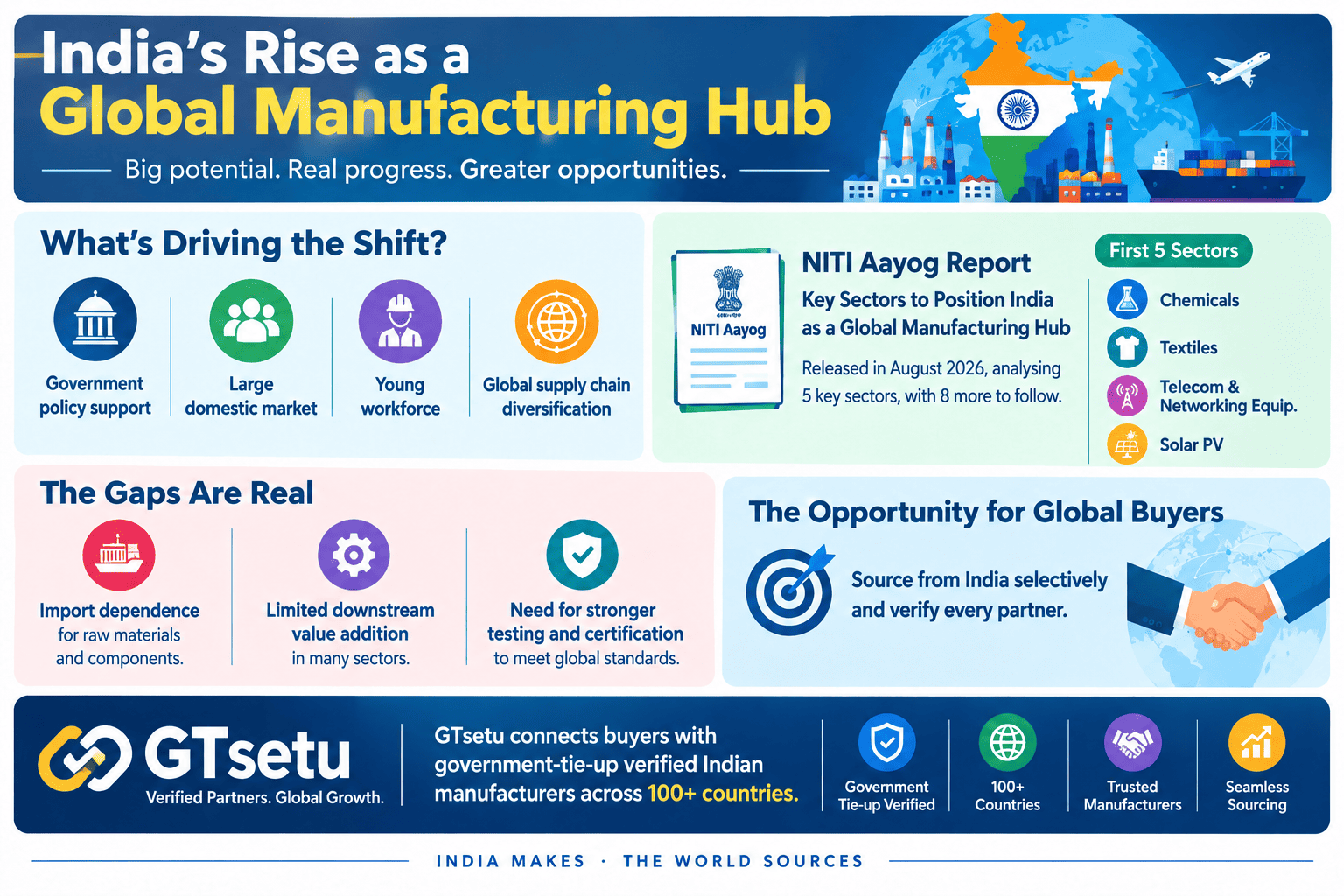
Direct Answer:Yes, India is becoming a global manufacturing hub, but the transition is still in progress. Government policy, a large domestic market, a young workforce and global supply chain diversification are pulling more production towards India. In August 2026, NITI Aayog released its report “Key Sectors to Position India as a Global Manufacturing Hub”, analysing chemicals, textiles, telecom and networking equipment, and solar PV, with reports on 8 more sectors to follow. The gaps are real: import dependence for raw materials and components, limited downstream value addition, and the need for stronger testing and certification. For global buyers, the opportunity is to source from India selectively and verify every partner. GTsetu helps by connecting buyers with government‑tie‑up verified Indian manufacturers across 100+ countries.
📅 Published October 12, 2026🔄 Updated October 12, 2026⏱ 12 min read✍️ GTsetu Editorial Team
4
Sectors in NITI Aayog’s First Report
8
More Sector Reports to Follow
100+
Countries on GTsetu
0%
Broker Commission
For two decades India was known as the world’s back office. Today the conversation has shifted to factories: electronics, solar modules, chemicals, textiles and engineering goods. Buyers, investors and policymakers are asking the same question: is India becoming a global manufacturing hub?
Global buyers, sourcing heads, importers, distributors and investors evaluating India as a manufacturing base, and Indian manufacturers positioning themselves for export markets.
⚖️ Disclaimer
This guide provides general commercial education, not legal, tax or investment advice. Figures cited come from the linked official sources and may be updated. Always verify current data and consult qualified professionals.
SECTION 1
1 What “Global Manufacturing Hub” Really Means
🎯 Definition
A global manufacturing hub is a country that combines scale, competitive costs, a deep supplier ecosystem, reliable logistics and strong export performance, so that international companies choose it as a primary production base, not just a low-cost alternative.
By that definition, hub status is not a single milestone. It is built sector by sector. That is exactly the approach NITI Aayog has taken: assessing market potential, infrastructure readiness, policy support, raw material availability, technology readiness, employment potential and India’s position in the value chain for each sector.
SECTION 2
2 Why Manufacturers Are Looking at India
🏛️
Policy Push
Initiatives such as Make in India, production-linked incentives and sector policies (for example, the National Telecom Policy 2025) aim to deepen domestic manufacturing.
🛒
Large Domestic Market
A big home market gives manufacturers scale before they export. India is the world’s second-largest telecom market, with over 1.2 billion subscribers.
👷
Workforce Depth
Textiles alone support more than 45 million livelihoods, and MSME-led clusters create a broad base of skilled manufacturing labour.
🌐
Supply Chain Diversification
Global buyers are reducing single-country dependence, and India is a natural candidate for the “China plus one” approach. See risk allocation in cross-border deals.
🤝
Trade Agreements
Strategic use of FTAs is highlighted by NITI Aayog as a lever to cut import dependence and widen export access.
⚡
Clean-Tech Momentum
Ambitious solar and green hydrogen targets are creating demand for domestic manufacturing of modules, components and equipment.
SECTION 3
3 NITI Aayog’s Four Priority Sectors
According to the PIB release of 13 August 2026, the first edition of NITI Aayog’s report examines four sectors, with eight more to follow. The report uses a four-phase method: shortlisting by attractiveness, detailed assessment, international benchmarking and actionable recommendations.
Chemicals
Petrochemicals · Specialty · Inorganic
Scope to raise domestic value addition through downstream production and better feedstock use, reducing import dependence.
⚗️ Value Addition
Textiles
Textiles & Apparel
About 2% of GDP, 11% of manufacturing GVA and 9% of merchandise exports. FY2025 exports of USD 37.7 billion; 4.1% global share.
🧵 Sixth-Largest Exporter
Telecom
Telecom & Networking Equipment
NTP-25 targets doubling telecom’s GDP contribution and exports, and one million new jobs by 2030.
📡 Localisation
Solar PV
Solar Photovoltaic
106 GW installed by March 2025; 280 GW targeted by 2030. Domestic PV market projected to grow at 17–20% CAGR (FY2023–FY2030).
☀️ Clean-Tech
Sector
Key Data Point (NITI Aayog / PIB)
Priority for Growth
Chemicals
Led by petrochemicals and organic chemicals, specialty chemicals and inorganic chemicals
NITI Aayog repeatedly points to joint ventures, technology transfer and technology partnerships as growth levers. That makes partner selection central to India’s manufacturing story. Use our partnership evaluation criteria to assess potential partners, and read how Maharashtra’s FTI is shaping quantum technology in Pune as an example of regional innovation ecosystems.
SECTION 4
4 Challenges Holding India Back
✅ Strengths
✅ Domestic scale: large consumer and industrial demand supports volume.
✅ Policy direction: sector-specific roadmaps and incentives.
✅ Workforce: a large, young labour pool and MSME ecosystem.
✅ Diversification demand: global buyers actively seeking alternatives.
⚠️ Gaps
⚠️ Import dependence: raw materials and components still imported in several sectors.
⚠️ Value addition: upstream and downstream capabilities need deepening.
⚠️ Skilling and productivity: technology adoption varies widely between firms.
⚠️ Standards: testing, certification and quality consistency must meet export norms.
India is strongest where scale, skills and policy support overlap. Match your category to the sectors above and research the market first: global market research for manufacturers.
2
Diversify, Don’t Replace
Treat India as part of a multi-country supply base rather than a one-for-one swap, and plan for transition periods.
A fast-growing manufacturing base attracts both excellent suppliers and opportunists. Before committing volume, run commercial due diligence: verify legal identity, review certifications directly, audit facilities and check references.
India’s manufacturing base is vast and fragmented. Trade fairs, directories and cold outreach are slow and unverified. A credible partner is easiest to find in an environment where identity is verified, discovery is private, and confidentiality is built in from the first conversation.
✨ GTsetu Insight
GTsetu verifies each company’s legal name, registered address, registration number, company status, company type and incorporation date through government tie‑ups. It does not verify certifications, product quality or financial standing; those should be exchanged and validated directly between partners.
SECTION 8
8 How GTsetu Helps Global Buyers Source from India
🌐 Platform Spotlight, GTsetu
Your Verified Gateway to Indian Manufacturers & Partners
GTsetu connects manufacturers, exporters, distributors and buyers across 100+ countries. Every company is verified through direct government tie‑ups across six credentials: legal name, registered address, registration number, company status, company type, and date of certificate of incorporation. GTsetu does not verify industry certifications, product quality or financial standing; these must be validated directly between partners.
✅
Government Tie‑Up Verification6‑point identity verification.
🕵️
Anonymous DiscoveryBrowse profiles without revealing your identity.
📄
Built-In NDA WorkflowFormalise confidentiality before sharing specifications.
🚫
Zero CommissionNo broker fees on any deal.
🔐
Encrypted CollaborationDocuments and messages encrypted in transit and at rest.
Yes, but it is a work in progress. Policy support, a large domestic market, a young workforce and global supply chain diversification are driving growth, and NITI Aayog’s 2026 report identifies chemicals, textiles, telecom and networking equipment and solar PV as high-potential sectors. Gaps in logistics, component depth and scale remain.
QWhich sectors does NITI Aayog highlight?
The first edition of “Key Sectors to Position India as a Global Manufacturing Hub” analyses chemicals, telecom and networking equipment, textiles and solar photovoltaic manufacturing. Reports on 8 more sectors are to follow.
QWhat are the main challenges for Indian manufacturing?
Import dependence for raw materials and components, limited upstream and downstream value addition in some sectors, infrastructure and logistics costs, skilling gaps, and meeting international testing and certification standards.
QHow should global buyers evaluate Indian manufacturers?
Verify legal identity, review certifications and audit history directly, run commercial due diligence, agree clear contract terms (warranty, Incoterms, termination rights), and sign an NDA before sharing specifications.
QHow does GTsetu help with sourcing from India?
GTsetu connects buyers with government-tie-up verified manufacturers across 100+ countries, verifying six core credentials, with built-in NDA workflows, encrypted collaboration and zero broker commission.
Ready to Find Verified Manufacturing Partners in India?
Join 500+ verified manufacturers, exporters and importers building cross-border partnerships on GTsetu, with government‑tie‑up verification of six core credentials, built-in NDA workflows and zero broker fees across 100+ countries.
They represents the product, and research team behind GTsetu, a global B2B collaboration platform built to help companies explore cross-border partnerships with clarity and trust. The team focuses on simplifying early-stage international business discovery by combining structured company profiles, verification-led access, and controlled collaboration workflows.
With a strong emphasis on trust, and disciplined engagement, Team GTsetu shares insights on global trade, partnerships, and cross-border collaboration, helping businesses make informed decisions before entering deeper commercial discussions.