Nearshoring vs Offshoring vs Reshoring (2026): Differences, Pros, Cons & How to Choose | GTsetu
Home ›
Blog ›
Nearshoring vs Offshoring vs Reshoring
🔄 Global Trade & Supply Chain
Nearshoring vs Offshoring vs Reshoring: Differences, Trade-Offs & How to Choose the Right Model
Direct Answer:Offshoring moves operations to a distant foreign country, mainly to cut labour and production costs. Nearshoring moves them to a nearby country, often one sharing a border or time zone, balancing savings with shorter lead times and easier coordination. Reshoring brings operations back to the company’s home country to regain control, reduce disruption risk and, in some countries, tap tax incentives. A fourth model, friendshoring, sources from politically aligned countries regardless of distance. There is no universally best option: the right choice depends on total landed cost, tariff and trade-policy exposure, skilled-labour availability, logistics risk, quality control needs and your ability to manage operations abroad. Many companies now blend all three. GTsetu helps you find government‑tie‑up verified partners across 100+ countries, whether offshore, nearshore or domestic, with built-in NDA workflows and zero broker commission.
📅 Published October 14, 2026🔄 Updated October 14, 2026⏱ 15 min read✍️ GTsetu Editorial Team
Few supply chain decisions carry as many long-term consequences as where to make your products. Pandemic disruptions, soaring freight rates, geopolitical tension and shifting tariffs have pushed companies to re-examine decades of offshoring decisions. The result is a toolkit of strategies: offshoring, nearshoring, reshoring and friendshoring, each with different cost, control and risk profiles.
Manufacturers considering a change of production location, procurement and supply chain leaders building resilience, exporters and importers weighing new supplier countries, and founders planning their first international supply chain.
⚖️ Legal, Tax & Compliance Disclaimer
This guide provides general commercial education. It does not constitute legal, tax, customs or investment advice. Tariffs, trade agreements, tax credits and incentives change frequently and differ by country. Always consult qualified legal, tax and customs professionals and refer to official government sources before relocating operations or changing suppliers.
SECTION 1
1 What Are Offshoring, Nearshoring and Reshoring?
🎯 Definition
Offshoring, nearshoring and reshoring describe where a company locates its production or business operations relative to its home market. Offshoring relocates operations to a distant foreign country. Nearshoring relocates them to a nearby foreign country. Reshoring (also called inshoring or onshoring) returns them to the home country. All three are location decisions, not decisions about who does the work.
That last point matters. Offshoring is not the same as outsourcing. Outsourcing means contracting work to an outside organisation, which could be down the street or across the world. Offshoring means moving operations to another country, whether through your own subsidiary or a third-party supplier. A company can outsource domestically, offshore internally, or combine both.
🌏
Location Is the Variable
The core distinction is distance and jurisdiction: far abroad, nearby abroad, or at home.
⚖️
Trade-Offs, Not Winners
Each model optimises a different mix of cost, speed, control and risk. None is best in every situation.
🧩
Blended Strategies
Many companies combine models by product line, for example offshoring commodity parts while nearshoring time-sensitive items.
🛡️
Resilience Is Now a Driver
Where cost once dominated, supply security, lead time and policy exposure now weigh heavily on location decisions.
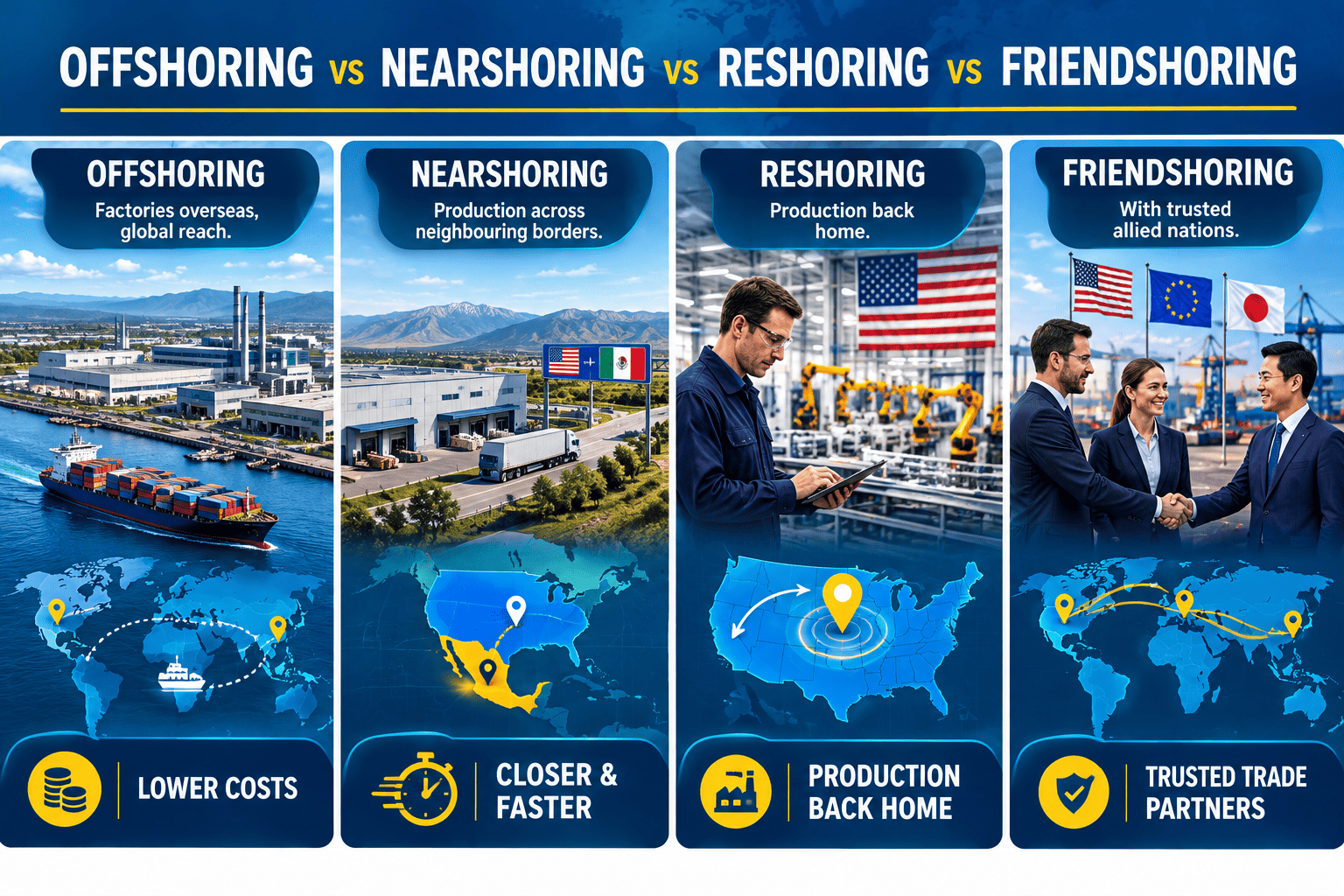
Here is each model in a single view, with its typical motivation and the main thing to watch out for.
Offshoring
Far abroad
Relocate operations to a distant country for lower costs, specialised skills or proximity to raw materials.
💰 Cost-led
Nearshoring
Nearby abroad
Relocate to a neighbouring or regional country with similar time zones and shorter shipping routes.
⚖️ Balanced
Reshoring
Back home
Return production to the home country to regain control, cut disruption risk and access local incentives.
🏠 Control-led
Friendshoring
Allied countries
Source from politically and economically aligned countries, regardless of distance. Also called allyshoring.
🤝 Trust-led
Outsourcing
Not a location
Contracting work to an external organisation, anywhere. Often confused with offshoring but a different decision.
📑 Who, not where
Onshoring
Domestic sourcing
Using suppliers within your home country. Reshoring is the act of moving back to this model.
📍 Home market
📌 Why the Debate Is Louder Now
A 2022 Capgemini Research Institute survey of executives, cited by Grainger, found that 89% saw supply chain disruption as the biggest short-term risk to their organisation. Among the actions being taken to diversify, onshoring or nearshoring production bases was the most common at 72%, followed by regionalising or localising suppliers (65%) and diversifying manufacturing (62%).
SECTION 3
3 Offshoring: Lowest Cost, Longest Reach
Offshoring means relocating business operations to another country, usually far from home, to benefit from cost advantages, specialised skills or better service delivery. In U.S. manufacturing the practice accelerated from the 1970s as companies sought lower costs. Popular offshore regions include China, Vietnam, Indonesia and wider Southeast Asia, plus Eastern Europe and Latin America for certain functions.
✅ Advantages
✅Lower Production Costs: Labour, materials and sometimes regulatory costs can be significantly lower than at home.
✅Access to Skills & Scale: Deep supplier ecosystems and specialised talent pools, often unavailable domestically.
✅Proximity to Inputs: Closer to raw materials or component clusters in some industries.
✅Market Entry: Producing in a region can ease sales into that regional market.
⚠️ Disadvantages
⚠️Long, Fragile Logistics: Transoceanic shipping adds lead time and exposes you to freight spikes and port disruption.
⚠️Tariff & Policy Risk: Politically driven trade measures can quickly erode the savings.
⚠️Quality & Communication Gaps: Time zones, language and culture complicate oversight.
⚠️IP & Data Exposure: Protecting designs and specifications requires strong contracts and confidentiality.
Nearshoring relocates operations, or shifts sourcing, to a nearby country, often one with a shared border or overlapping time zones, where labour is still more affordable than at home and shipping and communication links are strong. A classic example is a U.S. company working with a supplier in Mexico instead of one in China; for European buyers, Central and Eastern European countries play a similar role.
1
Shorter Lead Times
Shorter distances cut transit time and let you respond faster to demand changes, reducing inventory buffers.
Speed to market
2
Easier Collaboration
Similar time zones and closer cultures simplify engineering reviews, audits and day-to-day coordination.
Time-zone overlap
3
Moderate Costs
Labour is usually cheaper than domestic production but pricier than far-off offshore sites, and nearshoring generally offers fewer tax incentives than reshoring.
Cost-control balance
4
Regional Integration
Supply chains can span borders as one system. In North American autos, parts can cross borders as many as eight times before final assembly, so a slowdown in one plant can ripple to suppliers across the region.
Trade-bloc synergy
📌 Nearshoring Is Not Risk-Free
Nearshoring to a country with a favoured trade relationship can lower exposure, but rules and tax rates can still change. The nearby supplier base may also be thinner than in established hubs, so finding qualified local suppliers can take time. For Central Europe in particular, see our practical guide to expanding a manufacturing and industrial automation business in the Czech Republic.
Reshoring is the opposite of offshoring: moving manufacturing or services back to the home country or region. It is also called inshoring or onshoring. Companies reshore to regain end-to-end control of their supply chain, reduce exposure to events outside their control, and shorten lead times. Rising overseas labour costs, tariff changes, quality concerns and sustainability goals also push firms in this direction.
1
Greater Control & Quality Oversight
Shorter feedback loops, easier audits and consistent regulatory standards make it simpler to manage quality and compliance.
2
Lower Logistics & Tariff Exposure
Domestic production removes much of the shipping risk and the threat of new import tariffs on your finished goods.
3
Possible Tax Credits & Incentives
Some governments offer production credits, grants and local tax breaks to attract domestic manufacturing. In the U.S., for example, federal programmes have targeted areas such as clean-energy equipment, batteries and semiconductors, alongside state and local incentives. Programmes change, so verify current rules with a tax advisor.
4
The Trade-Off: Higher Operating Costs
Labour and regulatory costs are typically higher at home, and building or expanding domestic capacity needs significant upfront investment. Automation and advanced manufacturing can help close the gap.
Friendshoring, also called allyshoring, is a newer term for rerouting supply chains to countries that are politically and economically aligned with your home country, whatever their distance. The logic is that shared values and stable relationships reduce the risk of sudden policy shocks or supply cut-offs.
✅ Benefits
✅Stability & Reliability: Long-term relationships with trusted suppliers improve predictability.
✅Regulatory Alignment: Easier compliance when standards and legal systems are compatible.
✅Reduced Geopolitical Exposure: Less vulnerability to sanctions, export controls and political shocks.
⚠️ Challenges
⚠️Potentially Higher Costs: Allied countries may cost more than lowest-cost alternatives.
⚠️Slower Response: Distance can reduce agility when demand shifts.
⚠️Limited Capacity: Allied markets may not match the scale of established hubs for every product.
📌 A Practical Note for Indian Exporters
As buyers diversify, countries with large, growing manufacturing bases and friendly trade ties stand to gain. India’s share of global manufacturing value added has been rising, as we explored in our guide on global market research for manufacturers. Being verifiable and transparent is a strong advantage when buyers are re-qualifying suppliers.
SECTION 7
7 Head-to-Head Comparison
The table below summarises how the three core models typically compare. Actual results vary by country, product and company.
Factor
Offshoring
Nearshoring
Reshoring
Typical Location
Distant country (e.g., Asia for a Western buyer)
Neighbouring or regional country (e.g., Mexico for the U.S.)
Home country or region
Labour & Production Cost
Usually lowest
Moderate
Usually highest
Shipping Time & Cost
Longest and most volatile
Shorter, more predictable
Shortest
Time Zone & Culture
Large gaps; coordination is harder
Often overlapping hours
Same
Control & Quality Oversight
Harder; needs strong audits and contracts
Easier, with frequent site visits possible
Strongest
Tariff & Trade-Policy Exposure
Highest, especially with politically targeted countries
Moderate; depends on trade agreements
Lowest for domestic sales
Tax Incentives
Varies; often local special-zone benefits
Generally fewer
Potentially significant, programme-dependent
Upfront Investment
Moderate to high
Moderate
Often high (capacity, automation)
Best Suited For
Cost-sensitive, high-volume, stable products
Time-sensitive products and regional markets
High-value, IP-sensitive or regulated products
✨ GTsetu Insight
Price per unit is only one line in the equation. Always compare total landed cost, including freight, duties, inventory carrying cost, quality failures and management overhead. Agreeing delivery responsibilities clearly through Incoterms 2020, such as FCA (Free Carrier), prevents costly disputes.
SECTION 8
8 Tax, Tariff and Trade-Policy Considerations
Location decisions are often won or lost on the numbers that sit outside the factory gate. Four areas deserve early attention.
🛃
Tariffs & Duties
Changes to tariffs can abruptly alter profitability. Offshoring to countries targeted by punitive tariffs carries the highest exposure; nearshoring depends on the strength of the trade relationship.
🧾
Tax Credits & Incentives
Domestic production may qualify for federal, state or local credits, grants and abatements. These can offset higher labour costs, but programmes evolve with politics.
🚢
Freight & Disruption Risk
Transoceanic freight spikes, port disruption or regional conflict can wipe out savings. Shorter routes reduce the exposure.
🌿
Sustainability & Ethics
Labour standards, climate risk and consumer preference for locally made goods increasingly shape location choices and brand perception.
📌 Always Involve a Tax Advisor
Because tax strategy can materially shift profitability and risk in any location, treat it as a consultative process with a qualified advisor, especially before a change in manufacturing location. For broader strategic context on moving into new markets, see our guide on international business development consulting.
SECTION 9
9 How to Decide: A Practical Framework
There is no single right answer, but there is a right process. Start with a quick directional guide, then work through the detailed steps.
🧭 Quick Decision Guide: Which Model Fits Your Situation?
Are competitors undercutting you on price?
Explore offshoring or nearshoring
Cost
Analyse total landed cost first; the cheapest unit price is rarely the cheapest overall.
Is lead time or demand volatility your biggest pain?
Nearshoring
Speed
Shorter routes and overlapping time zones improve responsiveness.
Is IP, quality or regulation critical?
Reshoring
Control
Domestic production offers the tightest oversight and legal clarity.
Worried about geopolitical or sanctions risk?
Friendshoring
Stability
Source from aligned countries and long-term trusted suppliers.
Heavily tariff-exposed today?
Diversify across models
Resilience
Split volumes across two or three locations to avoid single-country dependence.
Limited experience managing foreign operations?
Start nearshore or domestic
Capability
Build capability gradually before expanding to distant markets.
Ten Questions to Ask Before You Move
1
Can you meet competitive prices today?
If competitors consistently undercut you on manufacturing cost, analyse your full cost base, covering labour, compliance, freight, tariffs, taxes and real estate, before choosing a location.
2
How exposed are you to trade-policy change?
Stress-test your margins against plausible tariff scenarios in each candidate location.
3
Is skilled labour available at a reasonable cost?
The cheapest site can require extra spending to find or train talent. Check local education, training and prevailing wages for the skills you need.
4
How much shipping risk can you absorb?
Consider freight spikes, delays and route disruptions, especially if your customers are price-sensitive.
5
What other external risks does the location carry?
Political instability, climate exposure and consumer sentiment toward the origin country all affect resilience and brand.
6
Which credits and incentives could offset costs?
Explore national, regional and local programmes, and confirm eligibility and durability with an advisor.
7
Do you have people who can manage international operations?
Local permitting, language, culture and business practices can quietly consume projected savings if you lack in-house expertise or trusted local partners.
8
How fast do savings repay the move?
Factor in relocation costs, disruption, lost productivity and the likelihood that another location becomes more attractive in a few years.
Operational needs, such as skilled labour, stable supply, suitable facilities and safety, must come first; cost savings come second.
✨ GTsetu Insight
Deloitte-style resilience thinking comes down to three habits: know your suppliers, decide which supply chains are critical, and diversify. Verified partner identity is the foundation of the first habit; see cross-border manufacturing partnerships for how to build durable supplier relationships.
SECTION 10
10 Contracts, Compliance & Risk Across Borders
Relocating production or changing suppliers is only as safe as the contracts and compliance framework behind it. These concepts deserve attention before the first purchase order, in every model.
Clause 01
Master Services Agreement
A framework for ongoing manufacturing relationships. See our MSA guide.
Clause 02
Warranty
Defines quality commitments and remedies for defects. Read about the warranty clause.
Choosing the right shoring strategy is half the battle. The other half is finding a credible supplier, manufacturer or distributor in the country you choose.
🎯 The Partner Challenge
Whether you are offshoring to Asia, nearshoring to Mexico or Eastern Europe, or reshoring to a domestic supplier, you need confidence about who is on the other side. Trade fairs, directories and cold outreach are slow and unverified. You need a secure environment where you can discover and engage partners with confirmed legal identities across countries.
🔍
Discover Verified Partners
GTsetu verifies legal name, registered address, registration number, company status, company type and incorporation date using direct government tie-ups.
🕵️
Explore Anonymously
Browse partner profiles across offshore, nearshore and domestic markets before revealing your identity.
📄
Execute NDAs Securely
Formalise confidentiality before sharing drawings, volumes or pricing, with a digital audit trail.
🔐
Collaborate Securely
Exchange commercial documents through encrypted channels with access controls and audit trails.
🔁
Diversify With Confidence
Qualify second and third suppliers in new locations without the cost of brokers or agents.
💼
Zero Commission
No broker fees on any partnership formed. Your commercial terms stay between you and your partner.
SECTION 12
12 How GTsetu Helps You Execute Your Sourcing Strategy
🌐 Platform Spotlight, GTsetu
Your Verified Gateway to Partners in Every Sourcing Model
Offshore, nearshore, onshore or allied-country sourcing: each depends on finding partners you can trust. GTsetu connects manufacturers, exporters, importers and distributors with government‑tie‑up verified partners across 100+ countries, with built-in NDA workflows and encrypted collaboration. Every company on GTsetu is verified using direct government tie‑ups across six essential credentials: legal name, registered address, registration number, company status, company type, and date of certificate of incorporation. GTsetu does not verify industry certifications, product quality, manufacturing capacity, tax status or financial standing; those must be exchanged and validated directly between partners.
✅
Government Tie‑Up Verification
6‑point verification: legal name, registered address, registration number, company status, company type, incorporation date.
📜
Certifications & Capacity
GTsetu does not verify these. They must be exchanged directly between partners during due diligence.
🕵️
Anonymous Discovery
Explore verified partner profiles without revealing your identity until mutual interest is confirmed.
📄
Built-In NDA Workflow
Formalise confidentiality before sharing specifications, pricing, or proprietary information, with a full digital audit trail.
🚫
Zero Commission
No broker fees on any deal, whether a distribution agreement, supply contract, or technology partnership.
🔐
Encrypted Collaboration
All documents and communications encrypted in transit and at rest. Cross-border partnerships from first contact.
🌍
100+ Countries
Active verified network of distributors, manufacturers and supply chain partners.
QWhat is the difference between nearshoring, offshoring and reshoring?
Offshoring moves operations to a distant foreign country, usually for lower costs or access to skills. Nearshoring moves operations to a nearby country, often sharing a border or time zone, balancing cost savings with proximity. Reshoring brings operations back to the company’s home country. The main difference is where the work is located relative to the company and its main market.
QWhat is friendshoring?
Friendshoring, also called allyshoring, means sourcing from or relocating production to countries that are politically and economically aligned with your home country. It prioritises trust and stability over pure cost or distance, and can mean higher costs or slower response to demand changes.
QIs offshoring the same as outsourcing?
No. Offshoring is about the location of operations, moving them to another country, while outsourcing is about who performs the work, contracting it to an external organisation. A company can outsource domestically, offshore within its own subsidiary, or do both.
QWhich is cheaper: nearshoring, offshoring or reshoring?
Offshoring usually has the lowest labour and material costs but adds shipping, tariff and management costs. Nearshoring typically sits in the middle, with moderate labour costs and lower logistics costs. Reshoring often has the highest labour costs but can offset them with lower logistics risk and, in some countries, tax credits and incentives. The cheapest option depends on total landed cost, not unit price alone.
QWhy are companies nearshoring and reshoring more now?
Pandemic-era disruptions, rising shipping costs, geopolitical tensions and shifting tariff policies exposed the fragility of long supply chains. Many companies now prioritise resilience, shorter lead times and control over cost alone, and are diversifying with nearshore, onshore and friendly-country suppliers.
QHow should a company choose between nearshoring, offshoring and reshoring?
Compare total landed cost, tariff and trade-policy exposure, skilled-labour availability, logistics risk, quality control needs, tax incentives, and your capacity to manage operations abroad. Many companies adopt a blend of models. Always involve legal, tax and compliance advisors before relocating operations.
QHow does GTsetu help with nearshoring, offshoring and reshoring?
GTsetu helps manufacturers, exporters, importers and distributors find government-tie-up verified partners across 100+ countries, whether offshore, nearshore or domestic. Verification covers six core credentials (legal name, registered address, registration number, company status, company type, incorporation date). GTsetu also provides built-in NDA workflows, encrypted collaboration and zero broker commission.
Ready to Find Verified Partners for Your Sourcing Strategy?
Join 500+ verified manufacturers, exporters, and importers already building cross-border partnerships on GTsetu, with government‑tie‑up verification of six core credentials, built-in NDA workflows, and zero broker fees across 100+ countries. Start building a more resilient supply chain today.
They represents the product, and research team behind GTsetu, a global B2B collaboration platform built to help companies explore cross-border partnerships with clarity and trust. The team focuses on simplifying early-stage international business discovery by combining structured company profiles, verification-led access, and controlled collaboration workflows.
With a strong emphasis on trust, and disciplined engagement, Team GTsetu shares insights on global trade, partnerships, and cross-border collaboration, helping businesses make informed decisions before entering deeper commercial discussions.