How Indian Companies Can Expand into Europe: A 10-Step Guide (2026) | GTsetu
Home ›
Blog ›
Indian Companies Expanding into Europe
🇮🇳 India → Europe 🇪🇺
How Indian Companies Can Expand into Europe: A 10-Step Guide
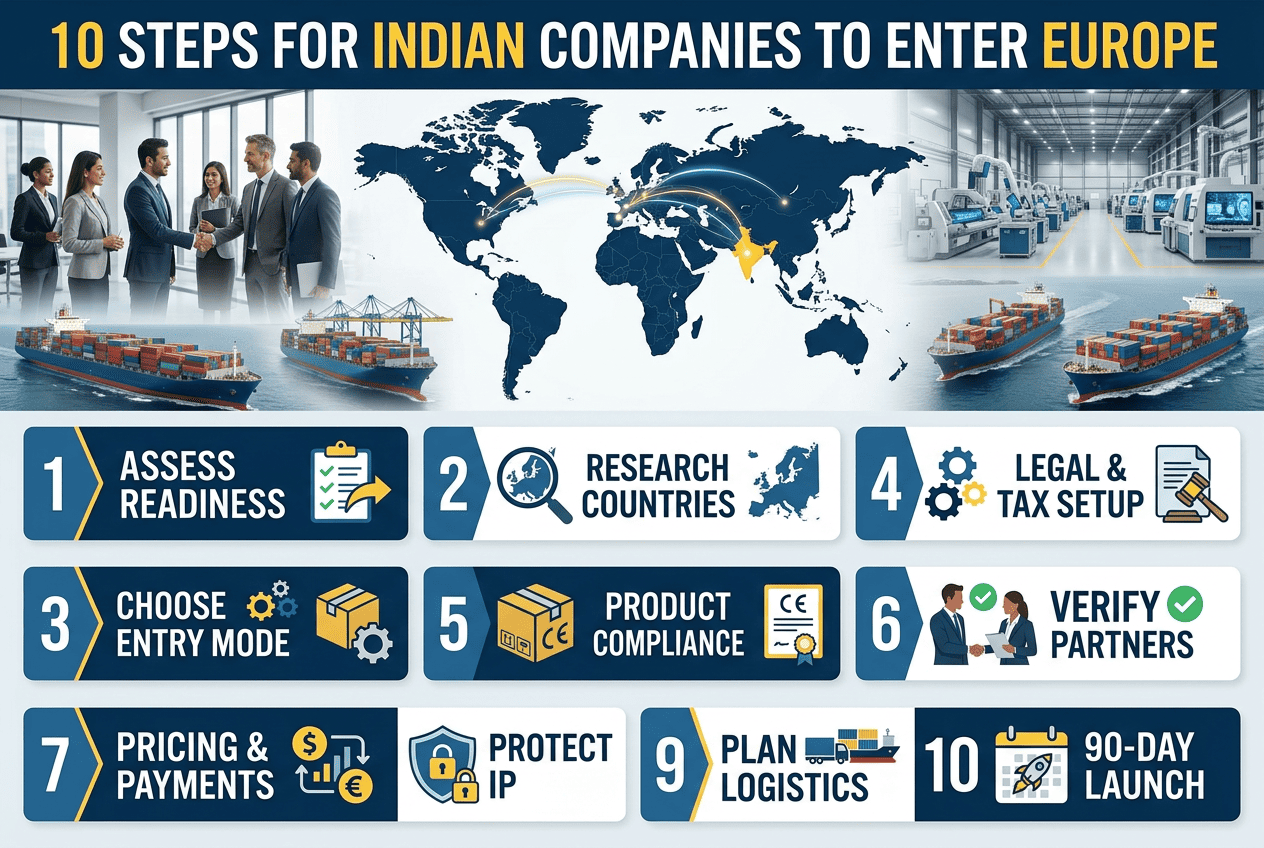
Direct Answer: An Indian company can expand into Europe in ten steps. First, test readiness and set goals. Second, research and score target countries. Third, choose an entry mode: direct export, distributor, joint venture, contract manufacturing, branch or subsidiary. Fourth, decide the legal entity, tax and banking setup. Fifth, clear product compliance such as CE marking, REACH and labelling where they apply. Sixth, find and verify local partners. Seventh, set pricing, Incoterms and payment terms. Eighth, protect your contracts and IP. Ninth, plan people, culture and logistics. Tenth, run a staged 90-day launch with KPIs and exit triggers. GTsetu helps Indian manufacturers find government‑tie‑up verified distributors and partners across 100+ countries, with anonymous discovery, built-in NDA workflows and zero broker commission.
📅 Published October 15, 2026🔄 Updated October 15, 2026⏱ 16 min read✍️ GTsetu Editorial Team
10
Expansion Steps
27
EU Member States
100+
Countries on GTsetu
0%
Broker Commission
Europe is attractive for Indian manufacturers and exporters: a large, high-income customer base, deep industrial supply chains and a regulatory framework that rewards quality. It is also demanding. Product rules, tax, data protection, language and buyer expectations differ from home, and they differ again between countries. Companies that treat Europe as one market, or skip compliance until the first shipment is stuck, tend to lose time and money.
Indian manufacturers, exporters, startups and business development teams planning to sell, partner or produce in Europe, and European buyers or distributors evaluating Indian suppliers.
⚖️ Legal, Tax & Compliance Disclaimer
This guide provides general commercial education and does not constitute legal, tax, immigration or regulatory advice. European Union, national and sector rules, trade agreements and incentives vary by country and change over time. Always confirm current requirements with the relevant authority and qualified advisers in the target country before committing.
SECTION 1
1 What Does Expanding into Europe Involve?
🎯 Definition
Expanding into Europe means building a repeatable way to sell, serve or produce in one or more European countries. For an Indian company it usually combines market and country selection, an entry mode, a legal and tax setup, product compliance, local partners, pricing and payment terms, contracts, logistics and a staged launch.
“Europe” is not one market. The European Union is a single market of 27 member states with shared rules on goods, but language, tax, labour law, business culture and buyer behaviour remain national. Non-EU markets in Europe, such as the United Kingdom and Switzerland, have their own rules. Plan by country, even when you plan for the region.
SECTION 2
2 Why Europe, and What Makes It Different
🌍
Access to a Large Single Market
Goods that comply with EU rules can generally circulate across member states, so one compliant product can reach many countries.
🏭
Deep Industrial Customers
Automotive, machinery, chemicals, healthcare, energy and food sectors offer large, technically demanding buyers.
📜
Rules-Based Environment
Clear standards and legal frameworks reward quality and documentation, but penalise shortcuts.
🛠️
Diversity to Manage
Different languages, tax systems, payment habits and buying norms mean one playbook rarely fits every country.
Look inward before looking outward. Europe rewards reliability: consistent quality, on-time delivery and responsive support. Check that you can meet those standards at scale before you commit.
1
Proven Product & Customers
Do you have repeat customers and references in India or other export markets that European buyers can validate?
Evidence, not enthusiasm
2
Capacity & Quality Systems
Can you absorb a European order without harming existing customers, and document quality to the level buyers expect?
Spare, not stretched
3
Financial Runway
Budget for certification, samples, travel, longer payment cycles and a slow first year, plus currency movements.
Fund the ramp-up
4
Ownership & Skills
Name an accountable leader, and check language, cross-cultural and technical-support skills in the team.
One accountable owner
5
Measurable Goals
Define revenue, margin, partner and timeline targets at 6, 12 and 24 months, and when you would stop.
Numbers with dates
6
IP & Brand Position
Is your IP documented, and can you protect it in Europe before you reveal designs to partners?
Know what you own
SECTION 4
4 Step 2: Research & Select Countries
Build a longlist of several countries from trade data, competitor presence and inbound enquiries, then score each on the same criteria. Many companies pick a hub country for infrastructure, services and access to the wider market, then expand to neighbours. Our guide to global market research for manufacturers covers data sources and methods in depth.
Criterion
What to Examine
Typical Evidence
Demand & Sector Strength
Size and growth of your sector, buyer clusters, price tolerance
Import statistics, industry reports, buyer interviews
Competition
Local and international rivals, price bands, existing Indian suppliers
Catalogues, distributor lists, tender data
Regulatory & Tax Climate
Company set-up rules, corporate tax, VAT, incentives, labour rules
Official investment agencies, tax authorities, local advisers
Logistics & Access
Ports, rail and road links, transit time from India, warehousing
Freight quotes, forwarder advice
Language & Business Culture
Working language of buyers, relationship norms, decision speed
Local advisers, trade bodies, existing contacts
Talent & Costs
Availability and cost of staff, offices and services
Salary surveys, office and service quotes
Network & Diaspora Links
Existing customers, Indian business communities, chambers and trade bodies
Chambers of commerce, embassy trade desks, partner introductions
The entry mode decides capital, speed, control and exposure, and it is hard to reverse. Most Indian companies start light and invest more as demand is proven.
Direct
Direct Export
Sell from India to European buyers, online or through your own team. High control; you handle compliance, customs and support.
Low commitment
Distributor
Distributors & Agents
A local partner buys and resells, or sells for you. Fast reach and local know-how; less control over customers and brand.
Fast reach
Branch
Branch or Representative Office
A local presence that is part of the Indian company. Quick to set up in some countries; liability stays with the parent.
Local presence
JV
Joint Venture or Alliance
Share ownership, cost and risk with a European partner. Strong local access; needs aligned goals and a clear exit.
Shared risk
Contract
Contract Manufacturing
A European manufacturer produces for you. Shortens delivery and eases “made in Europe” needs; demands tight quality and IP control.
Local production
Subsidiary
Subsidiary or Acquisition
Set up or buy a European company. Maximum control and credibility; highest capital, time and compliance burden.
Full control
Mode
Speed to Market
Capital Needed
Control
Key Risk
Direct Export
Fast to start
Low to medium
High
Compliance and service gaps
Distributor / Agent
Often fastest
Low
Medium to low
Partner dependency
Branch / Rep Office
Medium
Medium
High
Parent-company liability
Joint Venture
Slow to set up
Medium to high
Shared
Misaligned goals
Contract Manufacturing
Medium
Medium
Medium
Quality and IP control
Subsidiary / Acquisition
Slowest
High
Highest
Capital at risk, integration
✨ GTsetu Insight
Many Indian manufacturers start with a distributor or direct online sales, then move to a joint venture or local production once volumes justify it. For deeper alliances, read our guide to cross-border manufacturing partnerships. If you are considering buying a European business, see what is an asset purchase agreement.
SECTION 6
6 Step 4: Legal Entity, Tax & Banking
You may not need a local entity on day one, but you will need to know when you do. Hiring staff, holding stock, signing local contracts or creating a taxable presence can all change the answer. Take advice from a local lawyer and tax adviser in the target country, and from your Indian advisers on cross-border and foreign-investment rules.
Check 01
Entity Type
Compare a branch, a limited-liability subsidiary and other forms for liability, capital, governance and filing duties in your chosen country.
Check 02
Registration & Representation
Understand company registration, registered address, local director or representative requirements and beneficial-ownership disclosure.
Check 03
VAT & Customs Registration
Check VAT registration and the customs identifiers you need to import, and who acts as importer of record.
Check 04
Corporate Tax & Treaties
Review corporate tax, withholding, transfer pricing and the India tax treaty with your target country.
Check 05
Permanent Establishment
Test whether sales staff, warehouses or dependent agents could create a taxable presence without a formal entity.
Check 06
Banking & Currency
Plan a euro or local-currency account, payment methods, hedging and compliance with Indian remittance and reporting rules.
Check 07
Employment Law
Understand contracts, notice, social contributions and works-council rules before hiring or posting staff.
Check 08
Incentives & Support
Investment agencies and trade bodies may offer guidance or incentives. Treat them as inputs, and verify eligibility and terms.
Check 09
Data Protection
If you process personal data of people in the EU, confirm GDPR obligations for customers, staff and marketing.
SECTION 7
7 Step 5: Product Compliance & Certification
Compliance is where timelines slip, and it is the area where European buyers are least forgiving. Start the longest items first and confirm each requirement with the relevant authority, notified body or adviser.
✅ Typical Areas to Check
✅Product conformity: CE marking and related directives or regulations, where they apply to your product.
✅Chemicals: REACH and related rules for substances in products, plus safety data sheets where needed.
For many Indian companies the partner is the market entry. A good distributor, agent or joint-venture partner brings customers, language, compliance know-how and after-sales support. A poor one can sit on your brand for years. Combine several channels to build a longlist, then qualify and verify each candidate.
1
Define Your Ideal Partner Profile
Write down customer base, portfolio fit, country and regional coverage, sales and technical capacity, financial strength and compliance standing before you search.
2
Build a Longlist from Several Channels
Use investment and trade-promotion agencies, chambers of commerce, trade fairs, industry associations and verified platforms. Our guide to international wholesale distributors explains how to evaluate them.
3
Score Against Clear Criteria
Rate market reach, commitment, financial standing, compliance and cultural fit. Use our partnership evaluation criteria as a template.
4
Verify Independently
Check registrations, ownership, references and financial information yourself, scaling depth to your exposure. See commercial due diligence for a structured approach.
5
Trial Before You Commit
Start with a limited territory or short initial term with review points, and extend exclusivity only as performance is proven. Our international distribution agreement checklist covers the contract side.
📌 Market-Specific Planning
Partner norms and market structure differ widely between European countries. Reading a local-market guide before shortlisting helps you ask better questions. For example, our guide on how to expand a manufacturing and industrial automation business in the Czech Republic shows the level of detail worth gathering for any target country.
SECTION 9
9 Step 7: Pricing, Incoterms & Payment
A price that works in India can lose money in Europe once duties, freight, insurance, VAT treatment, partner margin, certification costs and currency movement are added. Build the export price backwards from what the European buyer will pay.
Topic
What to Define
Practical Tip
Landed Cost & Margin
Ex-works price, freight, insurance, duties, partner margin and your target margin
Model best, base and worst cases, including euro and rupee movements.
Incoterms
Who arranges transport, insurance and clearance, and where risk transfers
A rule such as FCA (Free Carrier) gives a clear handover and suits containerised exports.
Payment Terms
Currency, method, due dates, late-payment charges and security
For new buyers, consider letters of credit, advance payment or credit insurance.
VAT & Duties
Who is importer of record and who pays import VAT and customs duties
Confirm treatment with local tax advisers and check any applicable trade-agreement preferences.
Currency & Repatriation
Invoice currency, hedging, bank charges and receipt of funds in India
Confirm Indian remittance and documentation rules with your bank.
SECTION 10
10 Step 8: Contracts, IP & Risk
Put every material relationship in writing, and protect your intellectual property before you share it. Plan for failure while you still have leverage.
✅ Protect Yourself
✅Register IP first: secure trademarks, designs and patents for the markets you target before selling.
✅Sign an NDA early: before sharing drawings, pricing or strategy.
✅Define warranty clearly: scope, duration and claims handling. See warranty clause.
✅Document service duties: for installation or support, consider an MSA structure.
✅Choose dispute rules deliberately: many international deals use arbitration for neutrality and cross-border enforceability.
⚠️ Common Traps
⚠️Generic templates: they often miss mandatory local rules, such as agent or distributor compensation on termination.
⚠️Vague breach standards: define what counts as a material breach and the cure period.
⚠️No exit plan: without clear terms you may be stuck with an underperforming partner.
⚠️Assuming home courts: Indian courts are not automatically the best forum for a European dispute.
Exit Terms to Agree Up Front
Grounds:breach of contract, non-performance, insolvency, regulatory problems and change of control.
Convenience exits: whether either side may leave without cause, and on what notice. See termination for convenience.
After termination: unsold inventory, customer information, product registrations, marketing materials and trademark use.
Local law check: some European countries impose notice or compensation rules regardless of contract wording, so confirm with local counsel.
SECTION 11
11 Step 9: People, Culture & Logistics
People, Visas & Business Culture
Immigration and posting rules: sending Indian staff to Europe usually requires visas or work permits, and posting rules differ by country. Start early and confirm with local advisers.
Local hires: a local sales or technical lead often builds credibility faster than remote coverage. Understand employment contracts and notice rules first.
Culture and communication: punctuality, directness, formality and decision speed vary between countries. Adapt meetings, proposals and follow-up to local norms.
Language: provide specifications, manuals and sales material in the buyer’s language, reviewed by a native speaker.
Logistics & Supply Chain
Forwarder and customs broker: appoint experienced providers for your lane, and get written quotes with transit-time assumptions.
Documentation: prepare commercial invoices, packing lists, certificates of origin and conformity documents, and check they match the contract.
Insurance and risk transfer: match cargo insurance to your Incoterms and the value and fragility of the goods.
Stock and lead times: decide who holds European stock, and how replenishment and returns work.
Resilience: identify alternative routes, ports and suppliers, and ask key partners how they plan for disruption.
✨ GTsetu Insight
Single points of failure are the most common weakness in new markets: one forwarder, one port, one supplier or one partner. Mapping them before launch costs little; discovering them mid-shipment costs a great deal.
SECTION 12
12 Step 10: 90-Day Launch & Review
Launch in stages rather than all at once. A pilot in one country, with a few named customers or one product line, lets you learn cheaply and build references before you scale.
1
Days 1–30: Prepare & Set Up
Finish compliance and registrations, sign partner agreements, train partner teams, set up reporting and agree the first target-account list.
2
Days 31–60: First Shipments & Customer Meetings
Ship initial orders, attend joint customer meetings, and record objections, price feedback and competitor responses.
3
Days 61–90: First Formal Review
Compare results with goals: pipeline, orders, margin, delivery performance, payment behaviour and customer feedback. Decide whether to scale, adjust or pause.
4
Ongoing: KPIs & Expansion Triggers
Track a short set of KPIs, review quarterly, and agree in advance which results justify entering a second country or setting up a local entity.
Pipeline
Qualified opportunities and named accounts, not just enquiries.
Margin
Realised margin after duties, freight, discounts and currency.
Delivery
On-time, in-full shipments and customs clearance times.
Cash
Days to payment and overdue balances by customer.
SECTION 13
13 Red Flags That Should Slow You Down
None of these signs is automatically fatal, but each deserves a direct answer before you commit more money or time.
🚩
Treating Europe as One Market
One price list, one language and one plan for every country, without checking local rules and buyer habits.
🚩
Unverified Partner Identity
Unclear ownership, inconsistent company details or no verifiable registration for a prospective partner.
🚩
Compliance Left Until Later
Plans to ship before CE, REACH, labelling and import requirements are confirmed for your product.
🚩
Pricing Ignores Landed Cost
Quotes that leave out duties, freight, partner margin or currency risk, leaving no room for error.
🚩
Exclusivity Without Performance
Granting broad exclusive rights before a partner has shown capability, a plan or measurable commitments.
🚩
Unplanned Tax Presence
Staff or stock in Europe that quietly create a taxable presence or employment obligations without an entity.
✨ GTsetu Insight
Identity gaps and weak early diligence sit behind many failed partnerships. See our guide on why trust breaks in global deals for the failure patterns to avoid.
SECTION 14
14 The Final Pre-Launch Checklist
Use this list before you ship your first order or sign your first agreement. If you cannot tick an item, resolve it first.
Area
Confirm Before Launch
Readiness
Capacity, budget, owner and 6/12/24-month goals defined, with a stop point agreed.
Country
Several countries scored on the same criteria; first market tested with primary research.
Entry Mode
Mode chosen on capital, speed, control and risk; fallback option identified.
Entity, Tax & Banking
Need for a local entity assessed; VAT, customs, tax presence and payment flows confirmed with advisers.
Compliance
CE, REACH, labelling, customs and sector rules confirmed for your product; responsibilities assigned.
Partners
Identity, ownership, references and capability verified independently; written agreement signed.
IP registered for target markets; NDA, warranty, liability and exit terms agreed.
People & Logistics
Visas, local hires, language material, forwarder, documents, insurance and contingency routes in place.
Launch & Review
Pilot scope, KPIs, review dates and scale-up or exit triggers agreed.
PLATFORM
15 How GTsetu Helps Indian Companies Find Partners
🌐 Platform Spotlight, GTsetu
Your Verified Gateway to Distributors & Partners
For most Indian manufacturers, the hardest part of entering Europe is finding a local partner who exists as described, and sharing sensitive information safely. GTsetu connects manufacturers with government‑tie‑up verified distributors and partners across 100+ countries, with built-in NDA workflows and encrypted collaboration. Every company on GTsetu is verified through direct government tie‑ups across six credentials: legal name, registered address, registration number, company status, company type, and date of certificate of incorporation. GTsetu does not verify industry certifications, financial standing, sales capability or references; those must be checked directly between partners during due diligence.
✅
Government Tie‑Up Verification
6‑point verification: legal name, registered address, registration number, company status, company type, incorporation date.
📜
Certifications & Financials
GTsetu does not verify these. Exchange and validate them directly between partners.
🕵️
Anonymous Discovery
Explore partner profiles without revealing your identity until mutual interest is confirmed.
📄
Built-In NDA Workflow
Formalise confidentiality before sharing pricing, specifications or strategy, with a full digital audit trail.
🚫
Zero Commission
No broker fees on any deal, whether a distribution agreement, supply contract or technology partnership.
🔐
Encrypted Collaboration
Documents and communications encrypted in transit and at rest. Secure B2B collaboration from first contact.
🌍
100+ Countries
A verified network of distributors, importers and supply chain partners.
Most Indian companies follow a staged path: research and shortlist target countries, choose an entry mode such as direct export, a distributor, a joint venture or a local subsidiary, clear product compliance and tax requirements, find and verify local partners, set pricing and payment terms, and launch with a pilot before scaling. Many start with exports or a distributor and set up a local entity once demand is proven.
QDo I need a legal entity in Europe to sell there?
Not always. Many companies export directly or sell through a distributor without a local entity. A local entity or branch becomes useful when you need local employees, contracts, invoicing, warehousing or tax registration. Rules differ by country and by activity, so take local legal and tax advice before deciding.
QWhat compliance is needed to sell products in the EU?
Requirements depend on the product. Common areas include product safety and conformity marking such as CE marking where applicable, chemical rules such as REACH, labelling and language requirements, customs registration and classification, VAT, data protection under GDPR and sector-specific licences. Confirm the rules that apply to your product with the relevant authority or an adviser before shipping.
QWhich European country should an Indian company enter first?
There is no single best country. Score shortlisted countries on demand in your sector, competition, regulatory and tax environment, logistics, language, talent and existing customers or partners. Many companies choose a hub for its infrastructure and access to the wider single market, then expand to neighbouring countries.
QIs a distributor or a subsidiary better for entering Europe?
A distributor is usually faster and cheaper to start with and brings local relationships, but gives you less control over customers and brand. A subsidiary gives more control and a stronger local presence but needs more capital, compliance work and management time. Many companies start with a distributor and move to a subsidiary as volumes grow.
QHow do I find a trustworthy European distributor or partner?
Define your ideal partner profile, build a longlist from trade bodies, fairs and verified platforms, then verify identity, ownership, references, certifications and financial standing independently. Start with a limited territory or short initial term, and put the relationship into a written agreement with performance targets and exit terms.
QHow does GTsetu help Indian companies expand into Europe?
GTsetu helps manufacturers find and verify distributors and partners across 100+ countries. Every company is verified through government tie-ups on six core credentials (legal name, registered address, registration number, company status, company type, incorporation date). GTsetu offers anonymous discovery, built-in NDA workflows, encrypted collaboration and zero broker commission. GTsetu does not verify certifications, financial standing or sales capability, so those must be checked directly between partners.
Ready to Find a Verified Partner in Europe?
Join 500+ verified manufacturers, exporters and distributors already building cross-border partnerships on GTsetu, with government‑tie‑up verification of six core credentials, built-in NDA workflows and zero broker fees across 100+ countries.
They represents the product, and research team behind GTsetu, a global B2B collaboration platform built to help companies explore cross-border partnerships with clarity and trust. The team focuses on simplifying early-stage international business discovery by combining structured company profiles, verification-led access, and controlled collaboration workflows.
With a strong emphasis on trust, and disciplined engagement, Team GTsetu shares insights on global trade, partnerships, and cross-border collaboration, helping businesses make informed decisions before entering deeper commercial discussions.