How to Expand Your Business Into the Middle East: A Practical GCC Market-Entry Guide
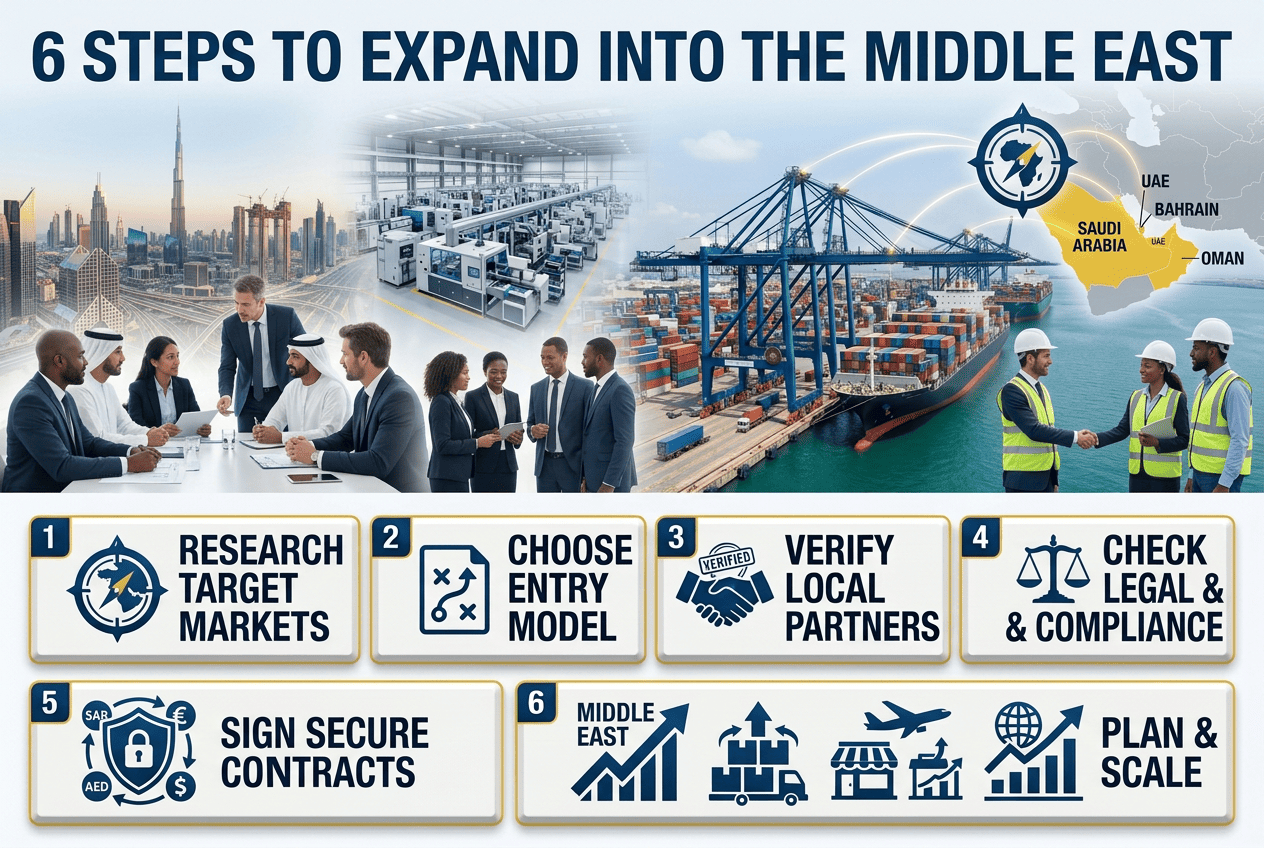
Direct Answer: To expand into the Middle East, follow six steps. First, research one or two target markets, usually within the GCC, and validate demand with real buyers. Second, choose an entry model: a distributor or agent, a free-zone or mainland entity, a joint venture, or direct sales. Third, find and qualify partners on six dimensions and verify them independently. Fourth, confirm legal structure, tax and product compliance country by country. Fifth, sign a written contract covering exclusivity, pricing, Incoterms, payment security, IP, termination and dispute resolution. Sixth, run a phased 12-month plan with regular reviews and contingency for regional risk. GTsetu helps manufacturers find government‑tie‑up verified distributors and partners across 100+ countries, with anonymous discovery, built-in NDA workflows and zero broker commission.
📅 Published October 26, 2026🔄 Updated October 26, 2026⏱ 16 min read✍️ GTsetu Editorial Team
6
GCC Markets Profiled
5
Entry Models Compared
100+
Countries on GTsetu
0%
Broker Commission
The Middle East, and the Gulf Cooperation Council (GCC) in particular, combines large infrastructure programmes, diversification away from oil, strong logistics hubs and a deep import base. For manufacturers and exporters it can be a high-value market. It can also punish assumptions: rules differ by country, local partners matter enormously, and conditions can shift quickly.
Manufacturers, exporters and business development teams planning to sell into or set up in the Middle East, and founders deciding between a distributor, a local entity or a joint venture. It is also useful for distributors in the region evaluating foreign suppliers.
⚖️ Legal, Tax & Conditions Disclaimer
This guide provides general commercial education and is not legal, tax or regulatory advice. Company-law, agency, tax, customs and product rules differ by country and change often, and regional security and trade conditions can shift. Confirm current requirements, rates and travel or trade advisories with qualified local advisers and official sources before committing.
SECTION 1
1 Why the Middle East Is on Every Expansion List
🎯 The Opportunity
The GCC offers sovereign-backed infrastructure investment, free-zone and licensing reforms, strong logistics hubs and growing local manufacturing and services demand. For foreign companies, the main opportunity is supplying the projects, industries and consumers those programmes create, usually through a well-chosen local partner.
HSBC’s October 2026 analysis reports that, excluding oil, UAE foreign trade reached a record AED 1.94 trillion (about USD 527 billion) in the first half of 2026, up 13.1% year on year, with non-oil exports up 24%. It also cites a regional capital-project pipeline that had reached an aggregate USD 3.2 trillion across all sectors by 2025, and notes that governments are opening privatisations, public-private partnerships, new free-zone and licensing regimes, and foreign ownership and residency reforms.
AED 1.94T
UAE non-oil foreign trade, H1 2026 (HSBC)
+13.1%
Year-on-year growth in UAE non-oil trade, H1 2026
$3.2T
GCC capital-project pipeline by 2025 (cited by HSBC)
📌 Read the Current Conditions Honestly
The same HSBC analysis notes that the ongoing regional conflict has changed corporate behaviour through 2026, with some Gulf companies delaying non-essential spending and building liquidity buffers, while others reshape supply chains toward local procurement. Treat that as a planning input, not a reason to ignore the region: build flexibility, insurance and contingency into your plan.
SECTION 2
2 The GCC Markets at a Glance
The “Middle East” is not one market. Even within the six GCC states, regulation, buying behaviour and entry routes differ. This table is a qualitative starting point for choosing where to look first, not a substitute for market research.
Market
Typical Entry Angle
Things to Check First
UAE
Trade and re-export hub; free zones; regional headquarters
Free zone vs mainland access, product registration, VAT and corporate tax treatment
Saudi Arabia
Largest domestic market; large government-backed programmes
Local-content expectations, conformity requirements, licensing and regional-HQ rules
Qatar
Infrastructure, energy, services and hospitality
Agent or sponsor requirements, tender processes
Kuwait
Project and consumer demand through established trading houses
Local agent rules, payment terms, public-sector procurement
Oman
Industrial zones, logistics and manufacturing partnerships
Local-value-add policies, port and zone options
Bahrain
Smaller market with a service and finance orientation; regional access
Licensing route, role as a base versus a market
SECTION 3
3 Step 1: Choose Your Entry Model
The entry model decides your capital at risk, speed, control and legal exposure. Many companies start light with a distributor or agent and add a local presence once demand is proven.
Desk research tells you a market is large; buyer conversations tell you whether it will buy your product from you. Do both for one or two priority markets rather than the whole region.
1
Demand Drivers
Map which projects, industries or consumer trends create demand for your product, and who actually buys: contractors, government entities, distributors or retailers.
Who buys and why
2
Competitor Landscape
See which local and international brands you will face, how they reach customers and where they are weak on price, service or lead time.
Gaps you can fill
3
Regulation & Standards
Identify product registration, conformity, labelling and import rules early, because they set your timeline and cost.
Before you ship
4
Pricing & Margin
Work back from the landed price: freight, duties, local VAT, distributor margin and payment-term costs, then test whether you stay competitive.
Landed-cost model
5
Local Content & Procurement
Government and large-project buyers may favour local suppliers or local value-add. Check whether partnering or local assembly improves your position.
Public-sector rules
6
Logistics & Routes
Compare ports, free zones and inland routes for reliability and cost, and plan alternatives given regional disruption risk.
Relationships carry real weight in Gulf business, and the right local partner can open doors that cold outreach cannot. Build a longlist from several channels, then verify everyone independently.
1
Government & Chamber Channels
Export promotion agencies, embassies’ trade desks and chambers of commerce offer introductions and market information. Treat them as one input, not a substitute for due diligence.
2
Trade Fairs & Industry Associations
Regional exhibitions and association directories let you meet many candidates quickly. Qualify them against your partner profile instead of collecting business cards.
3
Competitor & Project Mapping
Find out who already supplies comparable products and which contractors or trading houses win the projects you want. Their partners show how distribution works in your sector.
4
Professional Networks & Advisers
Local law firms, accountants and consultants can introduce credible counterparts and explain local practice. Our guide to international wholesale distributors explains how to evaluate them.
5
Verified Partner Platforms
Platforms such as GTsetu show companies whose legal identity has been checked against government sources, so you spend time on commercial fit, not basic existence checks.
SECTION 6
6 Step 4: Qualify and Vet Candidates
🎯 The Rule
A warm introduction is not due diligence. Qualify every candidate on six dimensions and independently verify what matters most, scaling the depth of checks to your financial exposure. See our guides on commercial due diligence and partnership evaluation criteria.
🤝
1. Market Reach & Customers
Which of your target customers do they supply today? Ask for references and call them yourself.
📈
2. Sales Capability & Commitment
Who owns your account, how many people will sell it, and what is the first-year plan? Ask for an account plan, not promises.
🏦
3. Financial Standing
Can they fund inventory, meet minimum orders and pay on agreed terms? Request trade references and financial information.
📜
4. Licences & Compliance
Check trade licences, relevant product registrations and public enforcement records, and verify certificates with issuers.
🎯
5. Strategic Alignment
Why do they want your product, and how will they prioritise it against competing suppliers they already represent?
🌐
6. Cultural & Commercial Fit
Discuss expectations on exclusivity, marketing spend, reporting and what happens if targets are missed.
Red Flags to Pause On
🚩
Exclusivity Demanded Up Front
Asking for the whole region before showing access, capability or a credible plan.
🚩
Opaque Ownership
Unclear owners, inconsistent company names or gaps between the registered and operating entity.
🚩
Unverifiable References
Big claims about government or project access with no named, checkable customers.
🚩
Resistance to Reporting
Reluctance to share pipeline, sales data or accept regular business reviews.
SECTION 7
7 Legal Structure, Tax and Agency Rules
Company, tax and agency law differs sharply across the region, and it has been changing. Your choice of structure should follow advice from local counsel, but these are the questions to bring to that conversation.
Foreign ownership and licensing. Which activities can a foreign company own outright, and which need a local partner or sponsor? Several GCC states have loosened ownership rules in recent years, so check current rules rather than old guides.
Free zone versus mainland. Free zones can offer simpler set-up and ownership, but may restrict direct onshore trading. Mainland access may need a local licence or distributor. Confirm exactly which customers you can sell to.
Commercial agency and distribution laws. Some countries regulate agency or distribution relationships, including registration, exclusivity and compensation on termination. A contract that ignores these can surprise you later.
Tax and customs. Confirm VAT, corporate tax, withholding tax, duty and customs treatment for your model, and how a local presence could create a taxable permanent establishment.
Put the relationship in a written agreement tailored to local law. For the full clause list, see our companion international distribution agreement checklist; the points below are the ones that most often matter in the Gulf.
⚠️Defaulting to home courts: choose governing law, seat and arbitration rules deliberately with local counsel.
SECTION 10
10 Relationships, Culture and Regional Risk
Relationships Come First
Deals in the Gulf are often built on trust developed over repeated meetings. Expect longer decision cycles, value in-person visits, respect local business customs and religious calendars (plan around Ramadan and Eid), and invest in a named relationship owner on both sides. Use local advisers to avoid avoidable missteps.
Plan for Disruption
Diversify routes and suppliers. Identify alternative ports, free zones and carriers before you need them.
Hold buffer stock locally for critical lines, with clear terms for who bears holding cost and risk.
Insure and review. Check cargo, credit and political-risk cover, and keep travel and security advisories under regular review.
Be flexible on timing. HSBC reports some regional buyers deferred non-essential spend during 2026, so build that into forecasts and payment-term assumptions.
Shortlist one or two markets, validate demand with buyer calls, model landed cost and choose your entry model.
2
Months 2–4: Partner Search and Due Diligence
Build a longlist, run structured qualification, verify identity and references, and sign NDAs before sharing sensitive information.
3
Months 4–6: Legal, Compliance and Contract
Take local advice, finalise structure and tax approach, complete product registration, register IP and sign the agreement.
4
Months 6–9: Launch and Onboarding
Train the partner’s team, agree a joint target-account list, attend key customer meetings together and ship pilot orders.
5
Months 9–12: Review and Scale
Hold a formal performance review, adjust targets, decide whether to add a local presence or second market, and refresh your contingency plans.
PLATFORM
12 How GTsetu Helps You Enter the Middle East
🌐 Platform Spotlight, GTsetu
Your Verified Gateway to Distributors & Partners
The hardest part of entering a new region is finding a partner who exists as described and sharing sensitive information safely. GTsetu connects manufacturers and exporters with government‑tie‑up verified distributors and partners across 100+ countries, with built-in NDA workflows and encrypted collaboration. Every company on GTsetu is verified through direct government tie‑ups across six credentials: legal name, registered address, registration number, company status, company type, and date of certificate of incorporation. GTsetu does not verify industry certifications, financial standing, sales capability or references; those must be checked directly between partners during due diligence.
✅
Government Tie‑Up Verification
6‑point verification: legal name, registered address, registration number, company status, company type, incorporation date.
📜
Certifications & Financials
GTsetu does not verify these. Exchange and validate them directly between partners.
🕵️
Anonymous Discovery
Explore distributor profiles without revealing your identity until mutual interest is confirmed.
📄
Built-In NDA Workflow
Formalise confidentiality before sharing pricing, specifications or strategy, with a full digital audit trail.
🚫
Zero Commission
No broker fees on any deal, whether a distribution agreement, supply contract or joint venture.
🔐
Encrypted Collaboration
Documents and communications encrypted in transit and at rest. Secure B2B collaboration from first contact.
🌍
100+ Countries
A verified network of distributors, importers and supply chain partners.
QHow do I expand my business into the Middle East?
Start by researching demand and regulation in one or two target markets, then choose an entry model (distributor or agent, free-zone or mainland entity, joint venture, or direct sales). Find and independently verify local partners, confirm product and labelling compliance, put the relationship in a written contract with clear Incoterms, payment and termination terms, and run a phased 12-month plan with regular reviews.
QWhich Middle East country should I enter first?
Many companies begin with the UAE because of its trade connectivity and re-export role, or Saudi Arabia because of its market size and large government-backed programmes. The right first market depends on your sector, customers, regulation and partner availability, so validate demand with buyer conversations before committing.
QShould I use a distributor, a free-zone company or a mainland entity?
A distributor or agent is the fastest, lowest-capital route and suits testing demand. A free-zone company can offer ownership and operating flexibility but may limit direct trading onshore. A mainland entity gives full local market access but involves more set-up and compliance. Rules differ by country and change over time, so get local legal advice before choosing.
QHow do I find a reliable distributor in the Gulf?
Combine government trade bodies, chambers of commerce, trade fairs, industry associations, professional networks and verified partner platforms to build a longlist. Then qualify candidates on market reach, sales capability, financial standing, compliance, strategic alignment and cultural fit, and verify references and registrations independently.
QWhat legal issues should I check before signing with a Middle East partner?
Check whether local commercial agency or distribution laws apply and what they say about exclusivity, registration and termination compensation. Also confirm governing law and dispute resolution, IP registration, tax and VAT treatment, and product registration. These rules vary by country, so take advice from local counsel.
QDo I need special certifications to sell in the GCC?
Many product categories need conformity assessment, registration or labelling that meets local requirements, and food, cosmetics, medical and some industrial products may need additional approvals such as halal certification. Requirements differ by country and product, so confirm with the relevant authority or your partner before shipping.
QHow does GTsetu help with entering the Middle East?
GTsetu helps manufacturers and exporters find and verify distributors and partners across 100+ countries. Every company is verified through government tie-ups on six core credentials (legal name, registered address, registration number, company status, company type, incorporation date). GTsetu offers anonymous discovery, built-in NDA workflows, encrypted collaboration and zero broker commission. GTsetu does not verify certifications, financial standing or sales capability, so those must be checked directly between partners.
Ready to Find a Verified Partner in the Middle East?
Join 500+ verified manufacturers, exporters and distributors already building cross-border partnerships on GTsetu, with government‑tie‑up verification of six core credentials, built-in NDA workflows and zero broker fees across 100+ countries.
They represents the product, and research team behind GTsetu, a global B2B collaboration platform built to help companies explore cross-border partnerships with clarity and trust. The team focuses on simplifying early-stage international business discovery by combining structured company profiles, verification-led access, and controlled collaboration workflows.
With a strong emphasis on trust, and disciplined engagement, Team GTsetu shares insights on global trade, partnerships, and cross-border collaboration, helping businesses make informed decisions before entering deeper commercial discussions.