Contract Manufacturer vs Captive Manufacturing: Complete Decision Guide | GTsetu
Home ›
Blogs ›
Contract Manufacturer vs Captive Manufacturing
🏭 Manufacturing Strategy & Procurement
Contract Manufacturer vs Captive Manufacturing: Complete Decision Guide
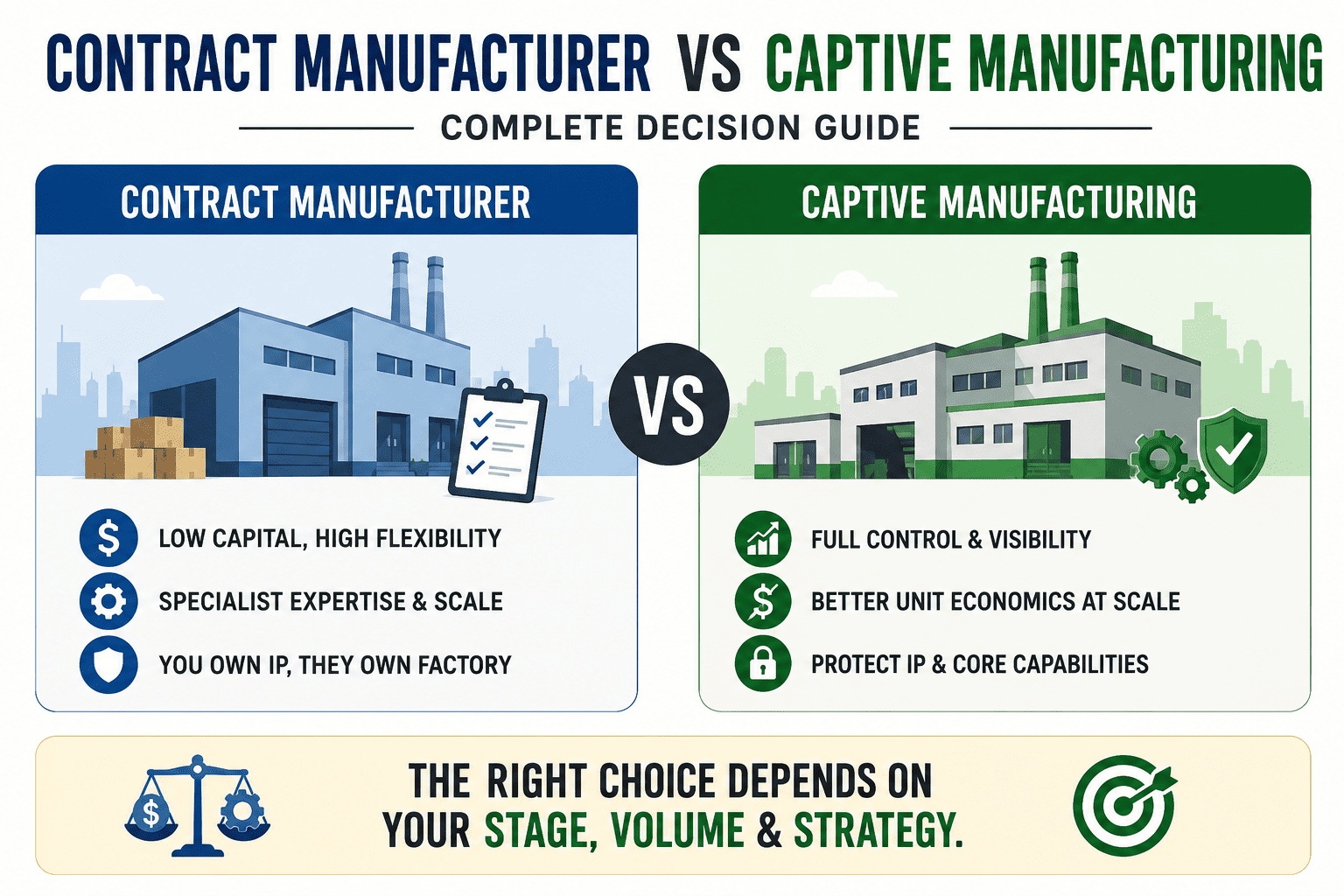
Direct Answer: Contract manufacturing means outsourcing production to a specialist third-party manufacturer who builds to your specifications, you own the IP, they own the factory. Captive manufacturing (in-house) means you own and operate the production facility yourself. The core trade-off is capital efficiency and flexibility (contract) versus direct control and long-run unit economics (captive). Neither is universally superior. The right answer depends on your growth stage, volume profile, competitive strategy, and how proprietary your manufacturing process actually is. This guide gives you the complete comparison and a five-question decision framework.
📅 May 1, 2026⏱ 19 min read✍️ GTsetu Editorial Team🔄 Updated regularly
9
Comparison Dimensions
5
Decision Questions
3
CM Types Covered
27
Internal Resources
The make-vs-buy decision is one of the most consequential a manufacturing company will face. Get it right and you build an operation that is lean, scalable, and commercially efficient. Get it wrong and you either tie up capital in facilities that constrain your flexibility for years, or you hand over production control to a partner whose incentives do not align with yours at the moments that matter most.
The choice between contract manufacturing and captive (in-house) manufacturing is not simply an operational question, it has direct implications for cash flow, product quality, speed to market, IP protection, and the ability to execute cross-border business partnerships and international market entry at pace. This guide gives you the complete framework to make the right call, rigorously, not on intuition.
💡 Who This Guide Is For
This article is written for founders, commercial directors, and procurement leaders in product companies, OEMs, and industrial manufacturers evaluating whether to outsource production to a contract manufacturer or invest in captive manufacturing capability. It is also relevant for distributors assessing the manufacturing models of their supplier partners. See also: trialing and scaling production for startups and long-term supplier management.
SECTION 1
1 Defining the Two Models
Model A
Contract Manufacturing
Production outsourced to a specialist third-party manufacturer
You own the IP, the brand, and the product design
The contract manufacturer owns the facility and employs the workforce
You pay per unit produced (variable cost structure)
Production can scale up or down without capital commitment
Multiple contract manufacturers may be engaged for different products or geographies
Model B
Captive Manufacturing (In-House)
You own or lease the production facility
You employ the production workforce directly
You maintain and invest in the equipment and production systems
High fixed cost structure regardless of production volume
Direct control over every production variable in real time
Manufacturing capacity is captive to your production requirements alone
📖 What “Captive” Means
The term captive manufacturing refers to the fact that the facility’s entire production capacity is “captive” to one company’s requirements, unlike a contract manufacturer’s facility, which serves multiple clients simultaneously. A captive factory is entirely dedicated to its owner’s production, which maximises control but also concentrates all the overhead, capital risk, and operational complexity in that single entity.
typical lead time to reach production readiness in a new captive facility versus weeks with an established contract manufacturer
30–60%
of production cost in captive manufacturing is fixed overhead, present even when demand falls below capacity
$2M–$50M+
typical capital investment range to establish a captive manufacturing facility, depending on product complexity and scale
SECTION 3
3 Types of Contract Manufacturing
Contract manufacturing is not a single model, it spans a spectrum of outsourcing arrangements that differ in how much the CM contributes beyond pure labour and facilities. Understanding which type of contract manufacturing arrangement fits your situation is as important as the make-vs-buy decision itself. The wrong type of CM arrangement can create the same problems as the wrong make-vs-buy choice.
Product design, specifications, brand, and quality sign-off. Minimal operational involvement.
Companies wanting maximum operational simplicity; early-stage products; OEM and brand owners with no in-house production capability
Partial / Consignment Contract Manufacturing
Production labour, facilities, and equipment. May provide some components.
Key materials, critical components, and sometimes tooling. You control the supply chain for critical inputs.
Companies with established supplier relationships for key components; situations where supply security for critical materials is a priority
Toll Manufacturing
Processing labour and equipment only. No materials sourcing.
All raw materials and inputs. You supply everything; the CM converts it.
Commodity chemicals, food processing, metals; situations where the buyer controls the raw material specification tightly and the CM is purely a processing resource
Design + Manufacture (ODM)
Design, engineering, production, and sometimes the brand itself. The CM creates the product to a specification brief.
Performance specification and brand identity. Limited engineering input.
White label and private label products; technology partnerships where the CM has deeper engineering capability; companies prioritising speed over design ownership
Electronic Manufacturing Services (EMS)
PCB assembly, electronics manufacturing, testing, and often supply chain management for electronic components.
PCB design files, firmware, and product design. Engineering collaboration throughout.
Electronics, industrial automation, medical devices; products with complex electronics requiring specialist assembly capability
📌 Toll Manufacturing vs Contract Manufacturing
The distinction between toll manufacturing and full contract manufacturing is critical for companies in chemicals, food, and materials processing. In toll manufacturing, you supply the raw materials and pay the CM for conversion only, you retain full control of the input supply chain and the CM’s role is purely processing. In full contract manufacturing, the CM also sources materials, which transfers both supply chain risk and supply chain management to them. The choice between these arrangements has significant implications for cross-border business tax treatment and import/export liability.
SECTION 4
4 Head-to-Head: 9 Key Dimensions
💰
Upfront Capital & Fixed Costs
Building captive production capability at commercial scale requires substantial capital: machinery, tooling, facility fit-out, infrastructure, compliance certification, and working capital for inventory. For most product companies, this capital generates higher returns when deployed into product development, market expansion, or distribution. Contract manufacturing converts production capex into a variable operating expense, you pay per unit shipped, and your balance sheet stays clean. Edge: Contract Manufacturing
📈
Scalability & Demand Flexibility
Captive capacity is fixed. When demand exceeds it, you turn away orders or invest in expansion, a process that takes months and capital. When demand falls below it, you carry the overhead of idle assets. Contract manufacturers are built to flex: increasing or decreasing volumes by 20–50% can typically be accommodated within weeks. For companies with seasonal demand, new product launches, or uncertain growth trajectories, this flexibility is commercially critical. Edge: Contract Manufacturing
⚡
Speed to Market
An experienced contract manufacturer already has the production processes, qualified supplier networks, and validated quality systems for the type of product you need. Your captive team would spend 6–18 months reaching equivalent production readiness. For companies facing competitive pressure to launch fast, particularly those pursuing international market entry simultaneously, speed is a critical advantage of the CM model. Edge: Contract Manufacturing
🔍
Quality Control & Oversight
Captive manufacturing gives you direct, real-time control over every production variable, walk the floor, stop the line, implement changes immediately. Contract manufacturing requires disciplined quality control in overseas manufacturing through inspection protocols, factory audits, and contractual SLAs. Reputable CMs with ISO 9001 and sector-specific certifications often have more mature quality management systems than early-stage captive operations, however. Edge: Marginal captive advantage unless CM has stronger QMS
🔐
IP & Process Protection
Captive manufacturing carries zero risk of IP leakage through the supply chain, your processes, formulations, and designs remain entirely within your control. Contract manufacturing introduces IP exposure that must be managed through comprehensive NDAs, IP registration in relevant jurisdictions, audit rights, and careful CM partner selection and due diligence. For companies where the manufacturing process itself is the source of competitive advantage, captive manufacturing may be the only viable model. Edge: Captive Manufacturing
🛠️
Access to Specialist Technology
State-of-the-art CNC machining, high-pressure die casting, precision injection moulding, SMT assembly, and pharmaceutical-grade clean room production each require years of capital investment and process mastery to operate at quality. An experienced CM has made those investments across multiple customers’ products. Building equivalent capability in a captive facility requires both the capital and the time to develop the operational expertise. Edge: Contract Manufacturing
🧠
Operational Focus & Management Attention
Running a factory is a full-time job requiring manufacturing engineering expertise, operational management talent, equipment maintenance, HR management, compliance oversight, and ongoing capital. Every senior person dedicated to running production is a person not focused on product development, customer relationships, or market expansion. The true cost of captive manufacturing includes this opportunity cost, which is rarely captured in financial models. Edge: Contract Manufacturing
📦
Supply Chain Resilience
Single-facility captive manufacturing concentrates supply chain risk in one location. Geopolitical events, natural disasters, or operational failures at one facility can halt production entirely. A well-managed contract manufacturing strategy, with dual-sourced production across multiple CMs in different geographies, provides resilience that captive manufacturing cannot replicate without enormous capital investment. The China plus one strategy is a direct response to this risk. Edge: Contract Manufacturing (with multi-CM strategy)
💹
Long-Run Unit Economics
At very high, very stable volumes, a single product manufactured in millions of identical units annually, with minimal variation, the fixed costs of captive production amortise to a per-unit cost that can beat contract manufacturing (which includes the CM’s margin). Below that threshold of volume and stability, the variable cost structure of CM is almost always more economical when total cost of ownership is calculated, including the capital cost of facility investment. Edge: Captive at ultra-high stable volume; Contract Manufacturing below that
SECTION 5
5 Cost Structure Breakdown
The most common mistake in comparing contract manufacturing and captive manufacturing is comparing unit costs in isolation. The real comparison is between cost structures, the pattern of fixed and variable costs, their behaviour at different volumes, and the total capital committed over the life of the production decision.
Cost Category
Contract Manufacturing
Captive Manufacturing
Facility
Zero, embedded in CM’s per-unit price
Lease or ownership cost, fit-out capex, ongoing maintenance, utilities
Equipment & Tooling
Tooling often shared cost; major equipment zero
Full equipment purchase or lease; ongoing maintenance and upgrade capex
Workforce
Zero direct, CM employs production staff
Full payroll: production operators, engineers, supervisors, HR, safety
Compliance & Certification
CM carries; may pass through as line item
Full cost: ISO, GMP, sector-specific certifications, audits, ongoing maintenance
Higher, raw material, WIP, and finished goods on your balance sheet
Idle Capacity Cost
Zero, you only pay for units produced
Full fixed cost burden continues when volumes fall below capacity
Per-Unit Variable Cost
Higher (includes CM margin) but only incurred on actual production
Lower variable cost per unit at high volumes, but fixed overhead must be added
Breakeven Volume
Low, no fixed cost base to recover
High, significant fixed costs must be covered before any profit is generated
⚠️ The Hidden Costs of Captive Manufacturing
Financial models for captive manufacturing frequently underestimate: (1) the time and cost of reaching full production efficiency, the “learning curve” ramp that can take 12–24 months; (2) ongoing maintenance and upgrade capex to keep equipment competitive; (3) the management time cost of running a factory rather than building products and markets; and (4) the regulatory compliance cost, which compounds in regulated industries. The true cost of global expansion, including production establishment, is almost always higher than the initial financial model projects. See also: challenges of global expansion.
SECTION 6
6 When Contract Manufacturing Wins
🚀
Early-Stage & New Product Launches
Before demand is validated at commercial volumes, committing capex to captive manufacturing is an enormous risk. Contract manufacturing lets you prove the product in the market, validate demand, iterate the design, and reach commercial volumes, before making irreversible facility investment. See: trialing and scaling production for startups for the detailed approach.
🔀
High-Mix, Variable Volume Production
If your product range spans multiple SKUs with varying volumes, different colours, configurations, specifications, maintaining captive tooling, equipment, and process expertise for all of them is impractical. Contract manufacturers with broader capabilities handle high-mix production efficiently across their multi-client base.
🌍
Geographic Market Expansion
Entering a new geography requires production capacity in or near that market, often without the lead time to build captive capability. A contract manufacturer in the target market gives you production capacity immediately, supporting market entry partnerships and distributor network expansion without facility investment. The China plus one strategy, diversifying production across multiple geographies, is only practically achievable through contract manufacturing partnerships.
⚙️
Specialist Technology Access
Your product requires manufacturing technology, precision machining, advanced ceramics, pharmaceutical-grade clean room production, that would require years and tens of millions to replicate in a captive facility. A specialist CM has already made that investment and developed the process expertise across multiple clients’ volumes, making access economically viable at your scale.
📅
Seasonal or Unpredictable Demand
Products with significant seasonal variation, consumer goods, agricultural equipment, fashion categories, need production capacity that flexes with demand cycles. Captive manufacturing for peak demand means idle capacity in the trough; captive manufacturing for trough demand means turning away orders at peak. Contract manufacturing absorbs the variation.
💡
Core Advantage Not in Manufacturing
If your competitive advantage is in product design, brand, distribution, or customer relationships, not in the manufacturing process itself, then captive manufacturing is a distraction from your core business. Contract manufacturing is not a concession; it is a strategic choice to focus your resources where your differentiation actually lives. This is why most global brands in consumer electronics, apparel, and consumer goods use contract manufacturing exclusively.
SECTION 7
7 When Captive Manufacturing Wins
Case 1: Unit Economics
Ultra-High Volume, Stable Runs
Single product manufactured in millions of units annually
Minimal design variation across the production run
Highly stable, predictable demand, no seasonal spikes
Fixed costs fully amortised across large volumes
Captive wins when volume is very high and very stable
Case 2: Competitive Advantage
Proprietary Process as Differentiation
Manufacturing process is itself the source of competitive advantage
Process cannot be adequately specified in a contract
Tacit knowledge that cannot be documented sits in your operators
IP leakage through a CM would erode market position
Captive wins when the process IS the product
Case 3: Regulatory Requirement
Direct Oversight Mandated
Certain pharmaceutical, nuclear, or classified defence applications
Regulatory framework requires direct production oversight
Audit rights and CM inspection cannot satisfy the compliance requirement
Customer or government contract mandates owned facility
Captive wins when regulation removes the choice
📌 Most Companies Overestimate When Captive Wins
The cases in which captive manufacturing genuinely outperforms contract manufacturing are narrower than most founding teams and senior executives believe. Ultra-high volume is rarely as high as assumed in early financial projections. The manufacturing process being a true competitive advantage, unspecifiable in a contract, is true for a very small subset of products. Regulatory mandates for captive production apply to a limited set of industries. Before concluding that captive manufacturing is the right model, pressure-test which of these three cases genuinely applies to your specific situation.
SECTION 8
8 The Hybrid Model: Best of Both
The binary framing of this decision, contract or captive, misses the operating reality of many sophisticated manufacturers: a hybrid model that keeps strategically critical processes in-house while outsourcing everything else. This is not a compromise; it is a deliberate strategy that extracts the advantages of both models simultaneously.
How the Hybrid Model Works
The principle is straightforward: identify which manufacturing processes are a genuine source of competitive advantage that cannot be protected through contract and NDA, and keep only those in captive facilities. Everything else becomes a candidate for contract manufacturing.
Keep in-house: The proprietary process, formulation, or assembly step that differentiates the product and cannot be fully specified in a contract without exposing it to reproduction risk
Keep in-house: Final assembly and quality inspection, where direct control over the customer-facing product has the most impact on brand and warranty outcomes
Outsource: Component manufacturing, sub-assembly, raw material processing, and non-differentiating production steps that a CM can execute as well or better than an internal team
Outsource: Surge capacity, when a product launch or seasonal peak drives volumes beyond captive capacity, a CM relationship provides flexible overflow without permanent investment
Outsource: Geographic production, manufacturing in new markets without building captive facilities in each one, supporting international wholesale distribution partnerships that require local production capability
Managing the Hybrid Model
The hybrid model creates supply chain complexity that must be actively managed. Components and sub-assemblies moving between contract manufacturers and captive assembly facilities require strong coordination, clear quality standards, and well-documented handoff protocols. The long-term supplier management framework, segmentation, SRM, KPI monitoring, and risk management, applies directly to the CMs in a hybrid model. Understand the supplier switching risks before designing a hybrid model that is difficult to exit from if a CM relationship deteriorates.
SECTION 9
9 The 5-Question Decision Framework
Rather than making this decision on intuition, gut feel, or generic pros-and-cons lists, work through these five questions sequentially. Each answer eliminates one or both models, or points clearly toward the hybrid approach.
Q1
What stage of growth are you in, and how validated is demand?
Early-stage companies, new product launches, and businesses entering new markets where demand has not yet been validated at commercial scale should default to contract manufacturing. The cost of being wrong about demand when you have committed capex to captive manufacturing is vastly higher than the cost of a slightly higher per-unit rate with a CM. If demand is unvalidated at the volumes that would justify captive investment, the answer is almost always contract manufacturing, and the question of when to transition to captive comes later, once volumes are proven. See: trialing and scaling production for startups.
Q2
How proprietary is your manufacturing process, and can it be protected in a contract?
Be honest about whether your manufacturing process is actually proprietary in the sense that it cannot be adequately specified in a contract and NDA. Most manufacturing processes, even complex ones, can be fully specified in documentation, enforced through audit rights, and protected through IP registration. If your process is documented and specifiable, a CM can execute it. The IP risk is manageable through the right contractual framework (see: business partnership contract) and the right CM partner selection. If the process genuinely lives in tacit knowledge that cannot be documented without being exposed, captive manufacturing may be necessary.
Q3
What are your volume and demand profile projections, and how confident are you in them?
Model the volume at which captive manufacturing becomes more economical than contract manufacturing, accounting for all fixed costs, the capital cost of facility investment, and the opportunity cost of that capital. Then discount that volume projection by the probability that it materialises. In most cases, this calculation reveals that the volume required to justify captive investment is higher than early projections suggest, and the confidence in reaching that volume is lower than assumed. Honest volume modeling, stress-tested against downside scenarios, eliminates most cases for captive manufacturing at early stages.
Q4
Where is your competitive advantage, and does manufacturing infrastructure contribute to it?
Identify clearly where your company wins in the market. Is it product design? Brand? Distribution reach? Customer relationships? Technology leadership? If the answer to all of these is yes, but none of them is “how we make things”, then investing management attention and capital in captive manufacturing diverts resources from the actual sources of competitive advantage. Contract manufacturing is the right model when manufacturing is a means to an end, not an end in itself. If manufacturing infrastructure, the specific machines, processes, or production knowledge you own, is how you win, captive manufacturing is defensible. See: partnership evaluation criteria for assessing this systematically.
Q5
What is the cost of speed, and can captive manufacturing deliver it?
If your market window requires production readiness in 3–6 months, captive manufacturing almost never delivers. The timeline from site selection through facility fit-out, equipment procurement, workforce recruitment and training, process qualification, and regulatory certification routinely runs 12–24 months for a new facility. If speed is a competitive requirement, for a product launch, a market entry, or a competitive response, contract manufacturing with an established CM is the only model that can meet the timeline. The cost of missing the market window is almost always higher than the per-unit cost premium of contract manufacturing.
SECTION 10
10 Managing the Risks of Contract Manufacturing
Choosing contract manufacturing is not the same as choosing to be unprotected. The risks of the CM model, IP leakage, quality variability, supply concentration, switching costs, are all manageable with the right contractual framework, CM selection process, and ongoing relationship management. The companies that fail with contract manufacturing are typically those who treated CM selection as a price negotiation rather than a partnership decision.
Risk
Description
Mitigation Strategy
Key Resources
IP Leakage
CM learns your process, formula, or design and replicates it or shares it with competitors
Comprehensive NDA; IP registration in CM’s jurisdiction; contractual IP ownership clauses; audit rights; selective disclosure of process steps; multi-CM model for sensitive processes
CM production quality inconsistent; defect rates creep up over time; sample vs. production quality diverge
Structured quality requirements in contract; incoming inspection protocols; regular factory audits; resident inspector for critical products; first article inspection; quality control in overseas manufacturing
Over-reliance on a single CM creates vulnerability if that CM has capacity issues, financial problems, or exits the relationship
Dual-source critical products across two CMs; qualify backup CMs before they are needed; maintain enough design documentation to transition production; understand supplier switching risks
Tooling, production knowledge, and accumulated process optimisation sit with the CM and are costly to transfer to a new partner
Own all tooling from day one; document all process specifications comprehensively; maintain first-article capability in-house; contractual obligation for CM to assist in transition
CM located in a jurisdiction subject to sanctions, tariff changes, or trade restrictions that affect your cost or ability to import
Multi-geography CM strategy; monitor geopolitical developments in CM jurisdictions; maintain production flexibility to shift volumes; understand cross-border tax implications of each geography
CM becomes financially distressed or insolvent, threatening continuity of supply and recovery of tooling and WIP
Annual financial health monitoring of CMs; contractual provisions for tooling return and WIP in insolvency; long-term supplier management framework including financial KPI monitoring
11 Red Flags When Selecting a Contract Manufacturer
The decision to use contract manufacturing is only as good as the CM partner selected. A poor CM selection, rushed, price-driven, or insufficiently verified, creates all of the risks of the CM model without the benefits. The red flags below are the most common signals that a prospective CM is not the right partner, regardless of how competitive their pricing appears.
🚩
Unable to Verify Legal Identity
A CM who cannot provide verifiable company registration documents, or whose registration details cannot be independently confirmed against official government records, is a fundamental red flag before any other assessment begins. See: company TIN number verification and limitations of partner discovery platforms.
🚩
Certifications That Cannot Be Verified
Quality certifications, ISO 9001, GMP, CE, sector-specific, that cannot be verified directly with the issuing certification body are a serious concern. A CM presenting certifications that the issuing body does not recognise, or that are held by a different legal entity, is misrepresenting its compliance status. See: factory audits explained.
🚩
Reluctance to Allow Factory Audit
A legitimate CM welcomes factory audits as part of a serious commercial relationship. Resistance to audit, or offers to conduct a “virtual tour” instead, is a strong signal that the facility does not match what has been presented in samples, capability claims, or certification documents.
🚩
Sample Quality Disconnected from Production Quality
A common failure mode: samples are produced with exceptional care and attention, but production runs revert to lower quality. Request production-line samples from an active production run, not dedicated samples produced specifically for your evaluation. Arrange a trial production run before committing to full volumes.
🚩
Unwillingness to Sign NDA Before Specifications Are Shared
Any prospective CM who asks for your full product specifications before signing an NDA is signalling that IP protection is not a priority in their commercial culture. This is not a negotiating position; it is a signal of how they will behave if the relationship deteriorates. See: why trust breaks in global deals.
🚩
Sub-Contracting Without Disclosure
If a CM sub-contracts your production to third parties without disclosure, common when a “manufacturer” is actually a trading company fronting for multiple factories, your quality oversight, IP protection, and compliance assurances are undermined. All sub-contracting should require prior written approval. See: common red flags in international partnerships.
🚩
Pricing That Is Implausibly Low
A CM quoting prices materially below market benchmarks for comparable production is either misrepresenting their capabilities, planning to cut corners on materials or quality, or intending to renegotiate once you are dependent on them and switching costs have risen. Implausibly low pricing is not an opportunity; it is a risk signal. The real cost of low-price CM failure includes the switching cost, the quality remediation cost, and the market impact of defective product reaching customers.
🚩
No Verifiable Reference Customers
A CM who cannot provide contactable references from existing customers producing comparable products is a significant risk. Reference checks should go beyond the CM’s provided contacts, seek industry references through your B2B business network, trade associations, or via a B2B matchmaking tool with access to the relevant geography.
SECTION 12
12 Procurement Strategy Implications
The contract manufacturing vs. captive manufacturing decision does not sit in isolation from procurement strategy, it is one of the most consequential strategic procurement decisions a company makes. It determines the cost structure, supply risk profile, and operational complexity of the entire production function for years to come.
Strategic Priority
Implication for CM vs Captive Decision
Cost leadership
Model both options honestly across the full cost of ownership. CM wins at most volume levels below very high, very stable production runs. Total cost of ownership, not unit cost, is the correct metric.
Speed to market
CM wins decisively. No captive facility can be established at competitive production quality in the timelines that market opportunities typically allow.
Geographic diversification
CM wins. A multi-geography CM strategy, consistent with the China plus one approach, provides supply chain resilience and market proximity without facility investment in each geography.
IP protection
Captive wins for genuinely proprietary processes. For everything else, the IP risk of CM is manageable through the right contractual and operational framework, see global partner portal infrastructure for managing CM relationships at scale.
ESG and supply chain transparency
Both models require active ESG management. CM relationships require audit programmes and contractual ESG obligations; captive manufacturing requires direct compliance management. Neither is inherently superior, both require investment to deliver genuine ESG performance.
Market entry partnerships
CM supports rapid market entry by providing local production capability alongside international business development and market entry partnerships. A distributor network gains confidence in a supplier who can demonstrate reliable, local, or regional production capability.
Choosing contract manufacturing as the right model is only half the decision. The second half, finding, vetting, and engaging the right contract manufacturer, is where most companies encounter the practical challenge: how do you identify verified, capable contract manufacturing partners across multiple geographies without the time, cost, and risk of cold outreach, trade show sourcing, or unverified directory listings?
The limitations of partner discovery through open directories and unverified platforms are well-documented: self-listed capabilities, unverifiable certifications, and no protection for the sensitive design and specification information that must be shared before a CM can provide a meaningful quote. GTsetu addresses these limitations through a verified partner network purpose-built for industrial trade partnerships.
🏭 Verified Contract Manufacturing Partners
GTsetu: Find Verified CM Partners Before You Share a Single Specification
Every company on GTsetu has passed a 6-point government tie‑up verification, legal name, registered address, registration number, company status, company type, and date of incorporation, before engagement is permitted. When you identify a potential contract manufacturing partner through GTsetu, you start with a confirmed legal identity, not an unverified claim. Built-in NDA workflows mean your design specifications and process details are legally protected before they change hands. Encrypted document workspaces replace unprotected email attachments for sensitive commercial files.
🏛️
Government-Verified IdentitiesEvery CM on the platform verified via official government sources across 6 credentials, the foundation that no open directory provides.
🕵️
Anonymous DiscoverySearch and evaluate potential CM partners across 100+ countries without exposing your product development plans or market entry strategy.
📄
NDA Before SpecificationsBuilt-in NDA workflow ensures your design files, specifications, and pricing targets are legally protected before any CM sees them.
🔐
Encrypted Document SharingAES-256 encrypted workspace for all files exchanged during CM evaluation and onboarding. No sensitive specifications sent via unprotected email.
🌍
100+ Country CoverageVerified manufacturers across Asia, Middle East, Europe, Africa, Australia, and the Americas, supporting multi-geography CM strategies and China plus one diversification.
🚫
Zero Broker CommissionNo percentage of deal value taken by the platform. The commercial terms of your CM relationship stay between you and your manufacturing partner.
QWhat is the difference between contract manufacturing and captive manufacturing?
Contract manufacturing means outsourcing production to a specialist third-party manufacturer who builds to your design, specifications, and quality requirements, you own the IP and brand, they own the factory. Captive manufacturing (in-house) means you own or operate the production facility yourself, employing the workforce, maintaining the equipment, and carrying the full cost and operational complexity of production. The core trade-off is capital efficiency and flexibility (contract manufacturing) versus direct control and, at ultra-high stable volumes, lower long-run unit cost (captive manufacturing). Neither is universally superior, the right answer depends on your growth stage, volume profile, competitive strategy, and how genuinely proprietary your manufacturing process is.
QWhat is captive manufacturing?
Captive manufacturing is a production model in which a company owns and operates its own manufacturing facility exclusively for its own production needs. The term “captive” refers to the fact that the facility’s capacity is entirely dedicated to that single company, unlike a contract manufacturer’s facility, which serves multiple clients simultaneously. Captive manufacturing gives the company direct control over every aspect of production, walking the floor, stopping the line, implementing changes immediately, but requires significant capital investment in facilities, equipment, workforce, compliance, and operational management. The full overhead of running the facility is present regardless of production volume.
QWhen should a company use contract manufacturing instead of captive manufacturing?
Contract manufacturing is typically the better choice when: demand is uncertain, variable, or early-stage and has not yet been validated at volumes that justify captive investment; the company lacks the capital to invest in facilities and equipment without constraining growth in product and market; speed to market is critical and an existing CM has already built the required production capability; the product range is high-mix, low-to-mid volume and captive capability for all SKUs is impractical; or the company’s competitive advantage lies in product design, brand, or distribution rather than in the manufacturing process itself. Captive manufacturing wins when volumes are very high and genuinely stable, when the manufacturing process is itself a source of proprietary competitive advantage that cannot be protected through contract and NDA, or when regulatory requirements mandate direct production oversight.
QWhat are the main risks of contract manufacturing?
The main risks of contract manufacturing are: IP leakage through the supply chain (mitigated through comprehensive NDAs, IP registration, audit rights, and careful CM selection); quality variability between sample and production (mitigated through factory audits, incoming inspection, and structured quality SLAs in the contract); supply concentration risk if a single CM handles too high a proportion of your production (mitigated through dual-sourcing and qualified backup CMs); switching costs if the CM relationship deteriorates (mitigated by owning all tooling from day one and maintaining comprehensive process documentation); and geopolitical or tariff risk in the CM’s jurisdiction (mitigated through a multi-geography CM strategy). These risks are all manageable with the right CM selection, contractual framework, and ongoing relationship management, but require active attention, not passive assumption.
QWhat is the difference between toll manufacturing and contract manufacturing?
In toll manufacturing, you supply all the raw materials and pay the CM for conversion processing only. You retain full control of the input supply chain, and the CM’s role is purely to apply their equipment and process knowledge to your materials. In full contract manufacturing, the CM also sources materials and components, transferring supply chain risk and management to them along with the production labour. Toll manufacturing is most common in chemicals, food processing, and materials sectors where the buyer has strong reasons to control the input specification and sourcing independently. The tax and import/export treatment of the two arrangements also differs, relevant for cross-border manufacturing relationships.
QCan a company switch from contract manufacturing to captive manufacturing later?
Yes, and many companies follow this progression. Start with contract manufacturing to validate demand and reach commercial volumes, then transition selectively to captive manufacturing for the highest-volume, most stable products once volumes justify the investment and the manufacturing process is fully understood. The transition requires careful planning: maintaining all tooling ownership from the CM relationship, documenting all process specifications comprehensively, qualifying the captive facility and workforce before transferring production, and managing the CM exit professionally. See: ending a business partnership contract and supplier switching risks for the transition management framework.
Find Verified Contract Manufacturing Partners Across 100+ Countries
GTsetu connects manufacturers, distributors, and OEMs with verified CM partners, every company government-verified across 6 credentials before engagement. Anonymous discovery protects your product plans. Built-in NDA workflows protect your specifications. Zero broker commission. Start your CM partner search on a verified foundation.
They represents the product, and research team behind GTsetu, a global B2B collaboration platform built to help companies explore cross-border partnerships with clarity and trust. The team focuses on simplifying early-stage international business discovery by combining structured company profiles, verification-led access, and controlled collaboration workflows.
With a strong emphasis on trust, and disciplined engagement, Team GTsetu shares insights on global trade, partnerships, and cross-border collaboration, helping businesses make informed decisions before entering deeper commercial discussions.