Logistics Responsibilities in Trade Deals: Who Owns What, and Why It Matters | GTsetu
Home ›
Blogs ›
Logistics Responsibilities in Trade Deals
🚢 Global Sourcing & Supply Chain
Logistics Responsibilities in Trade Deals: Who Owns Freight, Customs & Delivery
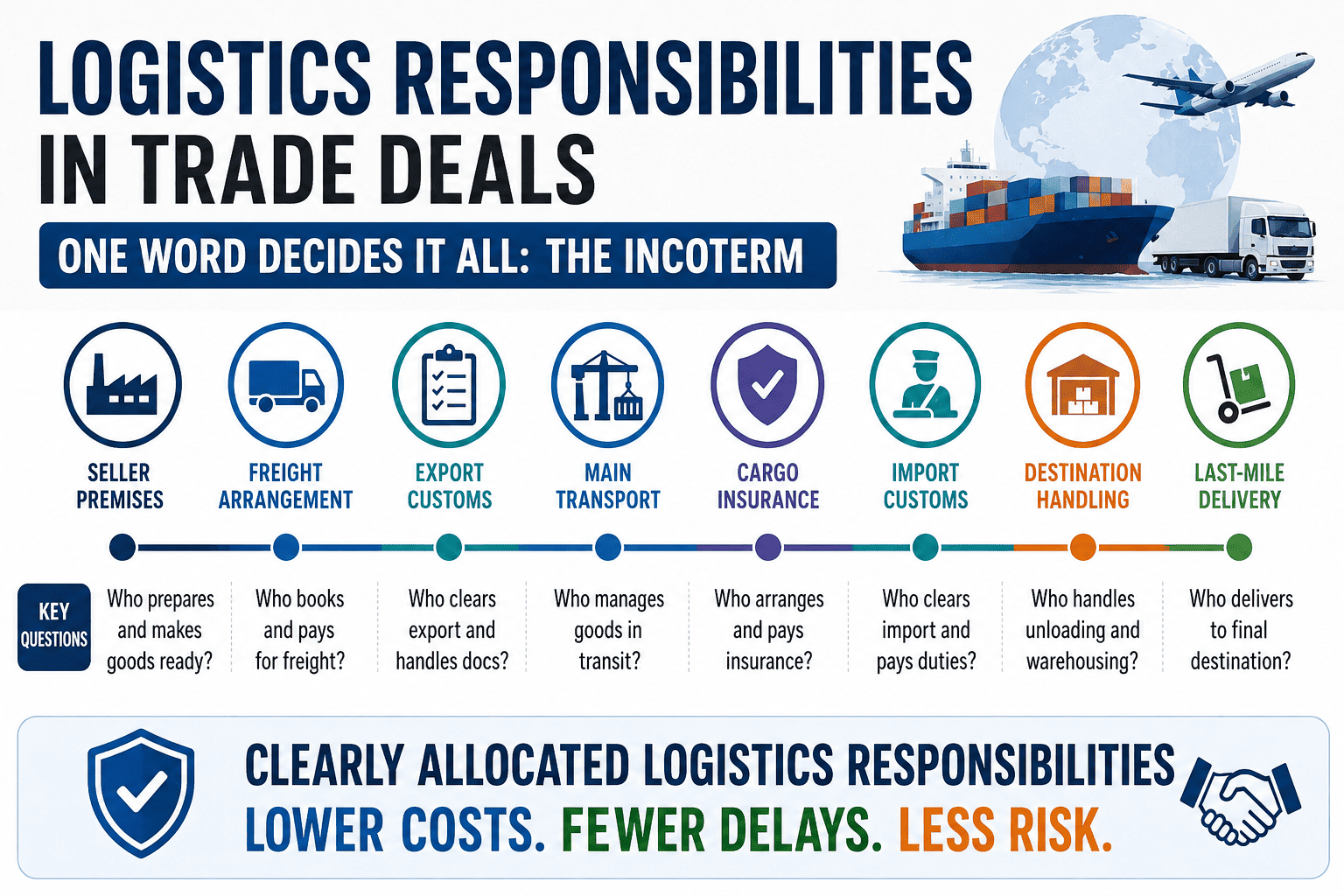
Direct Answer: Logistics responsibilities in a trade deal are the specific obligations, who arranges and pays for freight, who clears customs, who insures the shipment, and who is liable if goods are lost, damaged, or delayed, that get divided between buyer and seller before goods ever leave the factory floor. These obligations are usually set through Incoterms, the standardized shipping-term framework, and confirmed in the underlying commercial contract. Get the split wrong, and the fallout shows up later as unplanned duty bills, demurrage charges, or a dispute over who owed what when a container sat at port for three extra weeks. Because ten different customs regimes, dozens of carrier relationships, and multiple currencies are often involved in a single deal, logistics responsibility is not a detail to leave implicit, it needs to be mapped function by function, written into the contract, and matched to a trade partner who has actually been verified, which is where a platform like GTsetu becomes part of the sourcing process rather than an afterthought.
📅 August 10, 2026⏱ 19 min read✍️ GTsetu Editorial Team🔄 Updated regularly
11
Official Incoterms Rules
5
Core Responsibility Functions
100+
Countries on GTsetu
0%
GTsetu Partner Commission
Most trade deals fall apart on paper long before they fall apart in transit. Two companies agree on price, quantity, and quality, and then quietly assume the other side will handle whatever happens between the factory gate and the warehouse door. That assumption is where demurrage fees, missed customs deadlines, and six-figure disputes actually come from.
This guide provides general commercial and logistics education on how responsibility is typically allocated in international trade deals. It does not constitute legal, customs, insurance, or tax advice. Incoterms, customs rules, and carrier liability frameworks vary by country and change over time. Always consult qualified freight, legal, and customs counsel before finalizing shipping terms. For guidance on finding and verifying trade partners before you negotiate logistics terms, GTsetu’s verified matchmaking platform is available at platform.gtsetu.com.
SECTION 1
1 Why Logistics Responsibility Allocation Matters
🎯 Core Drivers
Logistics is not a downstream detail of a trade deal, it is a direct driver of landed cost, and by extension, of margin. Global logistics spending now runs into the trillions of dollars annually and consistently represents a high single-digit to double-digit share of GDP across major trading economies, which means the party carrying that cost in any given deal is absorbing a real, material expense, not an operational footnote. When responsibility for that expense, and the risk that comes with it, is left ambiguous, both sides are exposed the moment something doesn’t go to plan, a delayed vessel, a customs hold, a damaged pallet.
Structural Reality
Logistics Is a Cost Center, Not an Afterthought
Business logistics costs in major economies have run between roughly 7% and 9% of GDP in recent years, and considerably higher in markets with less mature freight and customs infrastructure, meaning the “who pays for shipping” question is rarely a rounding error.
Global logistics spend has grown into the trillions of dollars annually, and that spend sits inside the price of every cross-border deal whether or not the contract names who is responsible for it.
As external analysis on the importance of logistics in global trade and the broader role of logistics in global trade both point out, efficient movement of goods is now treated as a competitive differentiator in its own right, not simply a cost to be minimized.
Landed cost driverMargin impactCompetitive factor
Structural Reality
Ambiguity Is Where Disputes Are Born
When a deal doesn’t specify who owns freight booking, customs filing, insurance, or last-mile delivery, both sides tend to assume the other party has it covered, until a shipment is delayed and neither side moves.
Unclear responsibility also complicates insurance: underwriters price cargo risk based on a defined chain of custody, and gaps in that chain can leave a loss uncovered by either party’s policy.
Academic research into the role of logistics and infrastructure in promoting international trade consistently finds that predictable, well-defined logistics arrangements correlate with stronger trade flows between partner countries.
Dispute preventionInsurance clarityPredictability
None of this is solved by picking a shipping method. It is solved by explicitly assigning ownership of each logistics function in the deal, then documenting that allocation in a properly drafted business partnership contract before the first shipment ever moves.
SECTION 2
2 Incoterms: The Framework Behind Every Split
📜
What Incoterms Actually Control
A shared vocabulary, not a full contract
What They Define
Incoterms are the International Chamber of Commerce’s standardized three-letter trade terms that set the exact point where cost and risk pass from seller to buyer, and which party is responsible for export clearance, main carriage, insurance, and import clearance at each stage of the journey.
What They Don’t Define
Incoterms do not set price, payment terms, title transfer, or dispute resolution, those still need to be spelled out separately in the underlying commercial contract. Relying on an Incoterm alone to cover the full logistics relationship is a common and costly gap.
Implication
Choosing the wrong Incoterm for the deal, or using one without confirming both parties understand it the same way, is one of the most frequent sources of unplanned cost and after-the-fact disputes in cross-border trade.
Incoterm
Who Owns Most Responsibility
Typical Use Case
EXW (Ex Works)
Buyer, from the seller’s premises onward
Experienced buyers with their own freight forwarder network
FOB (Free on Board)
Split at the port of loading
Sea freight where the buyer wants control of main carriage
CIF (Cost, Insurance & Freight)
Seller arranges freight and insurance to destination port
Buyers who want a simpler, bundled cost to destination port
DAP (Delivered at Place)
Seller, up to the named destination, excluding import duty
Sellers confident in destination-country delivery logistics
DDP (Delivered Duty Paid)
Seller, nearly full responsibility including duties
First-time buyers wanting maximum simplicity and predictability
💡 Trade Facilitation Reforms Are Shrinking the Cost of Getting This Right
The WTO’s Trade Facilitation Agreement, which focuses on simplifying and harmonizing customs and border procedures, has been credited with meaningful reductions in global trade costs since entering into force, particularly for developing economies, alongside faster average clearance times at many borders. That makes the underlying customs and border process more predictable than it once was, but it does not remove the need for a deal to specify, in writing, which party is responsible for using that improved process. See the WTO’s own account of the agreement’s progress for more detail.
SECTION 3
3 Responsibility by Function: Freight, Customs, Insurance & More
Incoterms provide the skeleton, but a well-run trade deal maps responsibility function by function so nothing is left to interpretation when something goes wrong mid-shipment.
🚚
Freight Booking & Carrier Selection
Who chooses the mode, route, and carrier
When the Seller Owns It
Common under CIF and DDP terms, or when the seller has stronger local freight relationships and can secure better rates or space during peak season than the buyer could independently.
When the Buyer Owns It
Common under FOB and EXW terms, or when the buyer already works with an established freight forwarder and wants direct control over routing, timing, and cost.
🛃
Customs Clearance & Duties
Export clearance, import clearance, and who pays duty
Export Side
Typically handled by the seller in their own country, since they hold the relevant local licenses, registrations, and documentation needed for export filing.
Import Side
Typically handled by the buyer, unless the deal is structured as DDP, in which case the seller takes on import clearance and duty payment as well, a meaningful added cost and administrative burden. This is a common area of tax and duty complexity; see our cross-border business tax guide for manufacturers and distributors.
🛡️
Cargo Insurance
Who covers loss or damage in transit
Minimum Cover Terms
Under CIF, the seller is only required to arrange minimum-level cargo insurance, which can leave meaningful gaps for high-value or fragile goods unless the buyer negotiates broader cover.
Buyer-Arranged Cover
Under FOB and EXW, the buyer typically arranges their own cargo insurance from the agreed risk transfer point onward, giving them full control over coverage level and claims handling.
🏬
Warehousing & Inventory Holding
Who stores goods before shipment or after arrival
Origin Warehousing
Usually the seller’s responsibility until goods are collected or loaded, including any pre-shipment consolidation or quality holds.
Destination Warehousing
Usually the buyer’s responsibility once goods clear import customs, though ERP and inventory management platforms are increasingly used by both sides to keep visibility synchronized across the handoff. See NetSuite’s overview of logistics and inventory management for how this integrates with broader operations.
📦
Last-Mile Delivery
Who gets goods from the destination port or hub to the final address
Seller-Managed (DDP/DAP)
The seller arranges inland transport to the buyer’s named address, offering simplicity but reducing the buyer’s visibility into the final leg of the journey.
Buyer-Managed
The buyer arranges collection from the port or bonded warehouse using their own domestic distribution network, often through an established distributor network.
SECTION 4
4 Where Logistics Responsibility Gets Complicated
🛢️
Raw Material & Bulk Commodity Trading
High-volume, high-weight cargo means freight cost is a much larger share of total deal value, and delays carry outsized financial consequences, as detailed in analysis of logistics in international raw material trading.
💻
Electronics & High-Value Goods
Lower freight weight but much higher insured value, which shifts the priority from freight cost management toward insurance adequacy and security during transit and warehousing.
🧵
Apparel & Seasonal Goods
Timing matters more than almost any other factor, a missed delivery window can mean the goods lose most of their commercial value, so responsibility for delay risk needs explicit allocation.
🚗
Automotive & Industrial Components
Just-in-time manufacturing schedules mean a delayed shipment can halt a production line downstream, making responsibility for transit-time guarantees a central negotiating point.
🌾
Perishables & Agricultural Goods
Cold-chain integrity and customs speed both directly affect product quality on arrival, tying logistics responsibility closely to quality liability under the deal.
🏭
Multi-Country Distribution Deals
Sourcing through an international wholesale distributor network often layers a second set of logistics responsibilities on top of the original manufacturer-buyer split.
💡 Sector-Specific Guidance Exists, But the Principle Is the Same
Educational overviews of the role of logistics in global trade consistently make the same point across sectors: the specific logistics mechanics differ by product category, but the underlying discipline, documenting responsibility, tracking risk transfer, and confirming coverage, does not change.
Infrastructure Quality Shapes Who Should Take On Which Risk
Logistics cost as a share of GDP varies enormously by country
Mature Markets
In more developed logistics markets, business logistics costs have generally sat in the high single digits as a share of GDP, reflecting relatively efficient ports, customs processing, and inland transport networks.
Developing Markets
In markets still building out logistics infrastructure, costs as a share of GDP can run considerably higher, which is one reason many national governments have made logistics-cost reduction an explicit policy target as part of broader trade competitiveness strategy.
Implication
Academic and industry research into the role of logistics and infrastructure in promoting international trade points to a consistent pattern: countries and trade lanes with weaker infrastructure carry higher variability in cost and transit time, which is exactly where responsibility for delay and cost overrun needs to be assigned most explicitly rather than assumed.
7–9%
of GDP is roughly what business logistics costs run in several major, more mature trading economies
10–18%
potential reduction in worldwide trade costs estimated from full implementation of the WTO Trade Facilitation Agreement
$1T+
estimated annual boost to global trade value from broad trade facilitation reform, according to WTO-cited analysis
The tax and duty side of this equation is just as significant as freight cost. Import duty structures, VAT/GST treatment on cross-border shipments, and customs valuation rules all interact directly with whichever party has agreed to own the import-clearance function, a topic covered in more depth in our cross-border business tax guide for manufacturers and distributors and in broader analysis of customs duty and taxation frameworks affecting international shipments.
SECTION 6
6 Risks of Poorly Defined Logistics Responsibility
A trade deal can have excellent pricing and a strong product-market fit and still lose money in transit, if nobody clearly owns what happens between the factory and the final delivery point.
Risk Area
What It Looks Like in Practice
Unplanned duty exposure
A buyer discovers import duties were never budgeted because the Incoterm implied seller responsibility that the contract didn’t actually confirm
Insurance gaps
Minimum-cover cargo insurance under CIF leaves high-value goods underinsured, and neither party’s policy covers the shortfall
Demurrage and storage disputes
A container sits at port because customs paperwork wasn’t filed on time, and neither side agreed in writing who was responsible for filing it
Carrier and route disputes
The seller books freight through a carrier the buyer wouldn’t have chosen, with no contractual mechanism for the buyer to weigh in
Verification blind spots
A logistics dispute escalates faster and costs more when the counterparty’s legal identity, registration, or financial standing was never properly verified up front
⚠️ Logistics Risk Is Also Counterparty Risk
A well-drafted Incoterm and logistics clause only protects you if the counterparty is who they claim to be and is actually capable of fulfilling their side of the arrangement. Trust breaks down in global deals for reasons that often have nothing to do with the shipping terms themselves, and a logistics dispute with an unverified or financially unstable partner is far harder to resolve than one with a properly vetted company. See: why trust breaks in global deals and common red flags in international partnerships.
Choosing how to split logistics responsibility in a trade deal should be driven by which party has the stronger freight and customs relationships in the relevant lane, how much control the buyer wants over transit, and how much risk each side is prepared to absorb, not by defaulting to whichever Incoterm was used last time.
Decision Factor
→ Consider
→ Or Consider
Does the buyer already have a trusted freight forwarder in place?
FOB or EXW, buyer controls freight booking and cost
CIF or DDP, seller manages freight end to end
Is this a first-time deal between the two parties?
DDP, simplicity and predictability while trust is being built
FOB with a defined SLA, more control once trust is established
Is the buyer’s destination country customs process complex or unfamiliar?
DDP, seller absorbs the import clearance burden
DAP, buyer keeps import clearance but seller handles delivery
Is the cargo high-value, fragile, or time-sensitive?
Buyer-arranged full-value insurance regardless of Incoterm
Explicit transit-time and damage liability clauses in the contract
Is this a trial order or the start of a long-term supply relationship?
Simpler seller-managed terms during the trial phase
Renegotiated terms as volume and trust scale up
💡 Trial Orders Are the Right Place to Test the Logistics Split
Before committing to a full-volume supply relationship, a smaller trial order is the natural point to confirm whether the agreed logistics responsibility split actually works in practice, who really files what, how fast, and how communication holds up when something goes wrong. See: trialing and scaling production for startups.
SECTION 8
8 Common Mistakes in Trade Deal Logistics Clauses
5
core logistics functions, freight, customs, insurance, warehousing, last-mile, that need explicit ownership in every deal
11
official Incoterms rules, each assigning a different risk transfer point, picking the wrong one is a recurring, avoidable error
High Cost
of assuming a single Incoterm reference covers every logistics obligation in the relationship
🚩
Naming an Incoterm Without Defining the Rest
Writing “FOB Shanghai” into a purchase order and assuming that single reference covers insurance level, delivery timelines, and dispute resolution, when it only defines the cost and risk transfer point.
🚩
No Contingency Plan for Delay
Failing to specify who bears the cost of demurrage, storage, or expedited freight if a shipment is delayed for reasons outside either party’s direct control.
🚩
Skipping Factory and Capability Verification
Agreeing to a logistics split with a supplier whose actual production and shipping capability was never independently confirmed. See: factory audits explained.
🚩
No Long-Term Supplier Management Plan
Treating the logistics split as a one-time negotiation instead of something that needs periodic review as volumes, routes, or regulations change. See: long-term supplier management.
🚩
Underestimating Switching Costs
Building an entire logistics workflow around one supplier’s process without a contingency plan, then discovering how costly and slow it is to switch suppliers if performance slips. See: supplier switching risks.
🚩
Never Verifying the Counterparty
Structuring a detailed logistics arrangement with a company whose registration, legal status, and identity were never independently confirmed. Verify first with GTsetu’s verified matchmaking platform before finalizing any logistics or commercial terms.
SECTION 9
9 Finding Trade Partners Who Won’t Leave You Exposed
A well-drafted logistics clause is only as good as the counterparty standing behind it. A responsibility split negotiated with a company that turns out to be unregistered, misrepresented, or financially unstable is not a logistics problem, it’s a partner discovery problem that logistics language alone can’t fix. See: limitations of partner discovery.
🤝 Platform Spotlight, GTsetu
Verified Trade Partners Before You Negotiate Logistics Terms
GTsetu is a verified B2B matchmaking platform that helps manufacturers and distributors identify, verify, and engage trade partners across 100+ countries before a single logistics clause gets negotiated. Every company on GTsetu is verified using government tie-ups on six key points: Name, Address, Registration Number, Company Status, Company Type, and Date of Certificate of Incorporation. AI-assisted matching then surfaces the highest-fit partners by industry, geography, product category, and partnership intent, so freight, customs, and insurance negotiations start with a counterparty you already know is legitimate. GTsetu’s built-in NDA workflow and encrypted workspace protect the commercial and logistics data exchanged during due diligence.
🏛️
6-Point Govt. Verification
Every partner verified on Name, Address, Registration Number, Company Status, Company Type, and Date of Incorporation through government sources before joining.
🆔
Company & Tax ID Checks
Cross-market TIN and registration verification designed for the fragmented customs and regulatory landscape across global trade lanes.
🤖
AI-Assisted Matching
Multi-criteria fit scoring by industry, geography, product category, and logistics capability, surfacing the highest-fit verified candidates automatically.
🕵️
Anonymous Discovery
Browse verified manufacturers and distributors across 100+ countries without revealing your identity or sourcing intentions until you are ready to signal interest.
📄
Built-In NDA Workflow
Digital NDA execution with timestamped signatures triggered before any commercially sensitive logistics or pricing data is exchanged.
🔐
Encrypted Due Diligence Workspace
AES-256 encrypted document workspace with full audit trail for all information exchanged during partner assessment.
🚫
Zero Commission
No broker fee or success commission on any partnership formed. GTsetu’s incentives are fully aligned with finding you the best partner.
🌍
100+ Countries
Verified manufacturers and distributors across Asia, Middle East, Europe, Africa, Australia, and the Americas, available for matching from one platform.
📋
Full Audit Trail
Every access event, NDA signature, and document exchange logged with timestamp, providing a defensible record of due diligence for every deal you enter.
How GTsetu Supports a Sound Logistics Responsibility Strategy
✅
Step 1, Verify the Company Before Negotiating Incoterms
Every company on GTsetu is verified on six government-sourced points before joining, including company TIN number verification where applicable. When you identify a potential manufacturer or distributor through GTsetu, you already know their registration is legitimate and current, before any logistics clause gets drafted.
Pre-Screening
🤖
Step 2, Match on the Trade Lanes and Capability That Matter
GTsetu’s AI-assisted matching, delivered through its B2B matchmaking tool, scores prospective partners against your product category, geography, and logistics capability, connecting a buyer with counterparties who already have the freight and customs relationships the deal needs.
Matching
🕵️
Step 3, Compare Candidates Anonymously Across a B2B Network
Browse and assess potential trade partners across GTsetu’s B2B business network anonymously before revealing your identity or sourcing volumes, protecting your negotiating position while you compare logistics capability across candidates.
Protection
📄
Step 4, Execute NDA Before Sharing Logistics Documentation
GTsetu’s built-in NDA workflow ensures that the encrypted document workspace, where freight rates, delivery schedules, and commercial terms are shared, only unlocks after both parties have digitally signed a confidentiality agreement. See: business partnership contract guide for the clauses that follow.
Legal Gate
🔐
Step 5, Structure the Logistics Responsibility Split in Writing
QWhat are logistics responsibilities in a trade deal?
Logistics responsibilities in a trade deal are the specific tasks and cost obligations around moving goods from seller to buyer, who arranges and pays for freight, who clears customs at export and import, who carries insurance, who is liable if goods are lost or damaged, and at what point risk and cost transfer from one party to the other. These responsibilities are usually defined through Incoterms rules and spelled out in the underlying commercial contract, so both sides know exactly what they owe before the shipment ever moves.
QHow do Incoterms define who is responsible for what in shipping?
Incoterms are a standardized set of eleven three-letter trade terms published by the International Chamber of Commerce that define the exact point at which cost and risk transfer from seller to buyer. Terms such as EXW place almost all responsibility on the buyer from the seller’s premises onward, while terms such as DDP place nearly all responsibility, including import duties, on the seller until goods reach the buyer’s door. Terms like FOB and CIF sit in between, splitting responsibility at the port of loading or during main carriage. Choosing the wrong Incoterm for the deal is one of the most common sources of unplanned cost and dispute in international trade.
QWho is responsible for customs clearance in an international trade deal?
Customs clearance responsibility depends on the Incoterm and contract in place. Under terms like FOB or CIF, the seller typically handles export customs clearance in their own country, while the buyer handles import customs clearance and duties in the destination country. Under DDP, the seller takes on both export and import clearance, including duties and taxes, which increases the seller’s cost and administrative burden but removes that risk from the buyer. Misalignment on who is registered, licensed, and liable for customs in each country is a frequent cause of shipment delays and unexpected costs. See: cross-border business tax guide.
QWhat happens if logistics responsibility isn’t clearly defined in a trade agreement?
When logistics responsibility is not clearly defined, both parties are exposed to disputes over who pays for delays, damage, demurrage, storage, or customs penalties, often after the goods are already in transit and leverage has shifted. Ambiguity also makes it harder to obtain accurate insurance coverage, since insurers price risk based on a defined chain of custody and liability. Clear allocation of logistics responsibility, documented in the contract and confirmed through the correct Incoterm, protects both sides and prevents costly after-the-fact negotiation. See: common red flags in international partnerships.
QHow should buyers and sellers decide how to split logistics responsibility?
The right split depends on which party has stronger freight relationships and lower shipping costs in the relevant lane, which party is better positioned to handle customs in each country, how much control the buyer wants over transit timing and carrier choice, and how comfortable each side is with currency and risk exposure during transit. Smaller or first-time buyers often prefer seller-managed terms like CIF or DDP for simplicity, while larger buyers with established freight forwarder relationships often prefer FOB or EXW to control cost and routing directly. The right approach is to map responsibility function by function, freight, insurance, customs, warehousing, last-mile, rather than relying on a single blanket term. See: partnership evaluation criteria.
QHow should I verify a trade partner before finalizing logistics terms?
Verification should start with confirming the company’s basic legal identity, registration, legal status, and address, against the relevant national registry, followed by a technical or factory capability check once the company itself has been confirmed as legitimate. Because logistics obligations only matter if the counterparty can actually fulfil them, platforms that perform government-sourced company verification across multiple markets, such as GTsetu, are particularly useful before committing budget to freight bookings, customs registrations, or tooling investment. See: company TIN number verification.
Find Verified Trade Partners Before You Negotiate Logistics Terms
Whether you’re finalizing an FOB agreement with a manufacturer or negotiating DDP terms with a distributor, the partner decision is what makes the logistics split actually work. Join 500+ verified manufacturers and distributors across 100+ countries on GTsetu, AI-assisted matching, anonymous discovery, built-in NDA workflows, encrypted due diligence workspace, and zero broker commissions on every partnership formed.
They represents the product, and research team behind GTsetu, a global B2B collaboration platform built to help companies explore cross-border partnerships with clarity and trust. The team focuses on simplifying early-stage international business discovery by combining structured company profiles, verification-led access, and controlled collaboration workflows.
With a strong emphasis on trust, and disciplined engagement, Team GTsetu shares insights on global trade, partnerships, and cross-border collaboration, helping businesses make informed decisions before entering deeper commercial discussions.