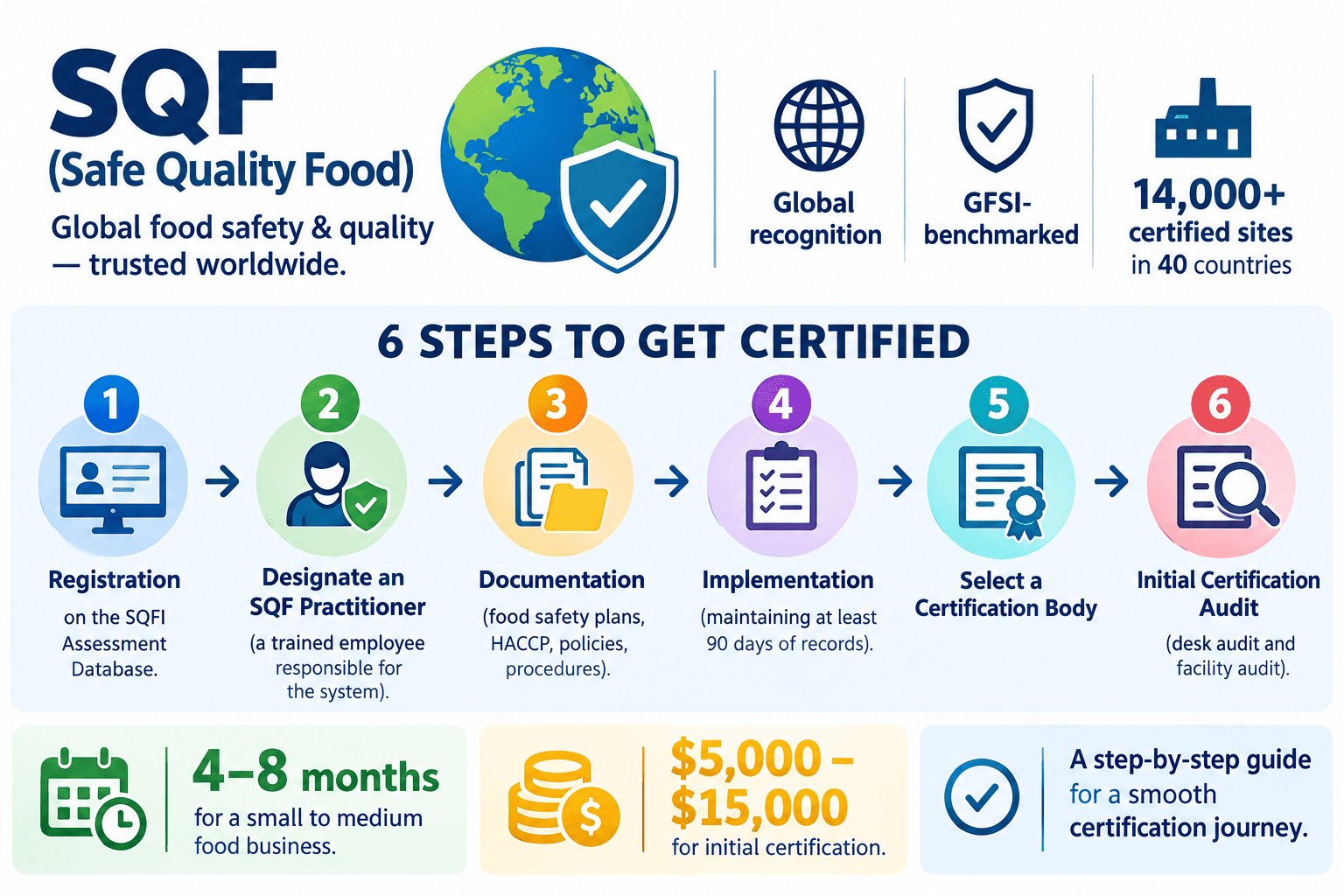
Direct Answer: SQF (Safe Quality Food) certification is a globally recognised, GFSI-benchmarked food safety and quality management scheme, with over 14,000 certified sites in 40 countries. Getting certified involves a structured 11-step process: Registration on the SQFI Assessment Database, Designating an SQF Practitioner (a trained employee responsible for the system), Documentation (food safety plans, HACCP, policies, procedures), Implementation (maintaining at least 90 days of records), Selecting a Certification Body, and completing the Initial Certification Audit (desk audit and facility audit). The process typically takes 4–8 months for a small to medium-sized food business, with costs ranging from $5,000–$15,000 for initial certification. This guide walks you through every step, with practical tips for a smooth certification journey.
📅 September 21, 2026⏱ 18 min read✍️ GT Setu Editorial Team🔄 Updated regularly
14K+
Certified Sites Worldwide
11
Steps to Certification
4–8
Months (Typical Timeline)
0%
GTsetu Broker Commission
SQF (Safe Quality Food) certification is one of the world’s most widely recognised food safety and quality management schemes. Administered by the SQF Institute (SQFI), a division of FMI—The Food Industry Association, SQF is benchmarked by the Global Food Safety Initiative (GFSI), meaning it meets the most rigorous international standards for food safety management. With over 14,000 certified sites in 40 countries across 6 continents, SQF is the certification of choice for food producers seeking to supply major retailers, brand owners, and foodservice providers worldwide.
For food manufacturers, processors, distributors, and primary producers, SQF certification is often a prerequisite for doing business with major retailers such as Walmart, Costco, Kroger, and Woolworths. It signals that your organisation has implemented a robust, science-based food safety management system based on HACCP principles. This guide covers the complete certification process, from initial registration through to the final certification audit, and provides practical, actionable advice for a smooth journey. See our related guides on ISO 9001, HACCP, and ISO 22000 to understand how SQF integrates with other management systems.
🍽️ Who Is This Guide For?
This guide is written for food safety managers, quality assurance professionals, business owners, and anyone responsible for implementing or maintaining an SQF System at a food production site. It covers the full certification process from registration to certification and maintenance. It is relevant for food manufacturers, processors, packers, storage and distribution operators, primary producers, and foodservice and retail operations. For related standards, see our guides on ISO 13485 (medical devices), ISO 27001 (information security), and ISO 45001 (occupational health and safety).
SECTION 1
1 What Is SQF Certification & Why Get Certified?
🍽️ The Standard Explained
SQF (Safe Quality Food) is a food safety and quality management certification scheme recognised by the Global Food Safety Initiative (GFSI). Administered by the SQF Institute (SQFI), the program provides a rigorous, science-based framework for managing food safety and quality across the entire food supply chain, from farm to fork. The SQF Code is built on the Codex Alimentarius HACCP methodology and ISO 17065 requirements. It comprises 13 industry-specific codes covering primary production, food manufacturing, packaging, storage and distribution, foodservice, and retail. Certification provides independent, third-party verification that your organisation produces, processes, and handles food to the highest possible standards. SQF is unique among GFSI schemes in offering an optional Quality module, allowing certified sites to display the SQF Quality Shield on their products.
🌐
GFSI-Benchmarked Standard
SQF is recognised by GFSI, meaning it meets the most rigorous international standards for food safety management. This recognition is trusted by retailers, brand owners, and foodservice providers worldwide.
🏛️
Retailer-Preferred Certification
Many major retailers, including Walmart, Costco, Kroger, and Woolworths, require SQF certification from their suppliers. It is often a prerequisite for market access in North America, Australia, and premium retail supply chains.
🛡️
HACCP-Based Framework
SQF uses the Codex HACCP methodology to identify and control food safety hazards. It covers prerequisite programs, food safety plans, and continuous improvement, providing a comprehensive management framework.
📈
Quality Shield Option
SQF is the only GFSI-recognised scheme that offers an optional Quality module. Certified sites can display the SQF Quality Shield on their products, providing added assurance to consumers and customers.
SECTION 2
2 Key Benefits of SQF Certification
SQF certification delivers tangible benefits across operational, commercial, and regulatory dimensions. The certification process requires investment, but the return on that investment is well-documented across the food industry.
40%
Reduction in food safety incidents reported by certified organisations (SQFI data)
25%
Higher customer satisfaction scores among certified food businesses (industry benchmarks)
15–20%
Typical cost savings from reduced waste and rework after SQF implementation (industry estimates)
🏷️
Retailer-Preferred Status
SQF certification is instantly accepted by Walmart, Costco, Kroger, Woolworths, and other major retailers. It is often a prerequisite for supplying these high-value retail chains, opening doors to new business opportunities.
Commercial
💰
Risk Management & Recall Prevention
By systematically identifying and controlling food safety hazards, SQF-certified organisations reduce the risk of recalls, withdrawals, and food safety incidents. The preventive approach saves costs and protects brand reputation.
Operational
🔗
Supply Chain Integration
SQF provides a common framework for food safety across supply chains, enabling smoother collaboration with partners, easier audits, and consistent food safety throughout the value chain. It reduces the need for multiple customer audits.
Partnership
📊
Quality Excellence (Optional)
The SQF Quality module allows organisations to demonstrate superior product consistency and customer satisfaction. The Quality Shield provides a visible differentiator on product packaging, building consumer trust.
Quality
👥
Employee Engagement & Food Safety Culture
Clear processes, defined responsibilities, and documented procedures improve employee understanding of their roles in food safety. SQF Edition 10 has a sharpened focus on food safety culture, driving engagement and accountability.
People
📋
Regulatory Compliance & Export Readiness
SQF helps organisations meet regulatory requirements, including the US Food Safety Modernization Act (FSMA). It facilitates export by meeting the food safety requirements of destination markets and reducing barriers to international trade.
Compliance
SECTION 3
3 SQF Certification Programs
SQF offers multiple certification programs designed to meet the needs of different food industry sectors and levels of food safety maturity. Understanding which program is right for your business is a critical first step.
GFSI-Benchmarked
🍽️ SQF Food Safety Program
The core GFSI-benchmarked program, covering HACCP-based food safety management. Designed for all food producers in the food industry. Features an emphasis on the systematic application of HACCP. This is the most widely recognised SQF program.
Not GFSI-Benchmarked
🌱 SQF Fundamentals Program
Designed for small and medium-sized enterprises. Addresses a buyer’s food safety requirements and provides solutions for businesses supplying local and global food markets. A stepping-stone towards full SQF certification.
Optional Module
⭐ SQF Quality Program
An optional add-on for sites that have already implemented a robust food safety plan. Uses a risk-based method such as Codex HACCP to identify and control quality threats. Allows display of the SQF Quality Shield.
Sector-Specific
🏨 SQF Foodservice Program
For businesses in the foodservice industry. Allows you to create a food safety culture and program that will reduce and eliminate food safety risks. Can be used for internal and external inspections.
Sector-Specific
🛒 SQF Food Retail Program
For food retailers. Builds transparency for customers and internal confidence within a company. Helps retailers protect their brands through verifying processes and systems, connecting corporate policies to store practices.
📋 SQF Edition 10: What’s New
SQF Edition 10 has been released with a sharpened focus on the areas where data and experience showed the need to raise the bar: food safety culture, change management, environmental monitoring, and audit scoring. The new edition introduces dedicated requirements for change management (Clause 2.3.5) and strengthens existing requirements. Sites currently certified to Edition 9 will transition to Edition 10 according to SQFI’s published timeline. For more information, see the SQF Institute website.
SECTION 4
4 Step 1: Register on the SQFI Database
🏗️ Starting Your Certification Journey
The first step in obtaining SQF certification is registering your site on the SQF Institute (SQFI) Assessment Database. This officially begins your certification journey and is a mandatory requirement for certification. Registration fees apply and are based on your site’s size (determined by annual sales revenue and industry sector). You must maintain an active registration to keep your certification valid.
1.1
Access the SQFI Assessment Database
Visit sqfi.com and navigate to the Assessment Database. The database is the central platform for managing your SQF certification, including registration, audit scheduling, and certificate management.
1.2
Create Your Site Profile
Enter your site details, including company information, location, products, and processes. This information forms the basis for your certification scope and audit planning.
1.3
Pay Registration Fees
Registration fees are payable at registration and annually at renewal. Fees are determined by site size (based on annual sales revenue) and industry sector. Check the current fee schedule on the SQFI website.
1.4
Download the Applicable SQF Code
Download the SQF Code relevant to your industry sector (e.g., Food Manufacturing, Storage and Distribution, Primary Production). The Code details all requirements that must be documented and implemented for certification.
💡 Pro Tip: Understand Your Food Sector Category
SQF certification is specific to your Food Sector Category (FSC). There are over 30 FSCs covering different food industry sectors, from dairy processing to packaging manufacturing. Your FSC determines which SQF Code applies to your site and which modules and GMP requirements you must implement. Ensure you select the correct FSC during registration to avoid issues during the audit. The same principle of careful scoping applies when conducting commercial due diligence, define your parameters before you begin.
SECTION 5
5 Step 2: Designate an SQF Practitioner
SQF certification requires each certified site to have a designated SQF Practitioner, a qualified employee responsible for overseeing the development, implementation, and maintenance of the SQF System. This is a mandatory requirement of the SQF Code. The practitioner is your internal expert on SQF and is the primary point of contact for the certification body.
👤
Full-Time Employee
The SQF Practitioner must be a full-time employee of the site. They cannot be an external consultant, though consultants can provide support and guidance during implementation.
🎓
HACCP Training Required
The practitioner must have completed a HACCP-based training course, typically a minimum of two days with an assessment. This ensures they understand the scientific principles behind food safety management.
📋
GMP Competence
The practitioner must have proven competence in implementing and maintaining Good Manufacturing Practices (GMP), or the relevant prerequisite programs for their sector.
📖
SQF Code Knowledge
The practitioner needs a thorough understanding of the SQF Code and its requirements as they apply to their site. SQFI recommends completing the “Implementing SQF Systems” training course.
🔄
Backup Practitioner
A backup employee should be designated to manage the SQF System in the practitioner’s absence. Multiple practitioners can be designated to cover different shifts and operational requirements.
📅
Continuous Development
SQFI recommends ongoing professional development for SQF Practitioners. Certified SQF Practitioner credentials are available and require continuing education for maintenance.
📋 SQF Practitioner Training Options
SQFI offers an online “Implementing SQF Systems” training course, accessible from sqfi.com. This web-based course allows practitioners to learn at their own pace. Alternatively, training is available through SQFI-licensed training centres worldwide. While this training is not mandatory, it is strongly recommended. The practitioner must have completed a HACCP course (minimum 2 days with assessment) regardless of whether they complete the Implementing SQF Systems course. When selecting training, apply the same rigor you would use for due diligence, verify the provider’s credentials and relevance to your sector.
SECTION 6
6 Step 3: Document Your SQF System
Documentation is a critical phase of SQF certification. You need to document and implement the system elements and relevant GMP requirements of the SQF Code that apply to your operations. The SQF Code is structured hierarchically: Module, Section, Clause, and Element. Not all elements are applicable to every site, some may be justified as “not applicable” if they don’t apply to your processes.
Document Type
Description
Key Consideration
Food Safety Policy
A statement of your organisation’s commitment to food safety, approved by senior management.
Must be communicated to all employees and available to relevant interested parties.
Food Safety Objectives
Measurable goals aligned with the food safety policy.
Should be SMART (Specific, Measurable, Achievable, Relevant, Time-bound) and monitored.
Food Safety Plan (HACCP)
The core document, based on Codex HACCP methodology, identifying hazards, CCPs, critical limits, monitoring, corrective actions, and verification.
Must be validated and verified. The SQF Practitioner leads its development.
Prerequisite Programs (PRPs)
GMP, sanitation, pest control, allergen management, and other foundational programs.
Must be documented, implemented, and maintained. These provide the foundation for the food safety plan.
Quality Plan (Optional)
For SQF Quality certification, a plan addressing quality control points and process controls.
Based on HACCP methodology, applied to quality parameters. Allows Quality Shield usage.
Procedures & Work Instructions
Documented processes and detailed task instructions.
Use your company’s vernacular. Avoid “ISO language.” Focus on usability.
Forms & Records
Tools for recording data and capturing evidence of compliance.
SQFI recommends a minimum of 90 days of records before the certification audit.
Food Defense Plan
Documented measures to prevent intentional adulteration or sabotage.
Mandatory requirement. Must be documented, implemented, and maintained.
Food Fraud Vulnerability Assessment
Assessment of vulnerabilities to food fraud and mitigation measures.
Mandatory requirement. Must be documented and kept current.
Supplier Approval Program
Documented methods for selecting, evaluating, approving, and monitoring suppliers.
Mandatory. Includes a register of approved suppliers and monitoring based on risk.
💡 Documentation Best Practices for SQF
DO: “Say what you do”, document policies, procedures, and work instructions that meet the SQF Code requirements. Use simple flowcharts for key processes instead of lengthy manuals. Ensure all documentation is accessible to staff who need it.
DON’T: Create overly complex documentation that staff cannot follow. Avoid documentation for its own sake, every document should add value to your food safety system.
Use guidance documents: SQFI publishes Guidance Documents for certain SQF Codes and FSCs. These help interpret SQF Code requirements and assist with documentation and implementation. While not auditable documents, they are valuable resources. The same principle of using proven templates applies when drafting warranty clauses, start with a solid foundation.
SECTION 7
7 Step 4: Implement Your SQF System
Implementation is where your documented SQF System becomes operational. This phase involves putting your policies, procedures, work instructions, and specifications into practice and ensuring that all records demonstrate compliance. The SQF Code requires that you “Do what you say”, your actual operations must match your documented system.
📢
Communicate the Food Safety Policy
Senior management should communicate the food safety policy, explaining its significance and how the company will put it into practice. Staff must understand the policy and connect it to their individual responsibilities.
Leadership
🎓
Train Your Team
Train all employees on the SQF System, their specific responsibilities, and the importance of food safety. Include training on hazard awareness, CCP monitoring, and corrective actions. Use a mix of classroom and on-the-job training.
Training
📋
Implement Prerequisite Programs
Ensure all PRPs are fully implemented and documented. These include GMP, sanitation, pest control, allergen management, and personnel practices. PRPs are the foundation of your SQF System.
Prerequisites
🔄
Operate the Food Safety Plan
Begin monitoring CCPs according to your plan. Document all monitoring results, corrective actions, and verification activities. Consistent documentation is essential for demonstrating compliance and is a key focus of audits.
Operations
📁
Maintain Records
As you implement your SQF System, records are being created and kept on file. These records will be reviewed by auditors to assess compliance. SQFI recommends maintaining a minimum of 90 days of records before the certification audit.
Records
✅
Conduct Internal Audits
Perform internal audits to verify the effectiveness of your SQF System. Use internal audits as a tool to identify areas for improvement and ensure the system is operating as intended. This is a mandatory requirement for certification.
Verification
💡 Pro Tip: Consider a Pre-Assessment Audit
A pre-assessment audit is not mandatory but is strongly recommended. It provides a “health check” of your implemented SQF System, identifying gaps that need to be addressed before the official certification audit. The pre-assessment can be conducted using internal resources, an SQF consultant, or an SQF food safety auditor. Self-assessment checklists are available on the SQFI website. Addressing gaps early can save significant time and cost during the certification process. This is a form of risk mitigation, identifying and addressing issues before they escalate.
SECTION 8
8 Step 5: Certification Audit, Getting Certified
The certification audit is the final step in obtaining SQF certification. It is conducted by an independent, third-party auditor from a certification body licensed by the SQF Institute. The SQF certification audit consists of two stages: a desk audit (documentation review) and a facility audit (on-site verification). Successful completion results in the issuance of your SQF certificate, valid for one year, subject to annual surveillance and recertification.
Audit Stage
What Happens
Key Focus
Desk Audit (Documentation Review)
The auditor reviews your SQF System documentation to verify it meets the requirements of the applicable SQF Code.
Completeness and adequacy of documentation. Identification of any gaps or nonconformities.
Facility Audit (On-Site Verification)
The auditor visits your site to verify that your SQF System is effectively implemented and working in practice. They interview employees, observe processes, and review records.
Effective implementation. Evidence that procedures are being followed and that the system is achieving its food safety objectives.
Audit Report & Non-Conformances
Following the audit, the auditor prepares a report detailing findings. Non-conformances are categorized (critical, major, minor).
All non-conformances must be addressed and corrective actions implemented and verified before certification is granted.
Technical Review & Certification Decision
The certification body conducts a technical review of the audit report and corrective actions. If all requirements are met, a senior technical officer approves the certification.
Overall conformity assessment. The certificate is issued upon successful completion of the technical review.
Surveillance Audits
Annual surveillance audits are required to maintain certification. One unannounced audit is required within every three-year certification cycle.
Ongoing compliance. The auditor checks that the SQF System is being maintained and that continuous improvement is taking place.
Recertification Audit
Annual recertification audits are required to renew your certificate. The recertification process is similar to the initial certification audit.
Full system re-assessment. You must demonstrate that your SQF System remains effective and has evolved to meet changing business needs.
💡 Preparing for the SQF Certification Audit
Prepare your site and staff: Ensure food handling areas are clean and organised, outdated documents are removed, and staff are ready for the auditor. Explain what to expect, reduce anxiety, and rehearse typical questions. Staff should answer truthfully without volunteering additional information.
Select your certification body: Choose a certification body licensed by SQFI that has auditors registered for your Food Sector Category (FSC). Compare quotes, check their reputation, and ensure they are recognised by your customers. Major certification bodies offering SQF certification include SGS, BSI, DNV, and Eurofins.
SECTION 9
9 Costs & Timeline: What to Expect
The cost and timeline for SQF certification vary significantly based on site size, complexity, existing food safety processes, and the resources you allocate to the project. Understanding these variables upfront helps in planning and budget setting.
Factor
Impact on Cost
Impact on Timeline
Site Size (Annual Sales Revenue)
Registration fees are based on site size. Larger sites pay higher fees. Audit fees also increase with site size and complexity.
Larger sites generally take longer to implement and audit.
Complexity of Operations
More complex operations (multiple product lines, high-risk foods) require more documentation and audit days.
Complexity extends documentation, implementation, and audit phases.
Industry Sector / Risk Level
Higher-risk food sectors require more rigorous audits and often higher fees.
Higher-risk = more audit days, potentially longer timeline.
Number of Employees / Shifts
More employees and multiple shifts require more audit time and training resources.
May extend the audit schedule and training timeline.
Use of Consultants / Templates
Consultant support adds cost but can accelerate implementation and reduce risk of failure.
Consultants can significantly reduce time to certification.
SQF Program Level
SQF Fundamentals is a lower-cost entry point. Full Food Safety certification involves higher fees. Quality module adds cost.
Fundamentals can be achieved more quickly; full certification takes longer.
📋 SQF Fundamentals: A Stepping-Stone for SMEs
For small and medium-sized enterprises (SMEs), the SQF Fundamentals Program offers a lower-cost, lower-complexity entry point to food safety certification. It addresses a buyer’s food safety requirements and provides a pathway towards full GFSI-benchmarked SQF certification. SQFI also offers a Fundamentals Program specifically designed for SMEs in the food supply chain. This tiered approach allows businesses to progress at a pace that matches their resources and market requirements. When evaluating which program is right for you, consider your customers’ requirements, your export ambitions, and your internal capacity for implementation, similar to how you would approach any major market entry partnership.
SECTION 10
10 How to Choose a Certification Body
The certification body is the independent organisation licensed by SQFI that will conduct your audit and issue your SQF certificate. Choosing the right certification body is a critical decision that affects the cost, timeline, and market recognition of your certification.
🏛️
SQFI Licensing
Ensure the certification body is licensed by the SQF Institute. Only SQFI-licensed certification bodies can issue SQF certificates. Verify their licensing status on the SQFI website.
🏭
Industry Experience
Choose a certification body with auditors registered for your Food Sector Category (FSC). They will understand your processes, terminology, and risks, leading to a more relevant and valuable audit.
📋
Market Recognition
Consider whether your customers or industry bodies recognise the certification body. Some retailers have preferred certification bodies. If you are exporting, ensure your certification body is recognised in your target markets.
💰
Cost & Value
Compare quotes from multiple certification bodies. The cheapest option is not always the best, consider the value of the audit, the auditor’s expertise, and the certification body’s reputation. Understand what is included in the quoted fee.
🌐
Global Capability
If you have or plan to have multiple sites in different countries, choose a certification body that can audit all sites consistently. This simplifies the management of your certification across locations.
🤝
Relationship & Support
Choose a certification body you feel comfortable working with. The relationship should be collaborative, not adversarial. A good auditor will help you improve your SQF System, not just find faults.
💡 Certification Body Selection Checklist
When evaluating certification bodies, ask: Are you licensed by SQFI? Do you have auditors registered for my Food Sector Category? What is your audit process and how many days do you typically allocate for my site? What is included in your fee and are there additional costs? How do you handle non-conformances and what is the process for issuing the certificate? Can you provide references from clients in my food sector? How do you conduct surveillance audits? Note that SQF certification bodies like SGS, BSI, DNV, and Eurofins have global reach and local expertise in India. Use this information alongside your master services agreement knowledge to make an informed decision.
SECTION 11
11 Common Mistakes & How to Avoid Them
📋
Under-Training Staff
One-off training sessions are insufficient. Staff need regular refreshers to maintain food safety awareness and compliance.
Avoid: Run quarterly SQF code refreshers, not a one-off session. Make training engaging and relevant to daily work. Document all training.
📖
Over-Complex Documentation
Lengthy manuals that staff cannot follow create compliance gaps and audit findings.
Avoid: Use simple flowcharts for key processes instead of lengthy manuals. Ensure documentation is practical and user-friendly.
📅
Missed Deadlines
Certification timelines can slip, leading to expired registrations and audit delays.
Avoid: Set calendar alerts for each certification milestone. Track progress against your implementation plan.
🏛️
Lack of Management Commitment
When leadership does not actively support the SQF System, it becomes a compliance exercise for employees rather than a strategic initiative.
Avoid: Secure top management commitment from the start. Ensure they understand the business case for food safety certification and communicate their support visibly.
🛡️
Weak Prerequisite Programs
PRPs that are not effectively implemented or documented undermine the entire SQF System. Without strong PRPs, HACCP cannot function effectively.
Avoid: Ensure PRPs (GMP, sanitation, pest control, allergen management) are fully implemented and documented before developing the food safety plan.
🔄
Treating Certification as the End Goal
Focusing solely on passing the audit rather than building a system that improves food safety. This leads to a system that is maintained only for the auditor.
Avoid: Design your SQF System to solve real food safety problems. Use internal audits and management reviews for genuine improvement, not just audit readiness.
SECTION 12
12 How GTsetu Supports Your SQF Certification Journey
SQF certification is a powerful tool for demonstrating food safety to customers and partners. GTsetu complements your certification by connecting you with verified food manufacturers, distributors, and suppliers who meet rigorous food safety standards. Our platform provides:
✅
Verified Company Profiles
Every company on GTsetu is verified on 6 key data points (Name, Address, Registration Number, Company Status, Company Type, Date of Incorporation) using government tie-ups, complementing your SQF due diligence.
🕵️
Anonymous Discovery
Browse verified partner profiles without revealing your identity until you’re ready to engage, protecting your sourcing strategy and commercial confidentiality.
📄
Built-In NDA Workflow
Digital mutual NDA with timestamped signatures, activated before any sensitive commercial or technical data is exchanged, supporting your IP protection and confidentiality commitments under SQF.
🔐
Encrypted Document Workspace
AES-256 encryption at rest, TLS in transit, role-based access controls, and full audit trail, ensuring the secure exchange of food safety documentation, specs, and contracts with partners.
🚫
Zero Broker Commission
GTsetu charges zero commission on any partnership formed. All commercial value stays between you and your verified partner, supporting the cost management objectives of your SQF system.
🌏
Global Network of Verified Partners
Access verified food manufacturers, distributors, and suppliers across 100+ countries, supporting your supply chain food safety objectives and enabling you to build a network of SQF-aligned partners.
QWhat is SQF certification and why is it important?
SQF (Safe Quality Food) certification is a globally recognised food safety and quality management scheme, benchmarked by the Global Food Safety Initiative (GFSI). It verifies that a food producer has implemented a rigorous food safety management system based on HACCP principles. SQF is recognised by retailers, brand owners, and foodservice providers worldwide, and is often a prerequisite for supplying major retailers like Walmart, Costco, and Kroger. Certification provides independent verification of food safety commitment, enhances market access, and builds consumer trust. For food manufacturers and distributors, it provides a competitive edge and is a key factor in commercial due diligence by potential clients.
QWhat are the main steps to get SQF certified?
The main steps are: (1) Register your site on the SQFI Assessment Database. (2) Designate a qualified SQF Practitioner.(3) Determine the scope of certification.(4) Document your SQF System according to the applicable SQF Code. (5) Implement the SQF System, maintaining at least 90 days of records. (6) Select an accredited certification body.(7) Conduct an optional pre-assessment audit.(8) Undergo the initial certification audit (desk audit and facility audit). (9) Address any non-conformances and close out the audit.(10) Receive SQF certification.(11) Maintain certification through annual surveillance and recertification audits. This structured approach is similar to building any termination for convenience framework, start with a solid foundation and build methodically.
QHow long does it take to get SQF certification?
The timeline varies by company size, complexity, and readiness. For small to medium-sized food businesses, the process typically takes 4-8 months from initial registration to certification. This includes system documentation, implementation, a minimum of 90 days of records, and the certification audit. Larger or more complex operations may take 8-12 months. Organizations with existing GFSI-recognised certification or robust HACCP systems may transition more quickly.
QHow much does SQF certification cost?
The cost varies based on site size, annual sales revenue, complexity of operations, and the certification body selected. Key cost components include: SQFI registration fees (annual, based on site size), certification body audit fees (for the initial certification audit), optional consultant fees, internal resource time, and ongoing surveillance/recertification audit costs. A typical range for a small to medium food manufacturer is $5,000-$15,000 for the initial certification, plus annual maintenance costs. SQF also offers a Fundamentals Program at a lower entry point for small and medium-sized enterprises. For more details, see SQFI and certification body websites like SGS.
QWhat is an SQF Practitioner and what are their requirements?
An SQF Practitioner is a designated employee responsible for overseeing the development, implementation, and maintenance of the SQF System at a certified site. Requirements include: being a full-time employee of the site, completing a HACCP-based training course (minimum 2 days with assessment), having proven competence in implementing and maintaining Good Manufacturing Practices (GMP), and possessing a thorough understanding of the SQF Code. SQFI recommends the practitioner complete the “Implementing SQF Systems” training course. A backup practitioner should also be designated. This role is critical to the success of your SQF System, treat it with the same importance as a material breach clause in a critical contract.
QWhat is the difference between SQF Food Safety and SQF Quality certification?
SQF Food Safety certification (GFSI-benchmarked) focuses on identifying and controlling food safety hazards using HACCP methodology. SQF Quality certification is an optional add-on module that applies quality management principles to control product and service quality attributes beyond safety. The Quality module allows sites to display the SQF Quality Shield on certified products—a unique feature not offered by other GFSI schemes. To pursue SQF Quality certification, a site must first hold or be working toward SQF Food Safety certification. For more information, see the SQF Institute website.
QWhat are the different SQF certification programs?
SQF offers multiple certification programs: (1) SQF Fundamentals Program, designed for small and medium-sized enterprises, covering basic food safety and prerequisite programs (not GFSI-benchmarked). (2) SQF Food Safety Program, the core GFSI-benchmarked program, covering HACCP-based food safety management (for food manufacturing, packaging, storage/distribution, etc.). (3) SQF Quality Program, an optional quality module for food manufacturers seeking to demonstrate quality management beyond safety. (4) SQF Foodservice Program, for foodservice operations. (5) SQF Food Retail Program, for food retailers. For details on each program, visit SQFI’s certification programs page.
Connect with verified food manufacturers, distributors, and suppliers on GTsetu, compliance-backed verification, anonymous discovery, built-in NDA workflows, and zero broker commissions. Find partners who share your commitment to food safety.
They represents the product, and research team behind GTsetu, a global B2B collaboration platform built to help companies explore cross-border partnerships with clarity and trust. The team focuses on simplifying early-stage international business discovery by combining structured company profiles, verification-led access, and controlled collaboration workflows.
With a strong emphasis on trust, and disciplined engagement, Team GTsetu shares insights on global trade, partnerships, and cross-border collaboration, helping businesses make informed decisions before entering deeper commercial discussions.