How to Expand Your Manufacturing & Industrial Automation Business to the UAE
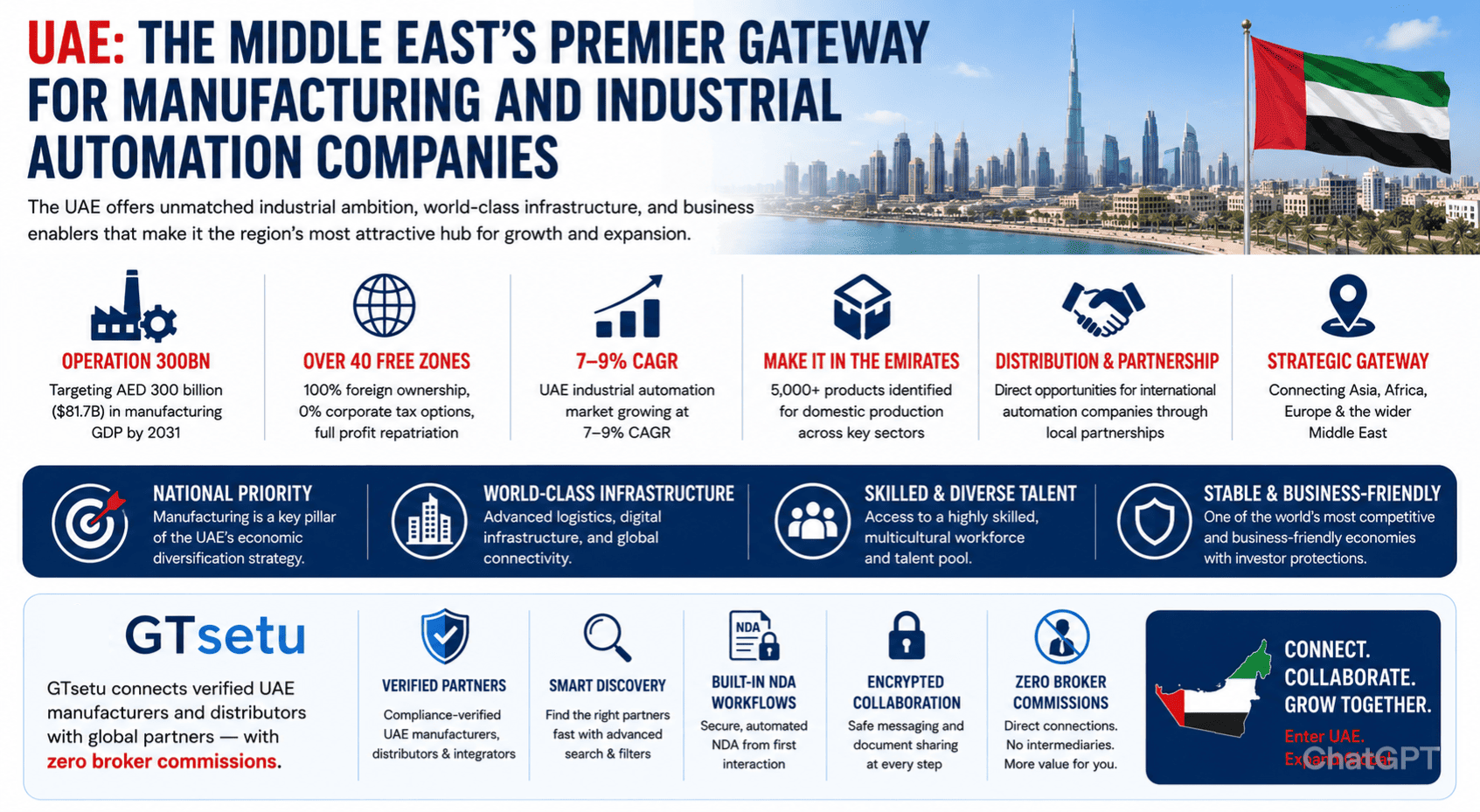
Direct Answer: The UAE is the Middle East’s premier gateway for manufacturing and industrial automation companies, with Operation 300bn targeting AED 300 billion ($81.7B) in manufacturing GDP by 2031, over 40 free zones offering 100% foreign ownership and 0% corporate tax options, and an industrial automation market growing at 7–9% CAGR. The Make it in the Emirates campaign has identified 5,000+ products for domestic production, creating direct distribution and partnership opportunities for international automation companies. GTsetu connects verified UAE manufacturers and distributors with global partners, with zero broker commissions.
📅 April 28, 2026⏱ 21 min read✍️ GT Setu Editorial Team🔄 Updated regularly
AED 300B
Manufacturing GDP Target by 2031
40+
Free Zones Nationwide
7–9%
Automation Market CAGR
0%
GTsetu Broker Commission
The United Arab Emirates has achieved something no other emerging market has managed at comparable speed: transforming from a hydrocarbon-dependent economy into one of the world’s most attractive advanced manufacturing and technology investment destinations, within a single generation. For international manufacturers and industrial automation companies, the UAE in 2026 offers a combination of strategic advantages that is genuinely unique: world-class logistics infrastructure, political stability, competitive taxation, 40+ free zones providing immediate 100% foreign ownership, a government actively incentivising domestic manufacturing investment, and a regional gateway serving 400 million GCC and broader MENA consumers.
Operation 300bn, the UAE Ministry of Industry and Advanced Technology’s national strategy, targets doubling the manufacturing sector’s GDP contribution from AED 133 billion to AED 300 billion ($81.7B) by 2031. The Make it in the Emirates campaign has identified 5,000+ specific products for domestic production. The National Industrial Resilience Fund is committing AED 1 billion to accelerate AI and automation adoption across strategic sectors. For international automation companies, these initiatives create both direct market demand and structured partnership opportunities that few other markets in the world can match for scale, accessibility, and commercial predictability. This guide covers everything you need to know to expand to the UAE successfully, from sector opportunity through to partner discovery, regulatory compliance, and commercial structure. For broader market context, see our guides on advantages and disadvantages of global expansion and international business development consulting.
🇦🇪 Who Is This Guide For?
This guide is written for international manufacturers, industrial automation OEMs, robotics companies, control system providers, technology integrators, and industrial equipment companies seeking to enter or expand in the UAE, whether through a distributor partnership, free zone establishment, joint venture, technology licensing, or contract manufacturing arrangement. It is also relevant for companies already exporting to the UAE informally who want to formalise and scale their market presence. If you are evaluating multiple MENA markets, see our companion guides for Egypt, India, Germany, and Romania.
SECTION 1
1 Why the UAE for Manufacturing & Industrial Automation?
🎯 The Strategic Case
The UAE is simultaneously the Middle East’s most advanced logistics hub, its most business-friendly regulatory environment, and the region’s fastest-growing manufacturing economy, driven by a government with both the financial resources and the political will to make Operation 300bn happen. For industrial automation companies, the UAE’s manufacturing modernisation agenda creates a demand trifecta: existing manufacturers modernising legacy operations, new manufacturers establishing greenfield facilities that specify automation from day one, and a government actively co-funding automation adoption through the National Industrial Resilience Fund and Manufacturer Loan Guarantee Schemes. The UAE also serves as a re-export hub for the broader GCC and MENA region, a distribution presence in Dubai or Abu Dhabi provides access to Saudi Arabia, Kuwait, Qatar, Bahrain, Oman, and beyond.
AED 1B
National Industrial Resilience Fund committed to accelerating AI and automation adoption across strategic UAE sectors
5,000+
products identified for domestic UAE production under Make it in the Emirates, each representing a distribution or licensing opportunity
25%
target share of national GDP from manufacturing, UAE’s goal for the sector’s contribution as advanced manufacturing scales
🌍
GCC & MENA Re-Export Gateway
A UAE presence gives instant access to 400M GCC and MENA consumers via preferential GCC customs union treatment. 95% of GCC goods move duty-free between member states, making the UAE the most efficient regional distribution hub for international manufacturers targeting the broader Arab world.
🏦
Unmatched Business Infrastructure
Jebel Ali Port, the world’s 9th-largest container port, combined with Dubai International Airport and Al Maktoum International gives the UAE unparalleled logistics infrastructure. World-class financial services, legal system (DIFC and ADGM common law jurisdictions), and digital infrastructure reduce operational friction to best-in-class levels for emerging markets.
💼
100% Foreign Ownership
The 2021 Federal Law on Commercial Companies eliminated the requirement for Emirati majority ownership across most commercial and industrial activities on the UAE mainland, matching the foreign ownership rights previously only available in free zones. This fundamentally changes the UAE’s attractiveness for international manufacturers considering direct establishment.
💰
Competitive Tax Environment
The UAE introduced a 9% corporate tax in June 2023, still among the world’s lowest rates for a developed commercial jurisdiction. Free zone companies meeting substance requirements can access a 0% rate. No personal income tax, no capital gains tax, and full profit and capital repatriation rights for registered investors.
⚡
Clean Energy & ESG Positioning
Emirates Global Aluminium’s manufacturing operations have a carbon footprint 50% below the global average, powered partly by solar and nuclear energy. The UAE’s alignment with net-zero targets and the EU Carbon Border Adjustment Mechanism (CBAM, effective 2026) makes UAE-based manufacturing particularly attractive for European-market-facing producers needing low-carbon credentials.
🤝
Government Partnership Approach
The UAE government actively co-invests in manufacturing through the Emirates Development Bank (EDB), provides direct introductions through Invest in UAE initiatives, and facilitates market entry through one-stop-shop free zone authorities. Government engagement quality in the UAE is significantly higher than in most comparable markets. See our guide to global partner service models.
The UAE’s industrial automation market is the most advanced and fastest-growing in the GCC, driven by Operation 300bn’s manufacturing expansion mandate, oil and gas sector digitalisation, logistics automation investment at Jebel Ali and Al Maktoum, and a government actively co-funding smart factory adoption. The market spans factory automation hardware, process control systems, logistics automation, and industrial software/AI platforms.
Research Source
Market Scope
Current Value
Forecast Year
Projected Value
CAGR
IndustryARC
Middle East Factory Automation & Assembly
Growing market
2030
USD 53 billion (Middle East)
7.90%
Grand View Research
UAE Logistics Automation
Growing rapidly
2030
USD 718.4 million (UAE)
14.8%
Grand View Research
UAE Warehouse Automation
USD 212M (2024)
2030
USD 521.5 million
17.4%
6W Research
UAE Industrial Automation
Strong growth trajectory
2031
Significant expansion
~7–9%
Mordor Intelligence
MEA Process Automation
USD 17.12B (MEA, 2024)
2034
USD 28.15B (MEA)
5.10% (MEA)
The UAE’s industrial automation market is structurally distinct from other MENA markets in two important ways: first, the government is not just creating regulatory conditions for automation investment, it is actively co-funding adoption through the National Industrial Resilience Fund and Emirates Development Bank loan programmes specifically designed for Industry 4.0 transformation. Second, the UAE’s role as a re-export and distribution hub means that automation technology distributed from a UAE base can serve the entire GCC market, effectively multiplying the addressable market for companies establishing UAE distribution operations.
Key Market Drivers for International Automation Companies
🏭
Operation 300bn Manufacturing Capacity Expansion
The doubling of UAE manufacturing GDP to AED 300B by 2031 requires new factory capacity, manufacturing technology, and automation solutions across every priority sector, creating direct and sustained demand for international automation companies with a UAE market presence.
National Strategy
🤖
AED 1B National Industrial Resilience Fund for AI & Automation
The AED 1 billion fund specifically targeting AI and automation adoption across strategic sectors provides direct co-investment incentive for UAE manufacturers to deploy automation technology, and direct demand for the technology providers who can supply it.
Government Co-Investment
📦
World-Class Logistics Automation Demand
The UAE’s position as a global logistics hub, Jebel Ali, Al Maktoum International Airport, Abu Dhabi’s Khalifa Port, is driving enormous investment in warehouse automation, AGVs, sortation systems, and port automation technology. UAE warehouse automation is growing at 17.4% CAGR to $521M by 2030, among the fastest-growing single-country segments globally.
Logistics Driver
⛽
ADNOC & Oil and Gas Digital Transformation
Abu Dhabi National Oil Company (ADNOC), one of the world’s largest oil producers, is investing heavily in digital transformation: AI-driven production optimisation, smart wells, predictive maintenance, and SCADA/DCS modernisation across its upstream and downstream assets. ADNOC’s automation investment programme is among the largest single-company automation procurement opportunities in the region.
Energy Sector
🌞
Clean Energy Manufacturing & Green Hydrogen
The UAE’s clean energy manufacturing ambitions, including the world’s largest solar single-site project (Mohammed bin Rashid Al Maktoum Solar Park), nuclear energy (Barakah), and emerging green hydrogen production, are driving demand for specialised automation in energy generation, storage manufacturing, and carbon-capture systems.
Energy Transition
🏙️
Smart City Infrastructure & Autonomous Systems
Dubai’s Autonomous Transportation Strategy targets 25% autonomous vehicles by 2030. Smart city programmes across the UAE are driving investment in smart infrastructure automation, building management systems, traffic management, and utility grid automation. The DIFC’s Regulation 10 on autonomous systems (effective January 2026) provides a clear regulatory framework for deploying advanced automation technologies.
Smart City
SECTION 3
3 High-Demand Sectors for Industrial Automation in the UAE
Operation 300bn has defined the UAE’s priority manufacturing sectors clearly, and each sector’s automation investment requirements are well-documented. International automation companies should align their UAE market strategy with these priority verticals to benefit from both government procurement support and private sector investment momentum.
⛽Largest Segment
Oil, Gas & Petrochemicals
ADNOC’s digital transformation programme, the “ADNOC 4.0” initiative, is one of the world’s largest industrial automation investment programmes. Upstream smart well automation, downstream refinery DCS/SCADA modernisation, pipeline management, safety systems, and predictive maintenance platforms are all priority investment areas. ADNOC has committed billions to AI-driven production optimisation across its asset base.
Key demand: DCS/SCADA, SIS, smart well automation, AI predictive maintenance, flow measurement
✈️Operation 300bn Priority
Aerospace & Defence Manufacturing
The UAE has built a world-class aerospace manufacturing cluster in Abu Dhabi, Strata Manufacturing (composite aircraft components for Airbus and Boeing), Sanad Aerotech (engine maintenance), and expanding defence manufacturing. This sector demands precision assembly automation, quality inspection systems, and advanced composite manufacturing technology, among the highest-value automation segments.
The UAE has identified pharmaceutical and medical device manufacturing as a national priority under Operation 300bn, driven by COVID-19 supply chain lessons and ambitions to become a GCC pharmaceutical hub. WHO-GMP compliance requirements and international export market standards are driving process automation, serialisation, cleanroom monitoring, and MES investment.
Key demand: process automation, serialisation systems, cleanroom HVAC control, packaging line automation, MES
🍔Food Security Priority
Food & Beverage Manufacturing
Food security is a national strategic priority in the UAE, driving significant investment in domestic food processing and manufacturing capacity. Export-oriented UAE food manufacturers are investing in automation for international food safety compliance (FSSC, BRC, Halal), filling and packaging automation, cold chain systems, and process control to serve GCC export markets.
The UAE is the GCC’s leading e-commerce market and global logistics hub. Investment in warehouse automation, automated storage and retrieval systems (AS/RS), AGVs, conveyor sortation, robotic picking, is growing at 17.4% CAGR. Major investments by Amazon, DP World, Aramex, and UAE Post are driving sustained demand for warehouse technology providers.
The UAE’s renewable energy ambitions, the world’s largest solar project, Barakah nuclear plant, and emerging green hydrogen production with companies like ADNOC Green Hydrogen, are creating demand for solar manufacturing automation, grid management systems, hydrogen plant control, and energy management platforms for new clean energy facilities.
Key demand: solar manufacturing automation, grid SCADA, hydrogen plant control, energy management systems
🚗Emerging Opportunity
Automotive & EV Manufacturing
The UAE has launched Rahayel City, a specialised automobile manufacturing hub, and is actively attracting EV component manufacturers. Dubai’s target of 25% autonomous vehicles by 2030 and the GCC EV adoption wave are creating demand for EV battery assembly automation, powertrain component manufacturing, and vehicle testing systems.
Key demand: EV battery assembly, robotic assembly lines, quality inspection, autonomous vehicle testing systems
🏗️Construction Materials
Aluminium, Steel & Advanced Materials
Emirates Global Aluminium (EGA), one of the world’s largest aluminium producers, is investing in process automation, quality control, and energy management to maintain its low-carbon manufacturing advantage. Advanced materials manufacturing for aerospace and construction is a growing UAE sector requiring sophisticated precision manufacturing automation.
Key demand: process automation, energy management, quality analytics, predictive maintenance
SECTION 4
4 UAE Free Zones & Industrial Parks: The Complete Picture
The UAE’s 40+ free zones are among the most sophisticated and comprehensive in the world, providing international manufacturers with immediate 100% foreign ownership, dedicated industrial infrastructure, logistics connectivity, and streamlined regulatory processes. Choosing the right zone is as important as choosing the right entry model.
🏭 Jebel Ali Free Zone (JAFZA), Dubai
The world’s largest free zone, home to 8,000+ companies from 100+ countries. Connected directly to Jebel Ali Port (world’s 9th-largest). Ideal for import-distribution-export operations serving GCC markets. Light to heavy manufacturing permitted with strong logistics infrastructure.
Best for: Distribution hubs, light manufacturing, industrial equipment, technology distribution
🏙️ Dubai Industrial City (DIC)
One of the world’s largest industrial parks at 560 km², designed as an integrated manufacturing city with sector-specific zones for food, pharma, machinery, chemicals, and transportation. Full utility infrastructure, on-site accommodation, and workforce ecosystem. Backed by TECOM Group.
Best for: Mid-to-large scale manufacturing in food, pharma, machinery, packaging, and construction materials
🏢 Abu Dhabi Industrial City (ICAD)
ICAD 1, 2, 3, and 4 provide 7,700 hectares of serviced industrial land adjacent to Abu Dhabi’s major infrastructure. Designed for energy-intensive and heavy industries with industrial gas, steam, and water utilities. Connected to Khalifa Port and ADNOC infrastructure. Managed by KEZAD Group.
Best for: Heavy manufacturing, chemicals, petrochemicals, metals, defence manufacturing
⚓ Khalifa Industrial Zone (KIZAD), Abu Dhabi
Integrated port-industrial zone adjacent to Khalifa Port, the UAE’s most modern container port. Free zone and non-free zone areas. Purpose-designed for integrated supply chain operations from manufacturing to container loading. Part of KEZAD Group with ICAD.
Best for: Export-oriented manufacturing, large-scale logistics, aluminium downstream, food processing
✈️ Sharjah International Airport Free Zone (SAIF Zone)
Popular for light manufacturing, assembly, and logistics operations with direct airport access. Competitive setup costs relative to Dubai free zones. Strong for technology distribution and light industrial operations targeting Northern Emirates markets.
Best for: Light manufacturing, assembly operations, technology distribution, SME industrial operations
🌊 Hamriyah Free Zone, Sharjah
Industrial free zone with direct port access, suitable for heavy manufacturing, chemicals, steel fabrication, and oil and gas equipment manufacturing. Competitive land pricing with flexible plot sizes. Strong for energy sector supply chain companies.
Best for: Oil and gas equipment, steel fabrication, chemicals, heavy industrial manufacturing
🇦🇪 Free Zone vs. Mainland: The Decision Framework for 2026
The 2021 Companies Law amendment, allowing 100% foreign ownership on the mainland, changed the calculation significantly. Choose a free zone if your primary model is import-distribution-re-export (JAFZA), you want dedicated industrial infrastructure with utility services for manufacturing (DIC, ICAD, KIZAD), or you require the 0% corporate tax rate (free zone entities meeting substance requirements). Choose mainland if your model involves significant direct B2B sales to UAE government entities or mainland UAE clients (free zone companies sometimes face restrictions on direct mainland commercial transactions without a mainland agent or branch), or if you want unrestricted UAE market access without the free zone sales limitation. Many international manufacturers establish both: a free zone entity for logistics and regional distribution, and a mainland commercial entity for UAE government and enterprise sales.
SECTION 5
5 Market Entry Models: Choosing the Right Approach
The UAE offers the most flexible and diverse menu of entry models in the MENA region, from importing via a local agent with no UAE establishment, through free zone company formation, to full mainland manufacturing operations. Here is the complete comparison for industrial automation and manufacturing companies.
Entry Model
How It Works
Capital Required
Time to Revenue
Best For
Key Reference
UAE Distributor / Channel Partner
Appoint a verified UAE company to import, stock, sell, and support your products across the UAE and GCC
Very Low
2–6 months
Industrial automation hardware, instruments, control systems, fastest UAE market validation with minimal capital
💡 Recommended Entry Sequence for Industrial Automation Companies
For most first-time UAE entrants in industrial automation: (1) Year 1–2: Appoint a verified UAE national distributor covering Dubai, Abu Dhabi, and Sharjah, the three emirates accounting for 90%+ of industrial automation procurement. Validate market demand and build reference installations. (2) Year 2–3: Based on validated revenue, establish a free zone entity (JAFZA or DIC for most automation companies) for direct import control and UAE commercial presence. (3) Year 3–5: If government or ADNOC tender access is required, establish a mainland entity or JV with an Emirati-linked partner. This staged approach manages setup cost while building the UAE market intelligence needed to make high-commitment structure decisions correctly.
SECTION 6
6 Operation 300bn & Make it in the Emirates: What Foreign Manufacturers Must Know
🏛️ National Strategy Overview
Operation 300bn is the UAE Ministry of Industry and Advanced Technology’s national industrial strategy, targeting the doubling of manufacturing’s contribution to GDP from AED 133 billion to AED 300 billion ($81.7 billion) by 2031. Key pillars include prioritising high-value sectors (aerospace, pharmaceuticals, food security, renewable energy), deploying cutting-edge technology (AI, robotics, additive manufacturing), and building domestic capacity through the Make it in the Emirates campaign. The Make it in the Emirates initiative has identified 5,000+ specific products for domestic UAE production, creating structured localisation opportunities for international technology companies with relevant manufacturing know-how or products that can be produced in the UAE.
Initiative / Programme
What It Does
Benefit for International Automation Companies
Operation 300bn
National strategy to double manufacturing GDP to AED 300B by 2031, prioritising high-value sectors and advanced technology adoption
Creates sustained, government-backed demand for automation technology in every priority sector; structured government engagement pathway for automation companies aligned with priority sectors
Make it in the Emirates
Campaign identifying 5,000+ products for domestic UAE production, providing localisation roadmap and procurement preference for locally manufactured goods
Technology licensing, JV, and OEM partnership opportunities for automation companies whose technology supports the manufacture of identified localisation products
National Industrial Resilience Fund (AED 1B)
Government fund co-investing in AI and automation adoption across strategic UAE manufacturing sectors
Direct government co-funding available for UAE manufacturers adopting automation solutions, reduces buyer cost of automation investment; accelerates procurement decisions
Emirates Development Bank (EDB)
Government-owned development bank providing financing to UAE manufacturers for capacity expansion, technology upgrade, and automation investment
EDB-financed manufacturers are actively purchasing automation solutions; EDB’s sectoral investment data identifies highest-priority automation procurement pipeline
National In-Country Value (ICV) Programme
ADNOC’s programme incentivising suppliers to the oil and gas sector to establish local manufacturing, employment, and service capability in the UAE
Automation companies serving ADNOC’s supply chain can earn ICV certification, qualifying for bid preference in ADNOC procurement with ICV scoring
Abu Dhabi Smart Manufacturing Initiative
ADDED (Abu Dhabi Department of Economic Development) programme to attract smart manufacturing companies with technology, talent, and capital incentives
Direct introductions to Abu Dhabi industrial companies; access to Abu Dhabi government manufacturing facilities for pilot projects; technology demonstration support
Dubai Industrial Strategy 2030
Dubai’s sector-specific manufacturing development strategy targeting advanced manufacturing in aerospace, maritime, aluminium, pharmaceuticals, and food
Dubai-specific incentive packages for manufacturers in priority sectors; DIC land allocation and infrastructure support; Invest in Dubai facilitation services
🇦🇪 The 5,000 Products Opportunity
The Make it in the Emirates campaign’s identification of 5,000+ products for domestic UAE production is one of the most structured technology partnership opportunity frameworks in any emerging market. For automation technology companies, each product on the localisation list represents a potential technology licensing, OEM, or co-development partnership with a UAE manufacturer seeking to produce that product domestically. The full product list is available through the UAE Ministry of Industry and Advanced Technology, reviewing it systematically against your technology portfolio is a practical first step in identifying structured UAE partnership opportunities. The full list of localisation products can be found through technology transfer agreement partners who can facilitate structured licensing to UAE manufacturers.
SECTION 7
7 Regulatory & Compliance Requirements for Entry
The UAE has one of the most streamlined business registration environments in the MENA region, JAFZA, DIC, and ADNOC free zones all offer one-stop-shop registration processes. But several product-specific and sector-specific compliance requirements must be addressed before commercial launch.
01
Company Formation & Trade Licence
Free zone companies (FZE for sole proprietorship, FZCO for partnership, FZ-LLC for corporate shareholder) are registered directly through the relevant free zone authority, JAFZA, DIC, ADAFSA (DIC’s authority), KEZAD, etc. Mainland companies register through the relevant emirate’s Department of Economic Development (DED). Industrial licences are required for manufacturing operations; Commercial licences for trading and distribution. Post-2021, 100% foreign ownership is available for both free zone and mainland establishments in most commercial activities. Registration timelines range from 3–5 business days (free zone, straightforward activities) to 2–4 weeks (mainland, complex activities). Minimum capital requirements vary by zone and entity type, many free zones have reduced minimum capital requirements to AED 1,000 or eliminated them entirely.
02
Corporate Tax & VAT Compliance
The UAE introduced a 9% Corporate Tax on taxable income above AED 375,000 (effective June 2023), one of the world’s lowest rates. Free zone entities can qualify for a 0% Corporate Tax rate if they meet the “Qualifying Free Zone Person” criteria, which include maintaining adequate substance in the UAE and earning income from “qualifying activities” (primarily activities conducted within or between free zones or internationally, not domestic UAE mainland sales). VAT at 5% applies to most goods and services in the UAE, registration is mandatory for businesses with taxable supplies exceeding AED 375,000 per year. VAT returns are filed quarterly through the Federal Tax Authority’s (FTA) e-portal. For industrial automation companies, UAE’s 5% VAT is among the lowest rates globally, making it a highly competitive commercial environment.
03
ESMA Product Certification & ECAS
The Emirates Authority for Standardisation and Metrology (ESMA) administers the Emirates Conformity Assessment Scheme (ECAS), mandatory for hundreds of product categories sold in the UAE including electrical equipment, electronics, industrial safety products, and many mechanical products. ECAS certification requires product testing at an ESMA-accredited laboratory and, for some categories, factory audit and ongoing surveillance. Lead times range from 4–8 weeks for straightforward products, longer for complex industrial electronics. International automation companies must confirm ECAS requirements for their specific product range, a missing ECAS certificate blocks customs clearance for regulated products. Engage an experienced UAE customs agent or product certification specialist early in your market entry planning.
04
Import Licensing & Customs Treatment
The UAE has one of the world’s lowest standard import duty rates, 5% CIF for most goods. GCC-manufactured goods and goods from FTA partners (US, European Union under pending agreement, ASEAN via bilateral) may enter duty-free with appropriate certificates of origin. Free zone imports are customs-free as long as goods remain in the free zone, customs duty applies when goods enter the UAE mainland. Import registration with the relevant port authority and a licensed UAE importer/customs agent are required for commercial importation. For automation equipment classified as industrial machinery (HS Chapters 84–85), the 5% UAE customs duty is significantly lower than Egyptian (5–20%) or Indian (18–32%) effective landed costs, making the UAE one of the most import-cost-competitive markets in the region.
05
IP Protection in the UAE
The UAE has strengthened its IP framework significantly over the past decade, Federal Law No. 38/2021 on copyrights and Federal Law No. 11/2021 on industrial property (trademarks, patents) provides TRIPS-compliant protection. Patent filing through the UAE Ministry of Economy Patents Registration Department provides 20-year protection. Trademark registration takes 6–9 months and is recommended before significant UAE market investment. For automation companies entering co-development partnerships or technology licensing agreements in the UAE, address IP ownership provisions explicitly before sharing any proprietary technical information. DIFC and ADGM common law jurisdictions provide English-law arbitration options for IP disputes between international parties, significantly more commercially predictable than federal court resolution.
06
DIFC Regulation 10, Autonomous Systems (2026)
The Dubai International Financial Centre’s Regulation 10 on autonomous systems, effective January 1, 2026, provides the UAE’s first comprehensive regulatory framework for deploying AI and autonomous systems in commercial applications, including industrial automation, autonomous vehicles, and robotics. For industrial automation companies deploying AI-driven or autonomous systems in the UAE, Regulation 10 compliance should be assessed as part of product architecture and commercial terms. The regulation creates both a compliance requirement and a commercial advantage, UAE industrial clients will increasingly require that automation suppliers can demonstrate Regulation 10 compliance for AI-enabled systems.
SECTION 8
8 Finding a Verified UAE Distribution or Technology Partner
For most international manufacturing and industrial automation companies entering the UAE, finding the right UAE partner, a distributor, system integrator, technology licensor, or joint venture candidate, is the most consequential early decision. The UAE has a well-developed industrial distribution ecosystem, but significant quality variance exists: verification of business identity, sector expertise, and commercial capability is essential before engagement.
What to Look for in a UAE Industrial Automation Distributor or Partner
✅
Verified Business Identity
UAE trade licence (indicating licensed activities), company registration, VAT registration, and relevant sector certifications. GTsetu verifies all of these before any UAE company appears in the network. See business verification requirements.
🏭
Sector & Application Expertise
Genuine application knowledge in your target vertical, oil and gas, pharma, food processing, logistics, aerospace. A distributor with sector-specific engineers and reference installations in your target industry will dramatically outperform a generalist technology distributor in UAE’s highly competitive and technically demanding market.
🗺️
Emirate Coverage & GCC Capability
Does the partner have commercial presence in both Abu Dhabi (ADNOC, aerospace, government) and Dubai (logistics, manufacturing, JAFZA)? Does their network extend to Saudi Arabia, Kuwait, Qatar, and Bahrain for GCC re-distribution? For most automation technology companies, a UAE distributor with active GCC subsidiary or reseller relationships multiplies your market reach significantly.
🏢
Government & ADNOC Relationships
In the UAE, government entities, ADNOC, DEWA, Etihad Aviation, Strata, represent a significant share of high-value industrial automation procurement. A distributor with proven government tender experience and vendor registration with key government entities is substantially more valuable than one limited to private sector sales.
⚡
Technical & After-Sales Capability
UAE industrial clients, particularly ADNOC-affiliated companies and aerospace manufacturers, require world-class technical support and guaranteed service response times. Assess whether the partner has qualified engineers with your specific technology certifications, a service centre or spare parts inventory, and the response time SLA capability your product requires.
📊
Financial Stability & Inventory Capacity
UAE industrial distribution requires maintaining demonstration equipment, application lab capability, and sufficient inventory for rapid delivery commitments. Assess the partner’s financial capacity to fund these requirements, and their payment track record with other international principals. Request references from 2–3 other international automation companies whose products they distribute. See our guide on partnership evaluation criteria.
🔐
Data Security & Confidentiality
UAE’s competitive distribution market means that commercially sensitive information, product roadmaps, pricing strategies, key account data, can migrate to competitors if shared without proper protection. Execute a mutual NDA governed by UAE law or DIFC/ADGM law before any sensitive technical or commercial data exchange. Use encrypted channels for all sensitive communication, see B2B secure collaboration.
🚫
Competitive Portfolio Conflict Check
Many UAE industrial distributors carry competing automation brands from multiple international principals. Assess whether their existing portfolio creates direct conflicts with your product line, and negotiate clear exclusivity or priority commitment terms before signing. See our guide on exclusivity clauses.
Channels for Finding Verified UAE Partners
💻
GTsetu Verified B2B Platform
GTsetu provides access to compliance-verified UAE manufacturers, distributors, and system integrators, with anonymous discovery, built-in NDA workflow, and encrypted collaboration. Zero broker commissions. The most efficient and secure channel for verified UAE partner discovery. Compare with alternatives to Alibaba for open marketplace comparisons.
Best for Verified Discovery
🏛️
Bilateral Chambers of Commerce
The German-Arab Chamber of Industry and Commerce (GACIC), American Business Council UAE (ABC), British Business Group UAE (BBG), French Business Council, and sector-specific bilateral groups maintain verified member directories of UAE industrial companies actively seeking international technology partnerships.
Community Channel
🎪
UAE Trade Shows & Industry Events
ADIPEC (Abu Dhabi, oil and gas), INDEX Dubai (manufacturing), AUTOMEX UAE, Gulf Manufacturing Expo, Arab Health (medical devices), Gulfood Manufacturing, and Defence & Security Exhibition are the primary industry-specific events for meeting potential UAE partners. See top B2B networking places for manufacturers and distributors.
In-Person Channel
🏢
Invest in Dubai / ADIO
Invest in Dubai (Dubai Investment Development Agency) and ADIO (Abu Dhabi Investment Office) provide official introductions to UAE industrial companies, free zone authority facilitators, and government procurement contacts. These government agencies actively support inbound manufacturing investors, particularly those aligned with Operation 300bn priority sectors.
Government Channel
🏭
UAE Manufacturers Association & Industry Bodies
Emirates Industries for Nature (EIN), the Industrial Business Council (IBC), and emirate-level Chambers of Commerce maintain directories of UAE industrial companies and provide peer introductions. The Federation of UAE Chambers of Commerce facilitates B2B matching programmes for international manufacturers entering the UAE market.
Association Channel
SECTION 9
9 Step-by-Step UAE Market Entry Roadmap
01
Market Validation, Confirm Demand Before Committing
Before committing to UAE market entry, validate demand for your specific product category: which UAE industrial sectors represent your primary target market; which Operation 300bn priority sectors align with your technology; what competitive landscape exists (Siemens, Rockwell, Schneider Electric, Honeywell, and ABB all have well-established UAE distribution networks); and which free zones concentrate your target customers. A 4–6 week market assessment, combining desk research with conversations with 10–15 potential UAE distributors via GTsetu’s platform or bilateral chamber introductions, will reveal more than any market research report. Use anonymous discovery on GTsetu to assess potential UAE partners without revealing your market entry plans.
02
Entry Model Selection, Free Zone, Mainland, or Distributor-Only
For most first-time UAE entrants, begin with a verified distributor appointment before committing to any UAE entity establishment. Confirm ESMA/ECAS certification requirements early, a 4–8 week certification delay affects your first shipment timeline regardless of entry model. Assess whether a JAFZA free zone entity (for import-distribution) or DIC establishment (for light manufacturing or demo/service centre) improves commercial capability beyond what a distributor appointment provides. The Make it in the Emirates product localisation list review should also inform whether a licensing or OEM partnership model creates additional commercial value beyond distribution. See market entry partnerships.
03
Ideal Partner Profile Definition
Define precisely what you need in a UAE partner: emirate coverage (Abu Dhabi ADNOC-facing vs. Dubai logistics/manufacturing vs. both); sector specialisation; existing government vendor registration status; technical engineering depth; and GCC distribution network capability. GTsetu’s verified UAE partner network surfaces candidates that match defined profiles within days, the more specific your brief, the more accurate the shortlist. Vague briefs produce irrelevant matches in any market.
04
Partner Discovery & Compliance Verification
Discover candidates through GTsetu’s verified platform, trade show attendance (ADIPEC for oil and gas, Gulf Manufacturing Expo for broader manufacturing), and bilateral chamber engagement. For every candidate, verify: UAE trade licence (activities must include relevant trading/distribution or manufacturing activities), VAT registration, and sector-specific certifications. GTsetu performs this verification before UAE companies appear in the platform, eliminating the fraud-screening workload from your discovery process. See business verification.
05
NDA Execution & Secure Technical Exchange
Execute a mutual NDA governed by UAE federal law, DIFC law, or ADGM law before sharing any technical or commercial data. DIFC and ADGM jurisdictions are preferred for international automation companies, they provide English common law frameworks commercially familiar to European, American, and Asian parties. All sensitive technical data exchange should occur through encrypted channels, GTsetu’s NDA workflow is built in and activates before the encrypted workspace unlocks. For technical evaluation by a potential UAE distributor, stage disclosure: public product information first, detailed technical specifications only after NDA execution.
06
Commercial Negotiation, UAE-Specific Terms
Negotiate all commercial terms with UAE-specific precision. Key considerations: territory scope (UAE only vs. GCC; specific emirate vs. national coverage); exclusivity structure (earned vs. granted; sector-specific exclusivity vs. geographic); pricing in AED or USD; payment terms (30–60 days credit typical for established UAE distributors); Incoterms for UAE import; warranty and local service obligations; annual volume commitments; and termination provisions.
UAE industrial buyers are technically sophisticated and internationally informed, they compare offers from Siemens, Rockwell, Schneider Electric, and ABB before purchasing. Your launch investment must include: comprehensive technical training for the distributor’s application engineers; co-development of UAE-specific application notes and case studies; a demonstration unit or application lab presence in the UAE; joint visit programme to 10–15 priority accounts in the first 90 days; first reference installation supported by your application engineers; and a shared market development plan covering ADIPEC, industry events, and UAE technical media. The first 6 months of any UAE partnership are critical for establishing competitive positioning.
SECTION 10
10 Key Commercial Terms for UAE Partnerships
Commercial Term
UAE-Specific Consideration
Reference Guide
Currency & Pricing
The AED is pegged to the USD (AED 3.6725/USD fixed since 1997), eliminating currency risk in USD-AED transactions. Price USD if you prefer; AED if local price visibility is commercially important. No significant FX risk for USD-invoicing principals, unlike Egypt or India markets.
UAE commercial payment culture is generally reliable, established distributors typically expect 30–45 day credit terms. For new relationships, 30% advance + LC for balance is reasonable for first transactions; move to open account after 3–4 successful transactions. Bank guarantee instruments are well-developed and commercially accepted in the UAE for large contracts.
Clarify whether the UAE distributor’s rights include GCC re-distribution (Saudi Arabia, Kuwait, Qatar, Bahrain, Oman) or are UAE-only. GCC-wide rights significantly expand the partner’s commercial opportunity, and your market penetration, but require careful performance commitment structuring to ensure all GCC territories are genuinely served.
If your UAE partner has access to government and ADNOC tenders, address how tender pricing, ICV compliance commitments, and tender-specific discount structures are handled within the distribution agreement. Government tender processes in the UAE have specific requirements around approved vendor registration, ICV scoring, and technical qualification that should be explicitly addressed.
UAE industrial buyers, especially oil and gas and aerospace, expect world-class local warranty service with defined maximum response times (often 24–48 hour on-site response for critical systems). Define service level obligations, spare parts stock requirements, and warranty cost-sharing mechanisms explicitly in the distribution agreement.
UAE exclusivity should be structured with clear performance triggers, annual minimum purchase commitments, market development activities, and customer coverage requirements. National UAE exclusivity without performance conditions risks locking you into an underperforming distribution relationship in one of your most commercially important Middle East markets.
Specify DIFC or ADGM as governing law and DIAC (Dubai International Arbitration Centre) or ADCCAC as arbitration body, both internationally recognised and commercially faster than UAE federal court proceedings. For smaller commercial disputes, DIFC Small Claims Tribunal provides efficient resolution under English common law.
UAE distribution agreements should include clear notice periods (typically 3–6 months), inventory buyback obligations, and transition assistance requirements. UAE commercial agency law provides some protections for registered agents, understanding whether your relationship qualifies as a “commercial agency” under UAE law is essential for structuring termination provisions correctly.
Siemens, Rockwell Automation, Schneider Electric, ABB, Honeywell, and Emerson have all invested heavily in UAE market presence over decades. New entrants must differentiate clearly, on application-specific expertise, Total Cost of Ownership advantages, Operation 300bn alignment, or technology innovation, not on price alone against established brands with deep government relationships.
📋
Commercial Agency Law Complexity
UAE Commercial Agency Law (Federal Law No. 18/1981, as amended) provides significant legal protections for registered commercial agents, including compensation rights on termination regardless of cause. Not all distribution relationships constitute “commercial agencies,” but the risk of inadvertently creating agency rights must be assessed with UAE legal counsel before signing any distribution agreement.
⚙️
ESMA/ECAS Certification Timelines
Product certification through ESMA’s ECAS scheme, particularly for electrical and electronic industrial products, can take 4–12 weeks. Begin certification applications 6+ months before target commercial launch. Engage a UAE-qualified product certification specialist early, self-managed ESMA applications by first-time market entrants frequently encounter documentation issues that extend timelines.
🕌
Ramadan & National Holiday Impact on Sales Cycles
UAE business culture is significantly affected by Ramadan (typically March–April) and national public holidays, procurement decisions slow, approvals are delayed, and commercial negotiations pause. Plan UAE launch timing to avoid Ramadan where possible; factor holiday patterns into your sales cycle forecasting and distributor performance target-setting.
🔄
Distributor Multi-Brand Commitment Issue
Top UAE industrial distributors typically represent 15–30 international automation brands simultaneously. Securing genuine mindshare and sales team commitment requires ongoing investment: joint account visits, technical training, co-funded marketing, and regular joint business reviews. Without this sustained investment, your product line risks becoming a passive catalogue item competing against more actively supported competing brands.
🏗️
Corporate Tax & Free Zone Substance Requirements
The UAE’s 9% Corporate Tax (effective June 2023) and the conditions for the 0% free zone rate (qualifying activities and adequate substance requirements) require careful tax planning. Free zone entities that sell significant volumes to the UAE mainland may lose their 0% rate eligibility. Engage a UAE tax advisor familiar with the Corporate Tax Law before finalising your UAE entity structure.
SECTION 12
12 How GTsetu Connects You with Verified UAE Partners
🇦🇪 GTsetu, Verified B2B Platform for UAE Market Entry
Discover Verified UAE Manufacturers & Distributors, No Broker Commission
GTsetu provides international manufacturing and industrial automation companies with direct access to compliance-verified UAE manufacturers, distributors, system integrators, and technology partners, across every industrial sector, all major free zones, and all UAE emirates. Every company in GTsetu’s UAE network has been verified through trade licence, VAT registration, and sector certifications before appearing in the platform. You discover, qualify, and engage, without broker intermediaries taking a percentage of your commercial economics.
🏛️
Multi-Layer Compliance Verification
Every UAE partner verified: trade licence, VAT registration, sector certifications, by GTsetu’s compliance team. Eliminates fraud risk and due diligence workload.
🕵️
Anonymous Discovery
Browse verified UAE partner profiles across all emirates without revealing your own identity. Protect your UAE market entry strategy until you choose to engage.
📄
Built-In NDA Workflow
Digital mutual NDA, available under UAE, DIFC, or ADGM law, with timestamped signatures activated before sensitive technical or commercial data can be exchanged.
🔐
Encrypted Document Workspace
AES-256 encryption at rest, TLS in transit. Role-based access controls. Full audit trail. No unprotected email attachments for sensitive technical or commercial data.
🚫
Zero Broker Commission
GTsetu charges zero commission on any partnership formed. All commercial economics stay between you and your UAE partner, always.
🌍
100+ Countries Including UAE
GTsetu’s network covers all UAE emirates as well as Egypt, India, and global markets, supporting your UAE entry today and broader MENA expansion tomorrow.
QWhy should I expand my manufacturing or industrial automation business to the UAE?
The UAE offers the most commercially compelling combination of factors for international manufacturing and industrial automation companies in the MENA region: Operation 300bn targeting a doubling of manufacturing GDP to AED 300 billion by 2031; an AED 1 billion National Industrial Resilience Fund co-funding AI and automation adoption; the Make it in the Emirates campaign identifying 5,000+ products for domestic production; 40+ free zones providing 100% foreign ownership and 0% corporate tax options; world-class logistics through Jebel Ali Port and Al Maktoum International; an AED-to-USD fixed peg eliminating FX risk for USD-invoicing companies; and a GCC customs union providing duty-free access to 400M MENA consumers from a UAE distribution base. The UAE’s industrial automation market is growing at 7–9% CAGR, with logistics automation specifically growing at 14.8% and warehouse automation at 17.4%, among the fastest-growing single-country automation segments globally.
QWhat is Operation 300bn and how does it create opportunities for automation companies?
Operation 300bn is the UAE Ministry of Industry and Advanced Technology’s national strategy to double manufacturing’s contribution to GDP from AED 133 billion to AED 300 billion by 2031. It creates three distinct opportunity streams for international automation companies: (1) Direct market demand, every manufacturing company investing in new capacity or upgrading existing facilities under Operation 300bn requires automation technology. (2) Government co-investment incentives, the AED 1 billion National Industrial Resilience Fund directly subsidises automation adoption, reducing buyer cost and accelerating procurement decisions. (3) Make it in the Emirates localisation partnerships, the 5,000+ products identified for domestic UAE production represent potential technology licensing, OEM, or co-development opportunities for automation companies whose technology supports localised manufacturing of those products.
QWhat are the best UAE free zones for manufacturing and industrial automation companies?
The best UAE free zones depend on your specific entry model. For import-distribution-GCC re-export: Jebel Ali Free Zone (JAFZA), the world’s largest free zone, directly connected to Jebel Ali Port. For mid-to-large scale manufacturing: Dubai Industrial City (DIC), 560 km² with sector-specific infrastructure for food, pharma, machinery, and packaging. For heavy or process industry manufacturing: Abu Dhabi Industrial City (ICAD) or Khalifa Industrial Zone (KIZAD), integrated with Abu Dhabi’s industrial utilities and Khalifa Port. For light manufacturing and technology distribution in Northern Emirates: Sharjah International Airport Free Zone (SAIF Zone) or Hamriyah Free Zone. For most first-time automation distribution entrants, JAFZA provides the best combination of logistics connectivity, established distribution ecosystem, and commercial flexibility.
QHow do I find a verified distributor for industrial automation products in the UAE?
The most efficient route is GTsetu’s compliance-verified B2B platform, where every UAE company has been verified through trade licence, VAT registration, and sector certifications before appearing in the network. You browse anonymously, execute digital NDAs before sharing technical data, and collaborate through an encrypted workspace, with zero broker commissions. Supplement with trade show attendance (ADIPEC for oil and gas, Gulf Manufacturing Expo for broader manufacturing), bilateral chamber engagement (GACIC, ABC UAE, BBG), and Invest in Dubai/ADIO introductions. Always verify candidates independently or use a platform where pre-verification is complete before sharing product specifications or pricing. Review our guide on how to find international distributors and our international wholesale distributors guide.
QWhat are the key regulatory requirements for manufacturing companies entering the UAE?
Key regulatory requirements for manufacturing companies entering the UAE: (1) Company formation, Free Zone company (3–5 business days) or Mainland LLC (2–4 weeks), 100% foreign ownership available in both structures since 2021. (2) Trade licence, Industrial licence for manufacturing; Commercial licence for distribution and trading. (3) Corporate tax, 9% on income above AED 375,000; free zone entities may qualify for 0% rate if meeting substance requirements. (4) VAT registration, 5% VAT mandatory above AED 375,000 taxable supplies. (5) ESMA/ECAS product certification, mandatory for regulated electrical, electronic, and industrial safety products (4–8 week lead time). (6) DIFC Regulation 10, for companies deploying AI or autonomous automation systems (effective January 2026). (7) Manufacturing facility permits, municipality approval, environmental permit, and industrial zone authority approval for production operations. Engage UAE-qualified legal counsel and a product certification specialist early in your market entry planning.
QWhich UAE industrial sectors have the highest industrial automation demand?
The sectors with the highest industrial automation demand in the UAE in 2026: (1) Oil and gas, ADNOC’s ADNOC 4.0 digital transformation programme is one of the world’s largest single-company industrial automation investment programmes. (2) Logistics and e-commerce, UAE warehouse automation growing at 17.4% CAGR driven by DP World, Amazon, Aramex, and UAE Post investments. (3) Aerospace and defence, Strata Manufacturing, Sanad Aerotech, and UAE defence manufacturing require precision assembly automation and quality inspection systems. (4) Pharmaceuticals and food processing, export-oriented manufacturers investing in automation for GMP compliance and international food safety standards. (5) Clean energy, renewable energy manufacturing, green hydrogen, and smart grid automation driven by UAE’s net-zero targets. (6) Smart infrastructure, building automation, traffic management, and utility grid automation driven by UAE’s smart city programmes.
QDoes the UAE’s new Corporate Tax affect free zone manufacturing operations?
The UAE’s 9% Corporate Tax (effective June 2023) applies to all UAE businesses with taxable income above AED 375,000. Free zone companies can qualify for a 0% rate as “Qualifying Free Zone Persons” if they meet specific conditions: maintaining adequate substance in the UAE (genuinely operating from the free zone with appropriate employees and assets), earning income from “qualifying activities” (primarily activities conducted within free zones, between free zones, or with foreign parties), and not crossing the de minimis threshold for non-qualifying income (5% of total revenue or AED 5 million, whichever is lower). Free zone companies that sell significant volumes to UAE mainland buyers risk losing their 0% rate eligibility. The interaction between free zone operations and the new Corporate Tax requires careful planning with a UAE-qualified tax advisor, particularly for companies considering combined free zone + mainland entity structures.
Ready to Expand Your Manufacturing Business to the UAE?
Connect with verified UAE manufacturers, distributors, and technology partners on GTsetu, compliance-backed verification, anonymous discovery, built-in NDA workflows, and zero broker commissions on every UAE market partnership you form.
They represents the product, and research team behind GTsetu, a global B2B collaboration platform built to help companies explore cross-border partnerships with clarity and trust. The team focuses on simplifying early-stage international business discovery by combining structured company profiles, verification-led access, and controlled collaboration workflows.
With a strong emphasis on trust, and disciplined engagement, Team GTsetu shares insights on global trade, partnerships, and cross-border collaboration, helping businesses make informed decisions before entering deeper commercial discussions.