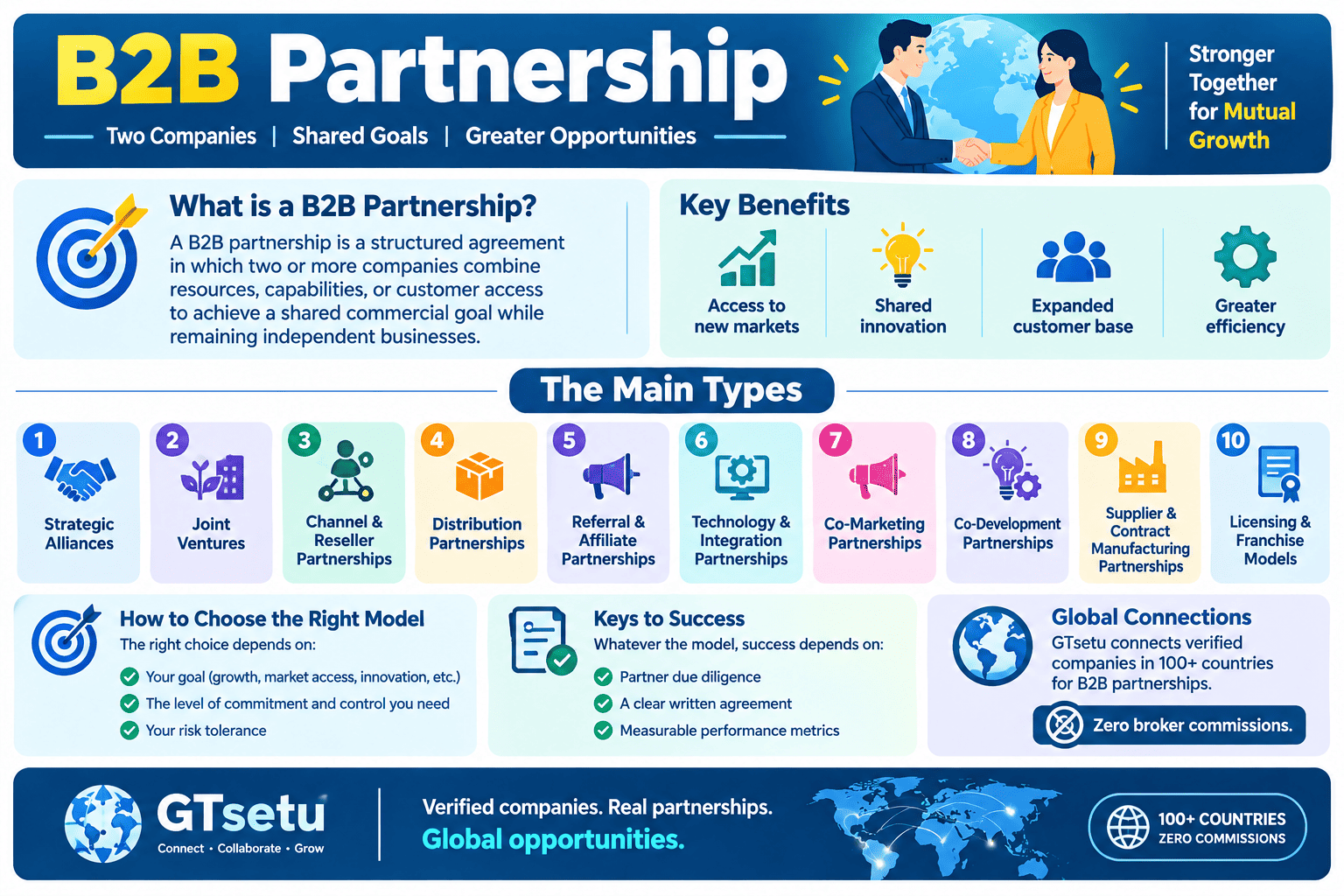
Direct Answer: A B2B partnership is a structured agreement in which two or more companies combine resources, capabilities, or customer access to achieve a shared commercial goal while remaining independent businesses. The main types are strategic alliances, joint ventures, channel and reseller partnerships, distribution partnerships, referral and affiliate partnerships, technology and integration partnerships, co-marketing, co-development, supplier and contract manufacturing partnerships, and licensing or franchise models. The right choice depends on your goal, the level of commitment and control you need, and your risk tolerance. Whatever the model, success depends on partner due diligence, a clear written agreement, and measurable performance metrics. GTsetu connects verified companies in 100+ countries for B2B partnerships, with zero broker commissions.
📅 October 13, 2026⏱ 18 min read✍️ GT Setu Editorial Team🔄 Updated regularly
10
Core B2B Partnership Types Covered
7
Steps to Build a Partnership
100+
Countries on GTsetu’s Verified Network
0%
GTsetu Broker Commission
Almost no company grows alone. Manufacturers rely on suppliers and distributors, software companies rely on integrations and resellers, and service firms rely on referral networks. The question is rarely whether to partner, but which kind of partnership fits the goal, and how much commitment, control, and risk each model demands.
This guide is written for founders, business development leaders, partnership managers, manufacturers, exporters, and procurement teams who are evaluating how to structure a relationship with another company, whether that is a first referral arrangement or a long-term international joint venture. If you are new to international growth, you may also want our guide on international business development consulting.
SECTION 1
1 What Is a B2B Partnership?
🎯 Definition
A B2B (business-to-business) partnership is an agreement between two or more companies to collaborate toward a shared commercial objective, such as reaching new customers, entering new markets, developing products, or improving supply chain efficiency. Partners keep their separate legal identities, contribute defined resources, and share risk and reward under terms set out in a written agreement. Partnerships range from informal, low-commitment referral arrangements to deeply integrated joint ventures that create a new shared entity.
Three features separate a true partnership from an ordinary buyer-seller transaction: shared objectives (both sides gain from the other’s success), shared investment (time, capital, data, or access), and ongoing collaboration rather than a one-off sale. The more of these a relationship has, the closer it sits to the strategic end of the spectrum.
SECTION 2
2 Why B2B Partnerships Matter
🌍
Faster Market Access
A local partner already has customer relationships, regulatory knowledge, and distribution. Partnering is usually faster than building the same presence from scratch.
🧩
Complementary Capabilities
Partners fill gaps in technology, manufacturing capacity, certification, or channel reach that would take years to build internally.
⚖️
Shared Risk & Investment
Costs and risks of new products, markets, or facilities are spread across partners instead of borne by one balance sheet.
🛡️
Credibility & Trust
Association with an established, verified partner shortens sales cycles and lowers buyer perceived risk, especially in new markets.
📉
Lower Customer Acquisition Cost
Channel, referral, and co-marketing models reach qualified buyers without the full cost of direct outbound sales.
🚀
Innovation & Speed
Co-development and technology partnerships combine expertise to build better products faster than either side could alone.
SECTION 3
3 The 10 Main Types of B2B Partnerships
Different sources slice the categories slightly differently, but ten models cover almost every B2B partnership in practice. They sit along a spectrum from light-touch and fast to launch (referral, co-marketing) to deeply integrated and slow to unwind (joint ventures, licensing).
🧭Strategic
1. Strategic Alliance
Two independent companies agree to cooperate on a defined objective, such as joint go-to-market, shared research, or complementary offerings, without creating a new legal entity. Each keeps its own ownership, brand, and operations.
Best for: flexible, medium-term cooperation without equity commitment
🏗️Equity-Based
2. Joint Venture (JV)
Partners create a separate legal entity, co-own it, and share capital, governance, profits, and losses. Common for entering regulated or restricted markets and for large capital projects.
Best for: deep, long-term market entry or capital-intensive projects
🔁Revenue Channel
3. Channel & Reseller Partnership
A partner resells, bundles, or implements your product to its own customers in return for margin, discounts, or commission. Often structured as tiered programmes with training and certification requirements.
Best for: scaling reach without building a large direct sales force
🚚Physical Goods
4. Distribution Partnership
A distributor buys, stocks, and sells your products within a territory, handling logistics, local compliance, and customer service. Exclusive, selective, and non-exclusive structures are all common. See our guide to international wholesale distributors.
Best for: manufacturers and exporters entering new territories
📣Low Commitment
5. Referral & Affiliate Partnership
A partner refers qualified leads and earns a fee or commission when they convert. There is no inventory, integration, or shared brand, so it is the quickest model to launch and the easiest to test.
Best for: testing new markets and customer segments cheaply
🔌Product-Led
6. Technology & Integration Partnership
Two companies integrate their products so customers get a combined solution, through APIs, certified connectors, or bundled offerings. Value comes from complementary functionality and shared customers.
Best for: software, hardware, and platform ecosystems
🎯Marketing
7. Co-Marketing Partnership
Partners with similar audiences but non-competing offerings run joint campaigns such as webinars, research reports, events, and content. Costs are shared and each side reaches the other’s audience.
Best for: brand awareness and demand generation on a shared budget
🔬Innovation
8. Co-Development & R&D Partnership
Partners jointly design or develop a product, process, or technology, pooling expertise and funding. IP ownership and commercialisation rights must be agreed up front. Regional research ecosystems matter here, as in Maharashtra’s FTI and quantum technology in Pune.
Best for: new products, deep-tech, and process innovation
🏭Operations
9. Supplier & Contract Manufacturing Partnership
A buyer commits to a supplier or contract manufacturer for components, assemblies, or finished goods under agreed quality, pricing, and delivery terms, often with long-term volume commitments. See our Czech Republic manufacturing expansion guide for a European example.
Best for: stable supply, capacity access, and cost optimisation
📜Rights-Based
10. Licensing & Franchise Partnership
One company grants another the right to use its technology, brand, or business model in return for royalties or fees. The licensor expands without heavy capital; the licensee gains a proven offering.
Best for: IP-rich companies scaling without direct investment
💡 Related Model: Acquisition
When collaboration is not enough and one company wants outright control of another’s business or assets, the relationship moves from partnership to transaction. Understand the mechanics in our resource on what an asset purchase agreement is before treating a partnership as a stepping stone to acquisition.
Match the model to your primary goal first, then to the level of commitment you can sustain. Use referral and co-marketing to test demand cheaply, channel and distribution to scale reach, technology and co-development to build capability, supplier partnerships to secure capacity, and joint ventures or licensing only when you are prepared for long-term, hard-to-reverse commitment.
📈
Goal: Grow Revenue Quickly
Referral, affiliate, channel, and reseller models add sales capacity with limited upfront investment.
Write down the objective, the capabilities you need, the markets involved, and the minimum standards a partner must meet. This becomes the filter for every conversation that follows.
02
Choose the Partnership Model
Use the decision framework above to select the lightest model that still achieves your goal. You can always deepen a relationship later; you cannot easily make a joint venture lighter.
03
Identify & Shortlist Candidates
Build a shortlist from verified platforms, industry associations, trade shows, and customer referrals. Prefer partners whose customers, geography, and capabilities complement yours without direct conflict.
04
Run Due Diligence
Verify legal identity, financial health, references, certifications, and reputation. For larger commitments, complete commercial due diligence covering market position, customers, and revenue quality.
05
Negotiate & Document the Agreement
Sign a mutual NDA before sharing sensitive information, then negotiate scope, commercial terms, IP, liability, performance metrics, and termination. Put every material term in writing.
06
Launch with a Joint Plan
Agree owners, milestones, communication cadence, and the first 90-day targets. Run onboarding, training, and a pilot before scaling.
07
Review, Optimise, or Exit
Hold regular reviews against agreed KPIs. Expand what works, fix what does not, and exit cleanly under the agreement when the relationship stops serving both sides.
SECTION 7
7 Legal Structure & Agreement Essentials
The agreement is where a partnership is won or lost. A handshake works until the first dispute; a well-drafted contract defines what happens when things go wrong. Every B2B partnership agreement should cover the following core terms.
Clause
What It Covers
Why It Matters
Scope & Roles
Objectives, deliverables, responsibilities, exclusivity, and territory
Prevents scope creep and finger-pointing. For ongoing services, a Master Services Agreement sets the framework.
Commercial Terms
Pricing, margins, commissions, payment timing, and trade terms
Gives both sides clear grounds and remedies. Understand the general concept of breach of contract.
Term & Termination
Duration, renewal, exit rights, and wind-down obligations
Decide whether either side may exit via termination for convenience and what notice and transition support apply.
Governing Law & Disputes
Applicable law, jurisdiction, and arbitration or mediation
Essential for cross-border deals where courts and enforcement differ.
⚠️ Not Legal Advice
This guide is general information, not legal advice. Partnership agreements, especially joint ventures, licensing, and cross-border deals, should be reviewed by qualified counsel in each relevant jurisdiction before signing.
SECTION 8
8 Cross-Border Partnerships & Compliance
International partnerships add layers of complexity: different legal systems, currencies, tax rules, trade terms, and certification regimes. Four areas deserve early attention.
📦
Trade Terms
Agree who handles freight, insurance, customs, and risk transfer using standard terms such as Incoterms 2020 and FCA.
If your goal is to build a production or supply relationship in Europe, start with a country-level view of the market. Our Czech Republic expansion guide shows how a regional manufacturing ecosystem shapes the partnership models available to you.
SECTION 9
9 Evaluating & Measuring Partnership Performance
Partnerships drift when nobody measures them. Agree a small set of KPIs at signing and review them on a fixed rhythm. The right metrics depend on the model.
Partnership Type
Primary KPIs
Review Cadence
Referral / Affiliate
Qualified leads, conversion rate, revenue per partner
Joint customers, integration adoption, support tickets
Quarterly
Co-Marketing
Leads generated, cost per lead, campaign conversion
Per campaign
Supplier / Contract Manufacturing
Defect rate, on-time delivery, cost per unit, audit results
Monthly / Quarterly
Co-Development / R&D
Milestones met, budget variance, IP filed, time to prototype
Milestone-based
Joint Venture / Licensing
Profitability, market share, royalty compliance, governance health
Quarterly / Annual
Beyond hard metrics, assess relationship health: responsiveness, trust, alignment of priorities, and willingness to resolve problems early. For a deeper checklist, see our partnership evaluation criteria.
SECTION 10
10 Common Challenges & How to Overcome Them
🎯
Misaligned Goals
Partners with different priorities pull in different directions. Mitigation: write shared objectives and success metrics into the agreement, and revisit them regularly.
📭
Weak Communication
Silence kills partnerships. Mitigation: name a single owner on each side, set a meeting cadence, and agree an escalation path.
🔐
IP & Data Leakage
Sharing designs, customer data, or pricing creates exposure. Mitigation: sign a mutual NDA first, share on a need-to-know basis, and use controlled, encrypted workspaces.
⚖️
Unequal Effort
One side often carries more work than the other. Mitigation: define contributions explicitly and tie rewards to measurable performance.
🕵️
Unverified Partners
Fraud, insolvency, and misrepresented capability are real risks, especially internationally. Mitigation: verify identity and credentials before engagement and complete due diligence proportionate to the deal.
🚪
No Exit Plan
Partnerships end, and messy exits are costly. Mitigation: define termination triggers, notice periods, and transition duties in advance.
SECTION 11
11 How to Find the Right B2B Partners
The best partner is rarely the first one you meet. Use several channels, compare candidates against the same criteria, and verify before you engage.
💻
GTsetu Verified B2B Platform
Discover compliance-verified companies across 100+ countries with anonymous browsing, built-in NDA workflow, and encrypted collaboration. Zero broker commissions.
Best for Verified Discovery
🏛️
Industry Associations & Chambers
Trade bodies and chambers of commerce provide member directories, introductions, and market intelligence.
Industry Channel
🎪
Trade Shows & Events
In-person events accelerate trust and let you meet several candidates in a short time.
🤝 GTsetu, Verified B2B Platform for Global Partnerships
Discover Verified Partners, Distributors, Suppliers & Manufacturers, No Broker Commission
GTsetu gives businesses direct access to compliance-verified companies for every type of B2B partnership, from distribution and supply relationships to co-development and joint ventures. Every company in the network is verified through business registration, trade licences, and relevant certifications before it appears on the platform. You discover, qualify, and engage without broker intermediaries taking a percentage of your commercial economics.
🏛️
Multi-Layer Compliance Verification
Company registration, trade licences, and certifications are verified by GTsetu’s compliance team, reducing fraud risk and due diligence workload.
🕵️
Anonymous Discovery
Browse verified profiles without revealing your identity until you choose to engage.
📄
Built-In NDA Workflow
Digital mutual NDA with timestamped signatures, activated before sensitive information can be exchanged.
🔐
Encrypted Document Workspace
AES-256 encryption at rest, TLS in transit, role-based access, and a full audit trail.
🚫
Zero Broker Commission
GTsetu charges no commission on any partnership formed. The commercial economics stay between you and your partner.
🌏
100+ Countries
A global network supporting partnerships across manufacturing, distribution, technology, and services.
A B2B (business-to-business) partnership is a formal or informal agreement between two or more companies to work together toward shared commercial goals, such as reaching new customers, entering new markets, developing products, or improving supply chain efficiency. Partners keep their separate legal identities, share resources, risk and reward according to an agreed structure, and are usually governed by a written agreement.
QWhat are the main types of B2B partnerships?
The main types are: (1) Strategic alliances, (2) Joint ventures, (3) Channel and reseller partnerships, (4) Distribution partnerships, (5) Referral and affiliate partnerships, (6) Technology and integration partnerships, (7) Co-marketing partnerships, (8) Co-development and R&D partnerships, (9) Supplier and contract manufacturing partnerships, and (10) Licensing and franchise partnerships. Each differs in commitment, shared risk, legal structure, and time to revenue.
QWhat is the difference between a strategic alliance and a joint venture?
A strategic alliance is a contractual cooperation in which each company stays fully independent and no new legal entity is created. A joint venture creates a separate legal entity that the partners co-own, with shared capital, governance, profits and losses. Alliances are faster and more flexible; joint ventures offer deeper commitment and control but are harder to set up and to exit.
QHow do I choose the right type of B2B partnership?
Start with your primary goal (revenue growth, market entry, product capability, cost reduction, or credibility), then match it to the level of commitment you can sustain. Referral and co-marketing suit low-risk testing; channel and distribution suit scaling reach; technology and co-development suit capability building; supplier partnerships suit securing capacity; joint ventures and licensing suit deep, long-term entry. Always verify a prospective partner through due diligence before committing. See our partnership evaluation criteria.
QWhat should a B2B partnership agreement include?
A strong agreement defines scope and roles, commercial terms, intellectual property and confidentiality, warranties, liability and risk allocation, performance metrics, dispute resolution and governing law, and term and termination, including what counts as a material breach and whether either party can terminate for convenience. Consult qualified legal counsel before signing, especially for cross-border deals.
QHow do I find verified B2B partners internationally?
Use a structured, multi-channel approach: (1) GTsetu provides compliance-verified companies across 100+ countries with anonymous discovery, built-in NDA workflow, and zero broker commissions; (2) trade shows and industry associations; (3) chambers of commerce and government trade bodies; (4) customers, suppliers, and advisors. Whichever channel you use, complete due diligence and certification checks before you sign.
Connect with verified companies on GTsetu: compliance-backed verification, anonymous discovery, built-in NDA workflows, and zero broker commissions on every partnership you form.
They represents the product, and research team behind GTsetu, a global B2B collaboration platform built to help companies explore cross-border partnerships with clarity and trust. The team focuses on simplifying early-stage international business discovery by combining structured company profiles, verification-led access, and controlled collaboration workflows.
With a strong emphasis on trust, and disciplined engagement, Team GTsetu shares insights on global trade, partnerships, and cross-border collaboration, helping businesses make informed decisions before entering deeper commercial discussions.