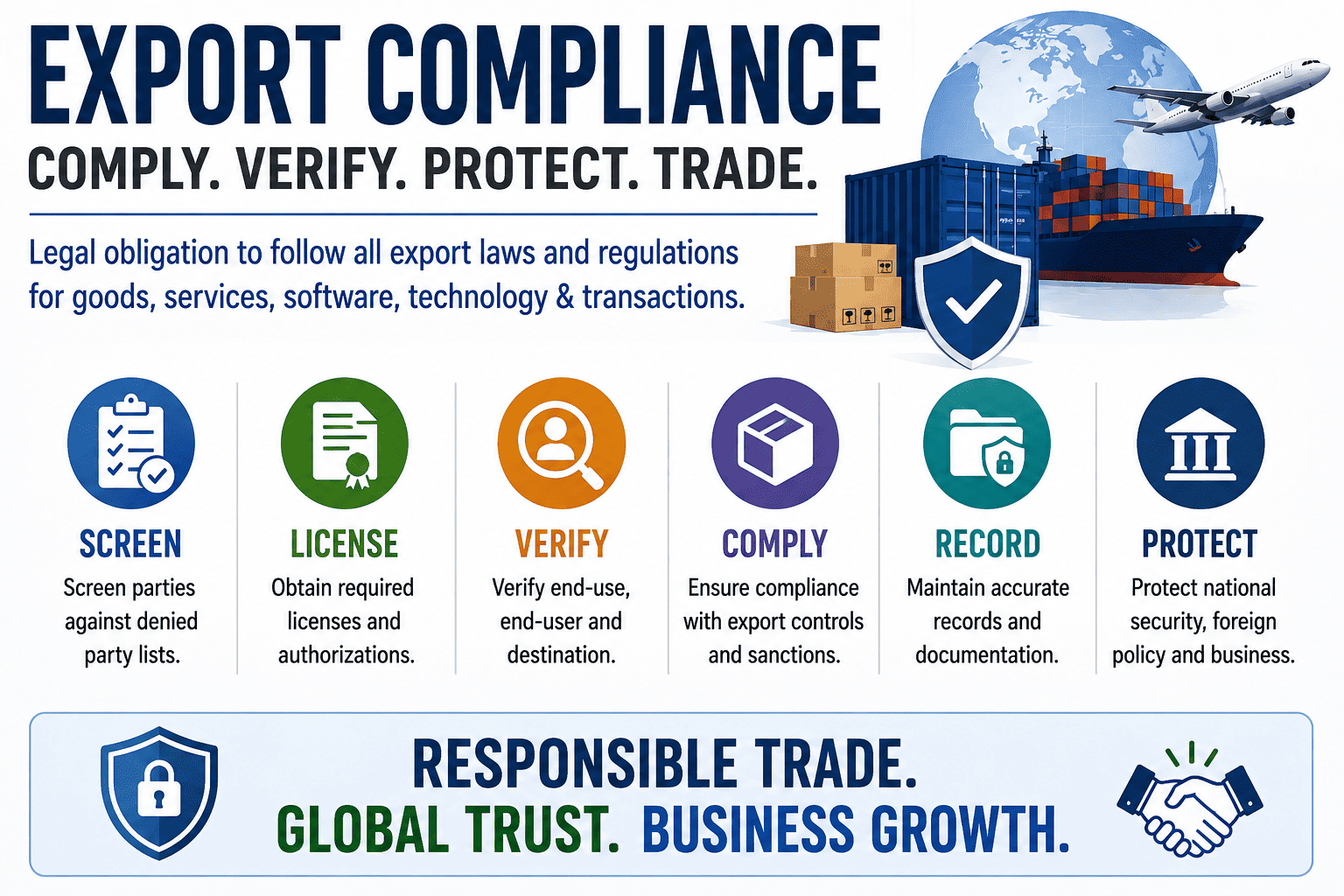
Why Export Compliance Matters
Export compliance is not just a legal checkbox—it is a critical business function that protects national security, supports foreign policy, and ensures the integrity of global supply chains. Governments impose export controls to prevent the proliferation of weapons of mass destruction, combat terrorism, and restrict trade with sanctioned regimes. For businesses, compliance is essential to avoid severe penalties, protect reputation, and maintain access to international markets. Non-compliance can result in fines, prison time, denial of export privileges, and irreparable brand damage. In an interconnected global economy, export compliance is a strategic advantage that enables sustainable growth and trust with partners and regulators.
📊 Key Statistic
Under U.S. Export Administration Regulations (EAR), civil penalties can reach up to $374,474 per violation or twice the transaction value, whichever is greater. Willful violations can lead to criminal fines up to $1 million and imprisonment for up to 20 years. These staggering penalties highlight the importance of a robust export compliance program.
Export Compliance vs. Trade Compliance: Understanding the Difference
While often used interchangeably, these terms have distinct meanings. Trade compliance is the broader umbrella covering all laws and regulations related to international trade, including both import (inbound) and export (outbound) activities. Export compliance is a specific subset focusing on outbound shipments, transfers, and disclosures. Effective trade compliance requires managing both import and export obligations, while export compliance specifically addresses the legal requirements for sending goods, services, or technology across borders.
| Aspect | Export Compliance | Trade Compliance |
|---|
| Scope | Focuses specifically on outbound shipments, transfers, and disclosures of goods, services, and technology. | Encompasses all import and export regulations, including customs, tariffs, and trade agreements. |
| Key Activities | Denied party screening, export licensing, ECCN classification, end-use verification, record keeping. | Includes export compliance plus import duties, customs clearance, tariff classification, and trade remedy actions. |
| Regulatory Focus | National security, foreign policy, non-proliferation, and sanctions. | Revenue collection, trade facilitation, market access, and fair competition. |
| Primary Goal | Prevent sensitive items from reaching prohibited end-users or destinations. | Ensure lawful and efficient movement of goods across borders while complying with all applicable laws. |
📌 Note on Terminology
In practice, the terms are often used loosely. A company’s “trade compliance” department typically handles both import and export functions. However, for legal and regulatory purposes, export compliance has its own distinct set of laws, agencies, and penalties that require dedicated attention and expertise.
Key Export Control Regulations
Major Export Control Frameworks Around the World
Export controls are administered by various government bodies and international organizations. Understanding the key regulations and their jurisdictional reach is fundamental to any compliance program.
| Regulation / Framework | Governing Body | Scope |
|---|
| Export Administration Regulations (EAR) | Bureau of Industry and Security (BIS) – U.S. | Controls “dual-use” items (commercial goods with potential military applications), technology, and software. Covers most U.S. exports. |
| International Traffic in Arms Regulations (ITAR) | Directorate of Defense Trade Controls (DDTC) – U.S. | Strictly controls defense articles, services, and technical data on the U.S. Munitions List (USML). |
| Foreign Assets Control Regulations (FACR) | Office of Foreign Assets Control (OFAC) – U.S. | Enforces economic sanctions, embargoes, and trade restrictions against targeted countries, regimes, and individuals. |
| Wassenaar Arrangement | 42 Participating Countries | International agreement on export controls for conventional arms and dual-use goods and technologies. |
| EU Dual-Use Regulation | European Union | Controls the export of dual-use items from EU member states. |
| SCOMET List (India) | Directorate General of Foreign Trade (DGFT) | India’s strategic export control list covering Special Chemicals, Organisms, Materials, Equipment, and Technologies. |
| UN Security Council Resolutions | United Nations | Impose mandatory sanctions and embargoes on specific nations or entities that all member states must enforce. |
The 5 Pillars of Export Compliance
The 5 Pillars of an Effective Export Compliance Program
Building a robust Export Compliance Program (ECP) requires a systematic approach. These five pillars form the foundation of any effective compliance strategy, helping organizations manage risk and demonstrate reasonable care to regulators.
1
Product Classification (ECCN & HS Codes)
Determine the correct Export Control Classification Number (ECCN) for dual-use items under EAR, or the appropriate USML category for defense articles. For customs, use Harmonized System (HS) codes. Accurate classification is the foundation for determining licensing requirements.
2
Denied Party Screening
Screen all parties involved in a transaction (customer, end-user, intermediaries, banks) against government watchlists, including the U.S. Entity List, UN Sanctions List, and country-specific restrictions. Screening must occur before quoting, again before shipping, and continuously for long-term contracts.
3
Licensing & Authorization
Determine whether an export license is required based on product classification, destination country, end-user, and end-use. When required, submit license applications to the appropriate authority (e.g., BIS, DDTC, DGFT) with detailed technical specifications and end-user certificates.
4
End-Use & Red Flag Verification
Verify the legitimacy of the end-use and end-user. Be alert for “red flags” such as reluctance to provide end-use information, requests to ship through third countries, or payment from unrelated parties. An affirmative duty to investigate suspicious circumstances exists.
5
Record Keeping & Internal Audits
Maintain accurate and auditable records of all export transactions, screening results, license applications, and compliance decisions. Most jurisdictions require five-year retention. Regular internal audits help identify gaps and demonstrate due diligence to regulators.
When and How to Get an Export License
The Export Licensing Decision: A 4-Step Framework
Determining whether an export license is required depends on four key factors. Exporters must assess each transaction against these criteria to ensure compliance.
| Factor | Key Questions | Why It Matters |
|---|
| 1. What is the item? | What is its ECCN or USML category? Is it a dual-use item, defense article, or EAR99? | Product classification determines the applicable regulatory framework and licensing requirements. Different rules apply to commercial goods vs. defense items. |
| 2. Where is it going? | Is the destination country subject to an embargo or sanctions? Are there specific regional restrictions? | Country restrictions vary significantly. Some destinations are prohibited entirely (e.g., Cuba, Iran, North Korea, Syria), while others have specific licensing requirements. |
| 3. Who will receive it? | Is the end-user on a denied or restricted party list? Is the end-user a military entity or of concern? | Even if the item and destination are low-risk, dealing with a prohibited end-user is a violation. Screening all parties is mandatory. |
| 4. What will it be used for? | Is the intended end-use prohibited (e.g., WMD proliferation, military use)? Are there red flags? | Specific end-uses are prohibited without a license. Exporters have a duty to inquire about suspicious end-uses and verify legitimacy. |
Penalties & Risks
Penalties for Export Compliance Violations
Non-compliance with export regulations can result in severe consequences that extend beyond financial penalties to include operational and reputational damage. Understanding the full spectrum of risks is crucial for building a compelling business case for compliance investment.
| Type of Penalty | Description | Example / Impact |
|---|
| Civil Monetary Fines | Administrative penalties imposed for violations of export regulations, regardless of intent. | Under EAR, fines up to $374,474 per violation or twice the transaction value (whichever is greater). Adjusted for inflation annually. |
| Criminal Penalties | Imposed for willful violations, including fines and imprisonment. | Fines up to $1 million per violation and imprisonment for up to 20 years for individuals. |
| Denial of Export Privileges | Placement on a denied party list, effectively ending the company’s ability to export. | Inclusion on the Denied Persons List or Entity List terminates export business, often leading to company failure. |
| Reputational Damage | Negative media coverage and loss of customer and partner trust. | Public listing in enforcement actions damages brand value, leading to loss of business and difficulty attracting new customers. |
| Supply Chain Disruption | Operational disruptions due to cargo seizures, delayed shipments, and loss of logistics partners. | Violations can result in disruption to the entire supply chain, causing economic losses and delaying time-to-market. |
Real-World Example
Export Compliance in Practice: A Transaction Walkthrough
The following scenario illustrates how an exporter would apply the 5 pillars of export compliance to a typical international transaction, demonstrating the practical steps involved in ensuring compliance.
📄 Export Compliance Scenario: Technology Export to India
Product: Advanced encryption software (ECCN 5A002) for a financial services company in India.
Destination: Mumbai, India.
End-User: A private bank (not on any restricted party list).
Steps Taken: 1) Classified the software as ECCN 5A002 (dual-use). 2) Screened the bank and its key individuals against all U.S. and UN watchlists. 3) Verified that India is not subject to a comprehensive embargo and that the software is eligible for license exception ENC. 4) Conducted end-use verification to confirm the software will be used for the bank’s own cybersecurity, not for resale or military use. 5) Maintained a complete record of all classification, screening, and verification activities for five years.
Contractual & Legal Context
Key Contractual Clauses Related to Export Compliance
Export compliance obligations are often reinforced through contractual provisions. Understanding these clauses is essential for managing risk in cross-border transactions.
| Clause | How It Relates to Export Compliance |
|---|
| Master Services Agreement (MSA) | Sets the overall framework for the relationship, often including general compliance obligations and the allocation of responsibilities for export compliance. |
| Non-Compete Clause | May be relevant in technology exports to prevent the unauthorized transfer of proprietary technology to competitors, indirectly supporting export control objectives. |
| Condition Precedent | Often requires that all necessary export licenses and authorizations be obtained before the contract becomes binding, ensuring compliance is addressed upfront. |
| Commercial Framework Agreement | Sets the terms for future purchases, often including standard compliance provisions that apply to all transactions under the agreement. |
| Definitive Agreement | Formalizes the terms of the export transaction, including representations and warranties related to compliance with export laws. |
| Warranty Clause | Guarantees that goods/services meet specified standards, which can include compliance with applicable export laws and regulations. |
| Material Breach | Defines what constitutes a serious failure, which can include violations of export compliance obligations, allowing the other party to terminate the contract. |
| Termination for Convenience | Allows the buyer to terminate without cause, which might be exercised if export licenses cannot be obtained or are revoked. |
| Indemnification Clause | Shifts liability for third-party claims arising from export compliance violations, making the non-compliant party responsible for associated costs and damages. |
| Exclusivity Clause | May require the supplier to provide goods exclusively, which can complicate export compliance if the buyer is in a restricted jurisdiction. |
| Breach of Contract | Defines the consequences when a party fails to perform its obligations, which can include failing to obtain required export authorizations. |
| Consequential Damages | Indirect losses from a breach, which can be significant in cases where export compliance failures lead to supply chain disruptions. |
| Commercial Due Diligence | Includes assessing a partner’s export compliance capabilities and history as part of the transaction evaluation process. |
| Due Diligence | Comprehensive due diligence includes reviewing export compliance practices, licenses, and history to identify potential risks. |
| Limitation of Liability Clause | Caps total liability, which can limit the exposure for export compliance-related damages, though this may be against public policy in some jurisdictions. |
| Market Entry Partnerships | Requires a clear understanding of export compliance obligations in the target market, especially in sensitive industries. |
| Letter of Credit (LOC) | Often requires compliance with export regulations as a condition for payment, making export compliance a financial prerequisite. |
| Distribution Agreement | Includes compliance obligations for the distributor, ensuring they adhere to export laws when reselling goods in international markets. |
| Repudiation of Contract | Can occur if a party indicates they will not comply with export regulations, making performance of the contract impossible or illegal. |
| Gross Negligence | Repeated or egregious export compliance failures may be considered gross negligence, potentially piercing liability caps. |
| Joint Venture Agreements | Require clear allocation of export compliance responsibilities, especially when dealing with sensitive technology or defense items. |
| Request for Proposal (RFP) | May include questions about the vendor’s export compliance program, assessing their risk management capabilities. |
| Invitation to Tender (ITT) | Often requires bidders to certify their compliance with all applicable export laws and regulations. |
| ESG Due Diligence | Increasingly includes export compliance as part of environmental, social, and governance (ESG) assessments, particularly for companies in sensitive industries. |
| Hardship Clause | May be invoked if unforeseen events, such as new export controls or sanctions, make performance extremely difficult. |
| Warranty Limitation Clause | May limit warranties if export compliance failures (e.g., improper documentation) void the manufacturer’s guarantees. |
| Frustration of Purpose | Can apply if a new export control law makes the contract’s fundamental purpose illegal or unachievable. |
| Financial Due Diligence | Includes assessing potential financial liabilities from export compliance violations, such as fines and legal costs. |
| Contract Termination | May be triggered by a material breach of export compliance obligations, allowing the aggrieved party to terminate the contract. |
| Commercial Due Diligence (CDD) | Includes a review of the target’s export compliance program, licenses, and history of violations. |
| Commercial Impracticability | May be claimed if obtaining an export license becomes commercially unreasonable due to unforeseen regulatory changes. |
| Third-Party Risk Management (TPRM) | Critical for managing export compliance risks across the supply chain, including screening all third parties and monitoring their compliance. |
| Material Adverse Change (MAC) | May be triggered by a significant export compliance violation or change in regulatory status that materially affects the business. |
Risks & Mitigation
Common Export Compliance Risks & How to Mitigate Them
⚠️
Incorrect Product Classification
Mitigation: Use a formal classification process. Engage technical experts for complex items. Document all classification decisions thoroughly. When in doubt, request a classification ruling from the relevant authority.
⚠️
Failure to Screen All Parties
Mitigation: Implement automated screening software that checks all parties (customer, end-user, intermediaries, banks) against multiple watchlists. Screen before quoting, before shipping, and continuously for ongoing relationships.
⚠️
Inadequate Record Keeping
Mitigation: Establish a centralized record-keeping system that retains all transaction documents, screening results, and license determinations for the required retention period (typically 5 years). Regular internal audits help ensure compliance.
⚠️
Ignoring Red Flags
Mitigation: Train all relevant staff to recognize and report red flags (e.g., reluctance to provide end-use information, requests to ship through third countries, payment from unrelated parties). Establish a clear escalation process for investigating suspicious transactions.
FAQ
Frequently Asked Questions About Export Compliance
QWhat is the difference between export compliance and trade compliance?
Trade compliance is the broader umbrella term covering all laws and regulations related to international trade, including both import (inbound) and export (outbound) activities. Export compliance is a subset that specifically focuses on the laws and regulations governing outbound shipments, transfers, and disclosures of goods, services, and technology.
QWhat are the key U.S. export control regulations?
The three primary U.S. export control frameworks are: 1) The Export Administration Regulations (EAR) administered by the Bureau of Industry and Security (BIS) for dual-use items; 2) The International Traffic in Arms Regulations (ITAR) administered by the Directorate of Defense Trade Controls (DDTC) for defense articles; and 3) The Foreign Assets Control Regulations (FACR) administered by the Office of Foreign Assets Control (OFAC) for economic sanctions.
QWhat are the potential penalties for export compliance violations?
Penalties for non-compliance can be severe and include: substantial civil monetary fines (up to $374,474 per violation under EAR), criminal fines up to $1 million, imprisonment for up to 20 years for willful violations, denial of export privileges, reputational damage, and disruption of business operations and supply chains.
QHow do I determine if I need an export license?
Determine licensing requirements by assessing four factors: 1) What is the item (its ECCN or USML category)? 2) Where is it going (destination country)? 3) Who will receive it (end-user screening)? 4) What will it be used for (end-use verification)? Most items are EAR99 and do not require a license, but certain destinations, end-users, and end-uses trigger licensing requirements.
QWhat is an Export Control Classification Number (ECCN)?
An ECCN is an alphanumeric code (e.g., 3A001) used under the Export Administration Regulations (EAR) to identify dual-use items for export control purposes. It determines licensing requirements based on the item’s technical characteristics, destination, end-user, and end-use. Items not on the Commerce Control List (CCL) are classified as EAR99.
QWhat is denied party screening and why is it important?
Denied party screening is the process of checking all parties involved in an export transaction against government watchlists of restricted, denied, or sanctioned individuals and entities. It is critical to ensure you are not doing business with prohibited parties, which would violate export regulations and lead to severe penalties.