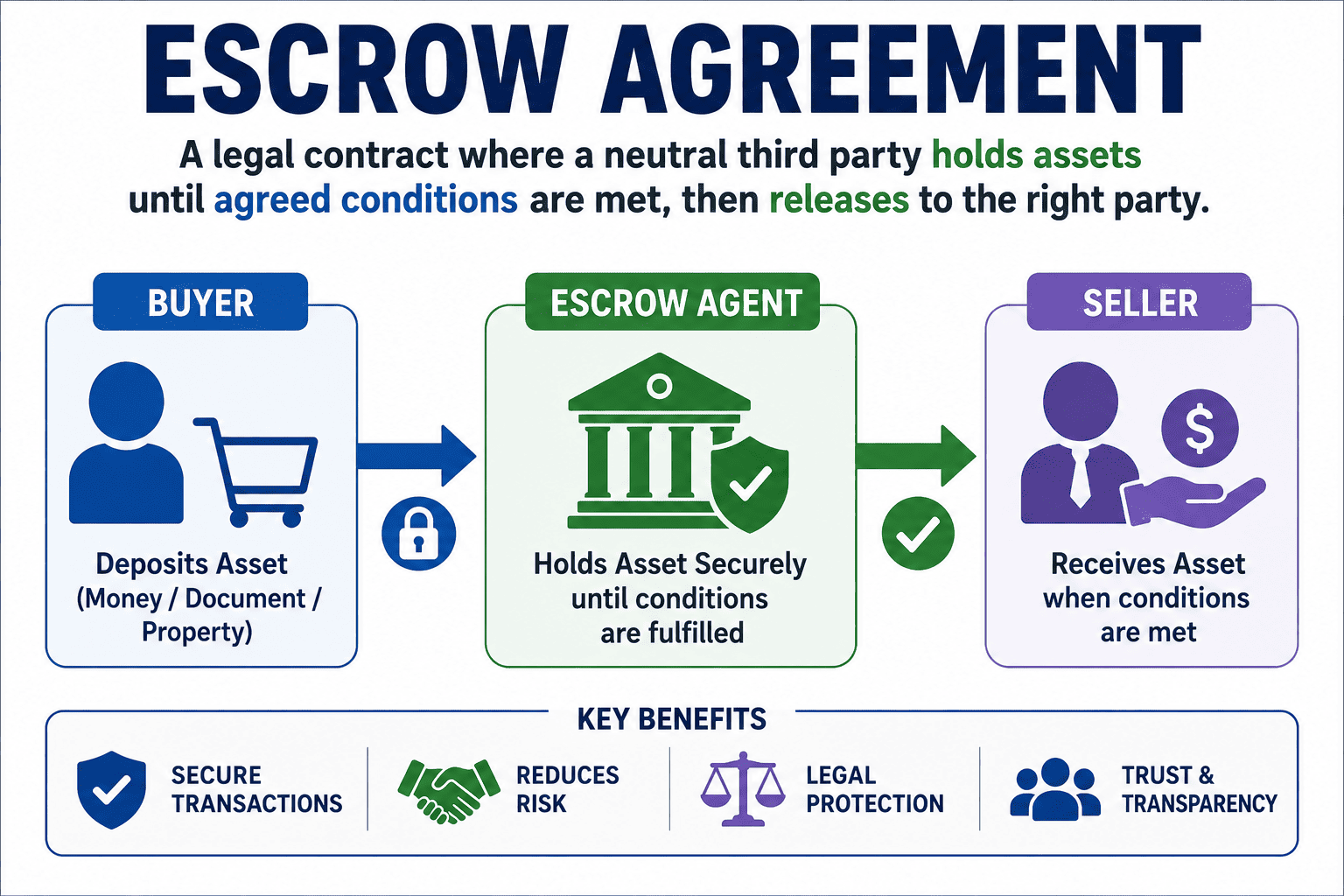
Why Escrow Agreements Matter in Business Transactions
Escrow agreements are the bedrock of trust in high-stakes transactions. They protect both buyers and sellers by ensuring that assets (funds, property, intellectual property, or source code) are not transferred until all predefined conditions are satisfied. This reduces the risk of fraud, non-performance, or disputes. In mergers and acquisitions (M&A), escrow holds a portion of the purchase price to cover post-closing adjustments or indemnification claims. In real estate, it secures earnest money deposits and ensures clear title transfer. In software licensing, source code escrow protects licensees if the vendor goes out of business or fails to meet support obligations. For businesses, understanding and using escrow agreements is essential for managing counterparty risk and ensuring deal certainty.
📊 Key Statistic
According to industry research, over 80% of M&A transactions involve an escrow arrangement to secure post-closing indemnification obligations. Escrow typically holds 10-20% of the purchase price for 12-24 months, providing a critical safety net for buyers.
How Escrow Agreements Work: A Step-by-Step Process
The escrow process follows a structured sequence of events, ensuring that all parties fulfill their obligations before the asset changes hands. The specific steps may vary by transaction type, but the core mechanics remain consistent.
1
Agreement Execution
The buyer, seller, and escrow agent sign the escrow agreement, which outlines the transaction’s terms: purchase price, closing date, conditions for release, and each party’s responsibilities.
2
Deposit of Asset
The depositor (typically the buyer) deposits the asset (e.g., purchase price, securities, or documents) into the escrow account managed by the escrow agent.
3
Verification & Fulfillment
The escrow agent verifies that all conditions of the agreement have been met. This may include confirming clear title, obtaining financing, or completion of due diligence.
4
Release of Asset
Once all conditions are satisfied, the escrow agent disburses the asset to the beneficiary (typically the seller) and transfers any related documents or title to the buyer.
Types of Escrow Agreements
Escrow agreements are versatile instruments used across various industries. Each type is tailored to the specific risks and requirements of the transaction.
| Type of Escrow | Description | Common Use Case |
|---|
| Real Estate Escrow | Holds earnest money deposits, purchase funds, and title documents during property transactions. Ensures clear title and compliance with sale conditions. | Residential and commercial property sales; often mandated by law (e.g., RERA escrow in India). |
| Business Asset Escrow (M&A) | Holds a portion of the purchase price in M&A transactions to cover post-closing adjustments, indemnification claims, or working capital true-ups. | Acquisition of a company; typically 10-20% of purchase price held for 12-24 months. |
| Intellectual Property Escrow | Holds IP assets (patents, trademarks, copyrights) to protect the licensor if the licensee defaults on obligations. | Licensing agreements where IP is critical to the licensee’s business. |
| Software Escrow | Holds the source code, documentation, and other critical materials of software. Released to the licensee if the vendor defaults, goes bankrupt, or fails to provide support. | Enterprise software licensing; protects businesses from vendor failure. |
📌 Note on Software Escrow
Software escrow is particularly important for mission-critical applications. The escrow agent verifies the deposited source code is complete and usable, providing the licensee with a “fail-safe” if the vendor ceases operations or breaches the support agreement.
Key Parties & Roles
Core Parties in an Escrow Agreement
While transactions may involve additional stakeholders, every escrow agreement has three fundamental parties. Understanding their roles is essential for drafting and executing a valid agreement.
| Party | Role & Responsibilities |
|---|
| Depositor | The party who deposits the asset into the escrow account. In a real estate transaction, this is typically the buyer. In an M&A escrow, it may be the seller (who deposits a portion of the purchase price). The depositor agrees to the terms under which the asset will be released. |
| Beneficiary | The party entitled to receive the asset from the escrow account once all conditions are met. In real estate, this is usually the seller. In M&A, the beneficiary is often the buyer (who receives escrow funds if indemnification claims arise). |
| Escrow Agent | A neutral third party (often a bank, title company, or specialized escrow firm) that holds the asset and administers the agreement. The escrow agent’s duties are ministerial: they follow the instructions in the agreement, verify conditions, and disburse funds. They are not responsible for the validity of the underlying transaction. |
Contractual & Legal Considerations
Key Contractual Clauses in Escrow Agreements
An escrow agreement is an ancillary document to a primary contract (e.g., a purchase agreement or software license). It must align with the main agreement and address specific escrow-related risks. The following clauses are critical.
| Clause | Why It Matters |
|---|
| Master Services Agreement (MSA) | The escrow agreement is often part of a broader MSA or purchase agreement. The terms of the escrow must be consistent with the primary contract’s indemnification, warranty, and dispute resolution provisions. |
| Condition Precedent | Escrow release is typically subject to conditions precedent (e.g., closing of the transaction, delivery of title, or completion of due diligence). The agreement must clearly define these conditions. |
| Definitive Agreement | The escrow agreement is an ancillary document to the definitive agreement (e.g., the Share Purchase Agreement or Asset Purchase Agreement). The definitive agreement governs the overall transaction, while the escrow agreement handles the specific escrow mechanics. |
| Warranty Clause | The escrow agreement often secures the seller’s warranties and indemnities. If a warranty is breached, the buyer can claim against the escrow funds. |
| Indemnification Clause | Escrow is a common mechanism to fund indemnification claims. The agreement specifies how funds are released to satisfy indemnity obligations. |
| Material Breach | Defines what constitutes a serious failure that triggers the release of escrow funds to the aggrieved party. Material breach of the underlying contract often allows the buyer to claim against escrow. |
| Termination for Convenience | If the primary contract includes a termination for convenience clause, the escrow agreement must address how escrowed assets are handled upon termination. |
| Exclusivity Clause | In M&A, the exclusivity clause in the purchase agreement may impact the escrow arrangement, particularly if the deal falls through. |
| Breach of Contract | Escrow agreements provide a remedy for breach by holding funds. The agreement should specify how breach claims are handled and how funds are released to satisfy judgments. |
| Consequential Damages | The escrow agreement often limits the liability of the escrow agent and may address whether consequential damages are recoverable from escrowed funds. |
| Limitation of Liability Clause | Escrow agents typically have very limited liability. The agreement will cap the agent’s liability and may require indemnification of the agent for claims arising from their ministerial duties. |
| Commercial Due Diligence (CDD) | Findings from commercial due diligence may influence the size and terms of the escrow. For example, if CDD reveals significant risks, a larger escrow holdback may be negotiated. |
| Financial Due Diligence | Financial due diligence is critical to determining the escrow amount, particularly for working capital adjustments and indemnity thresholds. |
| ESG Due Diligence (CSDDD) | In some transactions, ESG due diligence findings may be factored into the escrow release conditions, particularly for environmental or social compliance. |
| Third Party Risk Management (TPRM) | Escrow agreements can be part of a TPRM strategy, ensuring that critical assets (like source code or IP) are protected against third-party vendor failure. |
Real-World Example
Escrow Agreement Example: M&A Transaction
The following is a condensed example based on a typical M&A escrow arrangement, illustrating how the key components come together in practice.
📄 M&A Escrow: Acquisition of a Tech Company
Transaction: Acquirer Inc. acquires Target Corp. for $100 million.
Escrow Amount: 15% of purchase price ($15 million) held in escrow.
Escrow Term: 18 months from closing.
Release Conditions: Funds are released to Target Corp. at the end of the term, less any claims made by Acquirer Inc. for indemnification, breaches of warranties, or working capital adjustments.
Claims Process: Acquirer Inc. must submit a claim with supporting evidence. The escrow agent only releases funds if both parties agree or if a court/arbitrator orders release.
Risks & Mitigation
Common Risks in Escrow Agreements & How to Mitigate Them
⚠️
Ambiguous Release Conditions
Mitigation: Define all conditions with specificity. Avoid subjective language. Clearly state what constitutes fulfillment of each condition and the evidence required.
⚠️
Escrow Agent Insolvency or Malfeasance
Mitigation: Use a reputable, regulated financial institution as the escrow agent. Review the agent’s terms and liability limitations. Consider requiring the agent to post a bond or maintain insurance.
⚠️
Disputes Over Escrow Release
Mitigation: Include a clear dispute resolution mechanism in the escrow agreement. Specify a timeline for resolving claims, and consider Arbitration Clause or Mediation Clause to avoid costly litigation.
FAQ
Frequently Asked Questions About Escrow Agreements
QWhat is an Escrow Agreement?
An escrow agreement is a legal contract where a neutral third party (escrow agent) holds an asset (funds, property, or documents) until specified conditions are met. It protects both parties in a transaction by ensuring the asset is not released until all obligations are fulfilled.
QWhat are the main types of Escrow Agreements?
Common types include Real Estate Escrow (holds funds and title documents), Business Asset Escrow (used in M&A to secure indemnification), Intellectual Property Escrow (protects IP assets), and Software Escrow (holds source code for licensees). Each is tailored to specific transaction risks.
QWho are the key parties in an Escrow Agreement?
The three core parties are: (1) Depositor – the party depositing the asset into escrow; (2) Beneficiary – the party entitled to receive the asset when conditions are met; and (3) Escrow Agent – the neutral third party that holds and administers the escrow.
QWhat happens if the conditions for release are not met in an Escrow Agreement?
If the conditions are not met by the specified deadline, the escrow agent will not release the asset. The agreement may provide for the return of the asset to the depositor or an extension of the escrow term. Disputes are typically resolved through the agreement’s dispute resolution clause (e.g., arbitration or mediation).
QHow are escrow fees typically structured?
Escrow fees are usually based on a percentage of the transaction value or a flat fee. Fees may be split between the depositor and beneficiary, as specified in the agreement. The agreement should clearly state who bears the cost of the escrow agent’s services.
QCan an escrow agreement be terminated early?
Yes, if all parties agree or if the underlying transaction is terminated. The escrow agreement should include provisions for early termination, including how assets will be disbursed or returned and how fees will be apportioned.